
David Swanson: Three Images – Drone Bugsplat, Jesus on a Bench, Man vs. Machine

Cultural Intelligence
David Swanson
David Swanson

Three Images the World Needed

Employees of the U.S. government refer to people they murder as “bugsplat.” They pretend that the men, women, and children they are killing with drones are just bugs, because they just look like little fuzzy creatures on a computer screen. Thank goodness for the artists who have put a giant portrait of a child in a field for the drone murderers to see and think about. Maybe the rest of us could think about it, and do more than think about it, too.
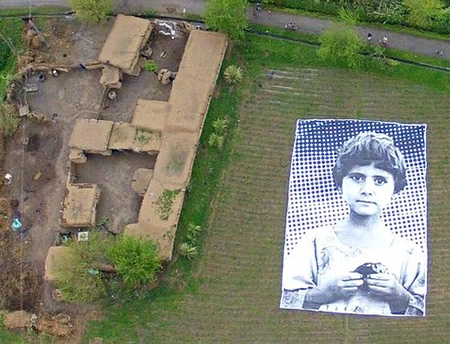
Click on Image to Enlarge

In Davidson, North Carolina, among many other places in the world, wealthy people ignore the suffering of the poor right nearby them as well as thousands of miles away. A fraction of what the U.S. government spends killing people with drones could end starvation in the world, and many certainly seem not to care. A fraction of what someone spends in a shopping mall could make a real difference in the life of someone sleeping on a bench, but most people provide no help.

Click on Image to Enlarge

But in an odd irony, many people in North Carolina, among many other places in the world, cling to ancient magical beliefs that just happen to include worshiping a man who was poor and who recommended caring for the poor. A sculpture of a homeless Jesus, a man you're supposed to worship because he has nail marks on his metallic feet, has got some people wondering whether they should find a little decency and compassion for those homeless people on benches who are made of flesh and blood.

Click on Image to Enlarge

CIA Director John Brennan, aka Obama's Cheney, was dispatched to Ukraine, where the U.S. had already spent $5 billion stirring up trouble. Ukrainian troops were immediately sent to attack protesters in eastern cities. Brennan may have had drones in his head. Drones have been known to crash, but never to stop and have a beer with the enemy. Drones often blow up the “wrong people,” but they don't invite people to climb on board and share a laugh. When unarmed Ukrainians confronted tanks, many soldiers joined the people. How Brennan thought Ukrainians could be sent to kill Ukrainians seems a mystery after the images of human decency have taken over. How Christians think the poor and homeless, the hungry and ill-clothed can be blamed for their own inability to satiate their greed seems baffling when faced with the homeless Jesus. How drone “pilots” can sit and take part in the world's worst real-life Milgram experiment ought to horrify anyone who stops and thinks — and nothing can make people stop and think the way a great work of art can. A picture is worth a million words, and a few lives let's hope.


Stephen E. Arnold: Technology Flopping – Thinking Still Out of Style

Advanced Cyber/IO, Commercial Intelligence, Cultural Intelligence, IO Impotency
Stephen E. Arnold
Stephen E. Arnold

Concern about the Future of Technology

I suggest you read two articles.

The first is from folks who make their living cheerleading technology. The article “What Does the Recent Tech Stock Downturn Meant? The Truth Is Nobody Knows.” is an admission that the future of technology is—well—not too clear. With increasing class tension in the City by the Bay, I suppose some reflection is warranted. I sort of knew this when I was a wee lad. Apparently for those surfing technology, the notion that the fancy analytics systems with their clever predictive methods are clueless is interesting. I assume not even insider information is illuminating the dark corners of what seems to be a somewhat trivial issue compared with some of the national and international news.

The second is “We got Bookies to Predict the Future of Tech.” Crowdsourcing the future is not too interesting. I checked out the investment and threat markets and concluded that the Ivory Tower folks had time on their hands. This article contains a quote I noted. The comment is about Google Glass. Few items of headgear trigger assaults, so I was intrigued:

Continue reading “Stephen E. Arnold: Technology Flopping – Thinking Still Out of Style”

SchwartzReport: Physics Revolution – Discovering Consciousness as Matter

Academia, Advanced Cyber/IO, Civil Society, Collective Intelligence, Cultural Intelligence, Earth Intelligence, Ethics
Stephan A. Schwartz
Stephan A. Schwartz

This report on the latest developments concerning consciousness research in physics is a wonderful illustration of a trend: the cutting edge of physicalist research is confronting consciousness. It is now one step away. Note two things: 1) the acknowledgement that the model is incomplete, missing a link, and a paradox: “why does the information content of our conscious experience appear to be vastly larger than 37 bi! ts of integrated information that can be stored in the human brain.”

Answering the paradox I predict will take physics into the nonlocal domain, and the matrix of information that is the all there is.

The German school of physics, referenced in is this report was made up of Planck, Pauli, Heisenberg, Einstein and others; the Olympiad of 20th century physics. All of them along with Jung, and Franz Boas, the founder of American anthropology, were strongly influenced by Adolf Bastian, a 19th century German polymath who posited the theory of Elementargedanke – literally ‘elementary thoughts of humankind.” It was an early attempt to recognize and try to study the nonlocal informational matrix, from which Jung developed the concept of the Collective Unconscious.

SOURCE: Consciousness as a State of Matter

Why Physicists Are Saying Consciousness Is A State Of Matter, Like a Solid, A Liquid Or A Gas
The Physics arXiv Blog

EXTRACT

Today, Max Tegmark, a theoretical physicist at the Massachusetts Institute of Technology in Cambridge, sets out the fundamental problems that this new way of thinking raises. He shows how these problems can be formulated in terms of quantum mechanics and information theory. And he explains how thinking about consciousness in this way leads to precise questions about the nature of reality that the scientific process of experiment might help to tease apart.

Tegmark’s approach is to think of consciousness as a state of matter, like a solid, a liquid or a gas. ‘I conjecture that consciousness can be understood as yet another state of matter. Just as there are many types of liquids, there are many types of consciousness,” he says.

G. William Domhoff: Who Rules America (1967)

Commerce, Corruption, Cultural Intelligence, Government
Amazon Page
Amazon Page

WHO RULES AMERICA? The Class-Domination Theory of Power

G. William Dornhoff

NOTE: WhoRulesAmerica.net is largely based on my book, Who Rules America?, first published in 1967 and now in its 7th edition. This on-line document is presented as a summary of some of the main ideas in that book.

Who has predominant power in the United States? The short answer, from 1776 to the present, is: Those who have the money — or more specifically, who own income-producing land and businesses — have the power. George Washington was one of the biggest landowners of his day; presidents in the late 19th century were close to the railroad interests; for the Bush family, it was oil and other natural resources, agribusiness, and finance. In this day and age, this means that banks, corporations, agribusinesses, and big real estate developers, working separately on most policy issues, but in combination on important general issues — such as taxes, opposition to labor unions, and trade agreements with other countries — set the rules within which policy battles are waged.

Click on Image to Enlarge

Contents

• Power and Power Indicators
• The Social Upper Class
• The Corporate Community
• How Government Policy Is Shaped From Outside Government
• The Power Elite
• The Power Elite and Government
• Why Business Leaders Feel Powerless
• The Weaknesses of the Working Class
• Community Power

The Weaknesses of the Working Class & Community Power Below the Line

Continue reading “G. William Domhoff: Who Rules America (1967)”

Berto Jongman: Star-Spangled Baggage — US Veterans Going Nuts…

04 Inter-State Conflict, 06 Family, 07 Health, 07 Other Atrocities, 11 Society, Civil Society, Corruption, Cultural Intelligence, Government, Idiocy, Ineptitude, Military
Berto Jongman
Berto Jongman

Star-Spangled Baggage

By Ann Jones, TomDispatch

This piece first appeared at TomDispatch. Read Tom Engelhardt’s introduction here.

After an argument about a leave denied, Specialist Ivan Lopez pulled out a .45-caliber Smith & Wesson handgun and began a shooting spree at Fort Hood, America’s biggest stateside base, that left three soldiers dead and 16 wounded.  When he did so, he also pulled America’s fading wars out of the closet.  This time, a Fort Hood mass killing, the second in four and a half years, was committed by a man who was neither a religious nor a political “extremist.”  He seems to have been merely one of America’s injured and troubled veterans who now number in the hundreds of thousands.

Some 2.6 million men and women have been dispatched, often repeatedly, to the wars in Iraq and Afghanistan, and according to a recent survey of veterans of those wars conducted by the Washington Post and the Kaiser Family Foundation, nearly one-third say that their mental health is worse than it was before they left, and nearly half say the same of their physical condition.  Almost half say they give way to sudden outbursts of anger.  Only 12% of the surveyed veterans claim they are now “better” mentally or physically than they were before they went to war.

The media coverage that followed Lopez’s rampage was, of course, 24/7 and there was much discussion of PTSD, the all-purpose (if little understood) label now used to explain just about anything unpleasant that happens to or is caused by current or former military men and women. Amid the barrage of coverage, however, something was missing: evidence that has been in plain sight for years of how the violence of America’s distant wars comes back to haunt the “homeland” as the troops return.  In that context, Lopez’s killings, while on a scale not often matched, are one more marker on a bloody trail of death that leads from Iraq and Afghanistan into the American heartland, to bases and backyards nationwide.  It’s a story with a body count that should not be ignored.

War Comes Home

During the last 12 years, many veterans who had grown “worse” while at war could be found on and around bases here at home, waiting to be deployed again, and sometimes doing serious damage to themselves and others.  The organization Iraq Veterans Against the War (IVAW) has campaigned for years for a soldier’s “right to heal” between deployments.  Next month it will release its own report on a common practice at Fort Hood of sending damaged and heavily medicated soldiers back to combat zones against both doctors’ orders and official base regulations. Such soldiers can’t be expected to survive in great shape.

Immediately after the Lopez rampage, President Obama spoke of those soldiers who have served multiple tours in the wars and “need to feel safe” on their home base. But what the president called “that sense of safety… broken once again” at Fort Hood has, in fact, already been shattered again and again on bases and in towns across post-9/11 America—ever since misused, misled, and mistreated soldiers began bringing war home with them.

Since 2002, soldiers and veterans have been committing murder individually and in groups, killing wives, girlfriends, children, fellow soldiers, friends, acquaintances, complete strangers, and—in appalling numbers—themselves. Most of these killings haven’t been on a mass scale, but they add up, even if no one is doing the math.  To date, they have never been fully counted.

Read full article.

The Next America – Two Dramas in Slow Motion

Cultural Intelligence
Stephan A. Schwartz
Stephan A. Schwartz

Here you see the research data supporting the demographic transition trend SR has been describing for almost 20 years. This is what is driving the Tea Party, and why the Republican Party, as constituted, is ultimately doomed. Click through to see the very helpful animated graphic.

The Next America: Two Dramas in Slow Motion
Paul Taylor – The Pew Research Group

Demographic transformations are dramas in slow motion. America is in the midst of two right now. Our population is becoming majority non-white at the same time a record share is going gray. Each of these shifts would by itself be the defining demographic story of its era. The fact that both are unfolding simultaneously has generated big generation gaps that will put stress on our politics, families, pocketbooks, entitlement programs and social cohesion.

noble gold