The Swiss Federal Institute (SFI) in Zurich released a study entitled “The Network of Global Corporate Control” that proves a small consortiums of corporations – mainly banks – run the world. A mere 147 corporations which form a “super entity” have control 40% of the world’s wealth; which is the real economy. These mega-corporations are at the center of the global economy. The banks found to be most influential include:
• Barclays
• Goldman Sachs
• JPMorgan Chase & Co
• Vanguard Group
• UBS
• Deutsche Bank
• Bank of New York Melon Corp
• Morgan Stanley
• Bank of America Corp
• Société Générale
However as the connections to the controlling groups are networked throughout the world, they become the catalyst for global financial collapse.
‘Arab Awakening' countries at increased risk from 2013 food price shocks
10/10/2012
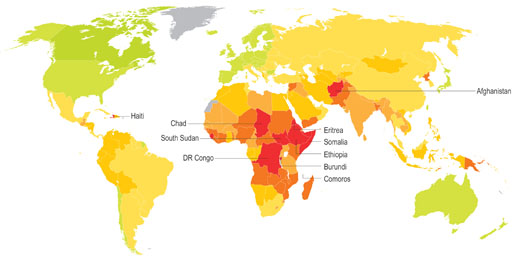
Despite strong economic growth, food security remains an issue of primary importance for Africa, according to a new study by risk analysis company Maplecroft, which classifies 75% of the continent’s countries at ‘high’ or ‘extreme risk.’
Click on Image to Enlarge
In the light of recent food price spikes, the findings are especially significant for areas of sub-Saharan Africa where poverty, armed conflict, civil unrest, drought, displacement and poor governance can combine to create conditions where a food crisis may take hold.
Africa accounts for 39 of the 59 most at risk countries in Maplecroft’s Food Security Risk Index and hosts nine of the eleven countries in the ‘extreme risk’ category. These include: Somalia and DR Congo (ranked joint 1st in the index), Burundi (4), Chad (5), Ethiopia (6), Eritrea (7), South Sudan (9), Comoros (10) and Sierra Leone (11). The countries of Haiti (3) and Afghanistan (8) complete the category.
Glad to see that a bunch of news outlets picked up the thesis by Chief of Staff of the Egyptian Armed Forces Sedky Sobhy I highlighted a few days ago. Some wanted to interview me but unfortunately I was not available, but here's a couple of links.
Professor Douglas Lovelace, the director of the Army War College's Strategic Studies Institute and Sobhy's adviser, remembered him as a “bold thinker,” charming and a “very impressive officer” who often offered thoughts counter to the conventional thinking at the time.
“I do recall he was provocative and an original thinker,” Lovelace said. “It was not surprising that he would either fail completely or rise to the top.”
The outbreak of violence by individuals who seek to harm other persons or institutions cannot be reliably predicted today, the Defense Science Board said in a new report to the Secretary of Defense. Instead, efforts to counter violence should focus on prevention and mitigation of the threat.
The new DSB study on “Predicting Violent Behavior” was initiated in response to the 2009 Fort Hood shooting in which thirteen people were killed and dozens wounded allegedly by Army Major Nidal Malik Hasan, who had not previously been identified as a threat.
“The state of the art in physiological and neurological sciences today does not provide useful capability for predicting targeted violence,” the DSB report said.
“While there are promising indicators that might predict aberrant behavior, severe personality disorders, addiction, and other anti-social behaviors, the current state of the science is such that the false positives and false negatives are very high. In addition, developing a practical means to observe any useful indicators may present a significant challenge.”
In the wake of the Fort Hood shootings, the Defense Department attempted to develop lists of problematic behaviors that might signal a propensity to violence. One such list was the behaviors included in the adjudicative guidelines for granting (or denying) security clearances.
But the use of that list was not justified, the DSB said. “The Task Force found little to no relationship between the adjudicative guidelines and targeted violence.”
Moreover, “the Task Force also found that indicator lists are most effective in the hands of trained professionals and are not an effective substitute for a more nuanced, comprehensive set of factors developed by threat-management practitioners. If not handled properly and by trained personnel, lists can lead to high false-positives with accompanying stigma, lack of trust, and reluctance to report. Lists also tend to be static and unless continually revisited the list of indicators becomes less likely to identify adaptive perpetrators who will purposefully avoid elements of listed behavior to avoid interdiction.”
Overall, the DSB Panel advised, “prevention as opposed to prediction should be the Department's goal. Good options exist in the near-term for mitigating violence by intervening in the progression from violent ideation to violent behavior.”





 Issandr El Amrani