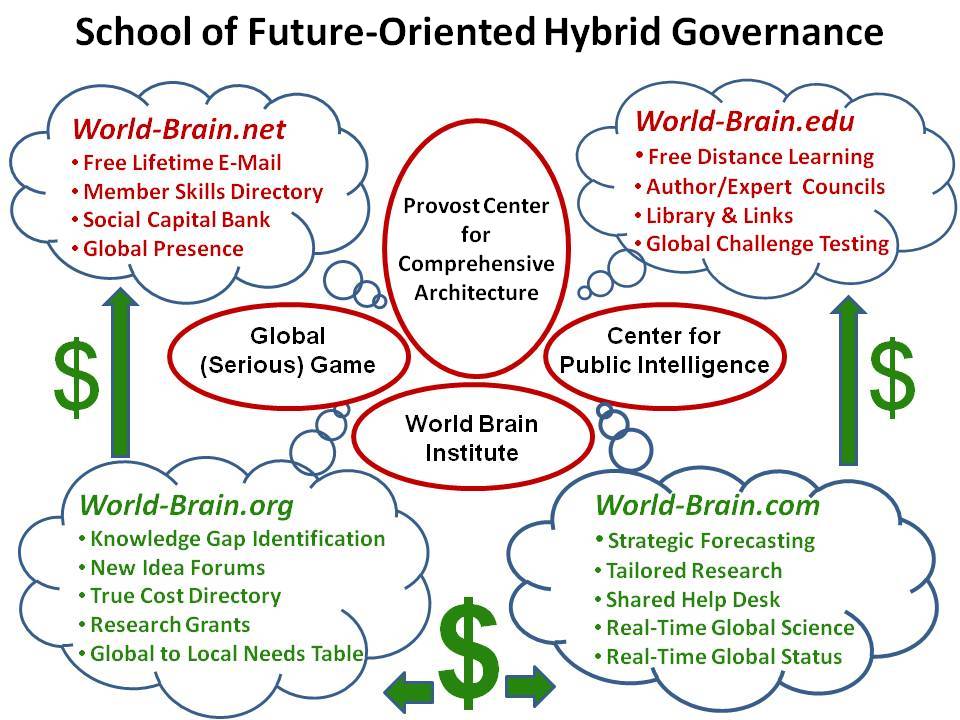
Creative Commons license applies — no financial exploitation without permission. Robert Steele owns three of the four world-brain urls (net, org, com) and is looking for a university with the gravitas to understand why this concept needs to be implemented in full, soonest.
Interesting headline…..why is it that we place the blame on others (Karzai more volatile) when we (the US) completely ignores him and runs roughshod over his country? That would make anyone “volatile”. This is how the world sees us, it is all about integrity….something the government lacks in spades.
KABUL, Afghanistan — The Americans in Afghanistan are “demons.”
They claim they burned Korans by mistake, but really those were “Satanic acts that will never be forgiven by apologies.”
The massacre of 16 Afghan children, women and men by an American soldier “was not the first incident, indeed it was the 100th, the 200th and 500th incident.”
Such harsh talk may sound as if it comes from the Taliban, but those are all remarks either made personally by the United States’ increasingly hostile ally here, President Hamid Karzai, or issued by his office in recent days and weeks.
The strongest such outburst came Friday. “Let’s pray for God to rescue us from these two demons,” Mr. Karzai said, apparently holding back tears at a meeting with relatives of the massacre victims, and clearly referring to the United States and the Taliban in the same breath. “There are two demons in our country now.”
Ever since the Koran-burning episode on Feb. 20 and its violent aftermath, the relationship between the two governments has lurched from one crisis to another. American officials have scrambled to run damage control, with President Obama expressing a personal apology for the Koran burning, as well as regrets about the massacre, while calling Mr. Karzai twice in the past week.
Phi Beta Iota: There are two Special Forces in the USA today — the old hands that stayed on, resisting the lure of higher wages from private military contractors, and the mass produced newbies that have no clue. The true Special Forces — the old hands — agree with Karzai. The USA is out of control, lacks legitimacy, and has no idea what to do other than bluster and do more harm.
The executive order signed by Obama March 16, 2012, authorizes widespread federal (and often military) control and manipulation of the national economy and resources “under both emergency and non-emergency conditions” as well as the right to install “government owned equipment” in private industrial facilities.
It is understandable that reasonable precautions and preparations should be taken for defense and emergency conditions. The question here is what is “reasonable” and democratic – and to what extent does THIS kind of preparation actually make sense when compared, for example, to developing decentralized energy and industrial capacity which is less susceptible to attack. (We won't even mention here the development of nonviolent “civilian based defense” as advocated by Harvard historian Gene Sharp http://en.wikipedia.org/wiki/Civilian-based_defense to make a country ungovernable by a domestic dictatorship or foreign power.)
I recommend that you read over the whole executive order. However, for your convenience, I've excerpted particularly interesting parts of it below.
In his new book, Vijay Vaitheeswaran argues that we’re thinking about worldchanging innovation all wrong: It’s not going to come from where we expect it.
Arnie Cooper
www.fastcoexist.com, 19 March 2012
The world is currently standing “on the cusp of a post-industrial revolution.” So writes Vijay Vaitheeswaran in his new book, Need, Speed and Greed: How the New Rules of Innovation Can Transform Businesses, Propel Nations to Greatness and Tame the World’s Most Wicked Problems, out March 13. Vaitheeswaran, a 20-year veteran correspondent for The Economist and adviser to the World Economic Forum, wrote the book, he says, as a way to inspire bottom-up solutions to top-down problems like resource depletion, climate change, and growing income inequality. We spoke with Vaitheeswaran about the importance of disruptive technologies, social entrepreneurship, and embracing China’s rise.
Co.Exist: As you point out in your book, modern humanity has arrived at the first phase of an unprecedented “innovation revolution,” yet many are being left behind. Why is that and what are we gonna do about it?
Vijay Vaitheeswaran: First, I think it’s a wonderful time to be alive. Shockingly, this might be the best time to be in the bottom billion because of transformations like mobile telephony and micro-credit. But it’s getting much harder to be in the middle class in places like America. The principal reason for this, I think, is that educational systems are increasingly out of touch with the needs of the ideas economy. The current education system that our and other countries developed was suited to the industrial revolution, a one-size-fits-all model for education that treats people as commodities. But we’re in an innovation age where creativity, individual initiative, willingness to think out of the box and disrupt established business or even lifestyle patterns is much more important than simple manual tasks that produce the next widget. So I think the great challenge for developed economies like the U.S. is to reinvent education. The challenge for each one of us is to keep relearning how to learn.
A couple years ago, Jay Baer wrote a great blog post called ‘The 39 social media tools I’ll use today’ which was an all-in-one toolkit for social media marketers (and still is).
A lot has changed in the two years since that post was published so here is a ’2012 remix’ featuring 50 (mostly free) tools you can use on a daily basis.
Whether you are just starting out in the social media arena or have been at it for a few years, this will hopefully be a handy resource. So, let’s serve ‘em up!
Listening / Research
The foundations for any social media marketing activity start with listening and in-depth research, ranging from influencer identification to campaign planning.
Petraeus says that the treasure trove of data connected appliances and devices will be able to gather on a “person of interest” will make it much easier to see what potential terrorists and others are doing inside home and to intercept communications. He also noted that connected household devices with the potential to be turned in the spy tools “change our notions of secrecy.” While the CIA has numerous regulations and laws preventing it from spying on American citizens, it’s apparently a much grayer area when it comes to collecting geolocation data that many devices
broadcast.
Earlier this month, Petraeus mused about the emergence of an “Internet of Things” — that is, wired devices — at a summit for In-Q-Tel, the CIA’s venture capital firm. “‘Transformational’ is an overused word, but I do believe it properly applies to these technologies,” Petraeus enthused, “particularly to their effect on clandestine tradecraft.”
CIA director David Petraeus (seen here playing Wii golf) is really excited about the idea behind the Internet of things. The thing is most excited about isn’t his refrigerator being able to order milk, but the effect that connected appliances and devices will have on “clandestine tradecraft.” In other words, he’s excited about being able to use these devices to spy on people.
Phi Beta Iota: Patraeus was “musing” at an In-Q-Tel conference, so he can reasonably be forgiven for being taken out of context. However, this is just one more stronger signal that the $80 billion a year US Intelligence Community, within which CIA provides armed drones, foreign liaison hand-outs, and very little else, is money wasted. Clandestine tradecraft is about humans. All-source analysis is about integrating a strategic analytic model with history and forecasting to deliver decision-support. It is not about technology except in so far as it supports human cognition. It's a pity the Director of the CIA has not learned that. Technology is not a substitute for thinking, and administration is not a substitute for leadership.