
Playpower.org aims to introduce the world’s cheapest computer programs to the poor by utilizing the technology of old 8 bit computers. The Apple II computer, which had its heyday in the 1970s in the West, has lived on in the developing world, where its technology is now open source and easy to manufacture. As a result, computers can be sold for as little as $10-12. Many of these systems are currently on sale as “TV computers” in Bombay, Bangalore, and Nicaragua, offering pirated, low-tech versions of games like Mario and Donkey Kong. Like the early home computers sold in the United States, they plug into a TV screen for display, making them an easy access technology. Continue reading “The $12 Computer”
Event: 10-12 Sept 2010, Berlin, Interdependence Day
02 Diplomacy, 10 Security, Academia, Civil Society, Collective Intelligence, Government, Non-Governmental, Peace Intelligence

Berlin, Germany 2010
In 2010 Interdependence Day will be celebrated in a dynamic global city and cultural melting pot at the heart of Europe.
> INTERDEPENDENCE DAY
In a world where global interdependence is not simply an aspiration of idealists, but a brute fact of the forces that bind us together— global warming, financial capital, AIDS, telecommunications, crime, migration, and terrorism—many people still think in narrow, insular terms.
Reality is global, but consciousness too often remains local — constrained by town and nation.
In the year 2000, a small group of scholars, civic and political leaders, and artists from a dozen nations met to design a program that might help raise consciousness around the realities and possibilities of interdependence. Their efforts were given impetus by the tragic events of September 11, 2001, and the group created a project that would:
> Make September 12, the day following the memorial of 9/11, an international celebration of interdependence “Interdependence Day”
> Draw up a “Declaration of Interdependence”, making clear that both liberty and security require cooperation among peoples and nations and can no longer be secured by sovereign nations working unilaterally;
> Develop a Civic Interdependence Curriculum that would make interdependence a central concept in Civics and Social Studies programs in middle and high schools in as many schools around the world as possible.
Prospect Maps for Solar & Wind Power Harvesting
05 Energy, Earth Intelligence, MapsWhere Wind and Solar Power Make Sense
GOOD Blog > Andrew Price on February 15, 2010
How much energy we can generate with wind and solar power projects depends, of course, on the wind and the sun. So being smart about where we put solar panels and turbines is pretty important. A company called 3TIER has made a business out of providing “prospecting tools” for renewable energy.Here's their latest map for where solar power can be harvested in the western hemisphere:

Graphic: “The True Cost of Coal”
01 Agriculture, 03 Economy, 03 Environmental Degradation, 05 Energy, 07 Health, 10 Security, 12 Water, Civil Society, Earth Intelligence, Graphics, Peace Intelligence, True Cost, True Cost

After two years of collaborative research, storysharing, metaphor crafting, and meticulous illustrating, the bees have completed an epic illustration about mountaintop removal coal mining.

Related:
+ True Cost Meme
+ True Cost T-Shirt
Journal: Google, CIA Invest in ‘Future’ of Web Monitoring
Commerce, Commercial Intelligence, Government, Intelligence (government), IO Mapping, Methods & ProcessThe investment arms of the CIA and Google are both backing a company that monitors the web in real time — and says it uses that information to predict the future.
The company is called Recorded Future, and it scours tens of thousands of websites, blogs and Twitter accounts to find the relationships between people, organizations, actions and incidents — both present and still-to-come. In a white paper, the company says its temporal analytics engine “goes beyond search” by “looking at the ‘invisible links’ between documents that talk about the same, or related, entities and events.”
The idea is to figure out for each incident who was involved, where it happened and when it might go down. Recorded Future then plots that chatter, showing online “momentum” for any given event.
Recorded Future strips from web pages the people, places and activities they mention. The company examines when and where these events happened (“spatial and temporal analysis”) and the tone of the document (“sentiment analysis”). Then it applies some artificial-intelligence algorithms to tease out connections between the players. Recorded Future maintains an index with more than 100 million events, hosted on Amazon.com servers. The analysis, however, is on the living web.
Phi Beta Iota: Both CIA and Google (as well as DoD/USDI) are treating OSINT as a technical processing problem. They will fail for lack of focus on human intelligence–all humans, all minds, all the time; and for lack of respect of the four quadrants cubed (knowledge, new craft, spivak). When they can overcome the web of fragmented knowledge, and get a grip on all information in all languages all the time (the information cube), we will be impressed. Right now, Google is nowhere near getting a grip on everything digital, let alone analog or unpublished.
Journal: Who will trust open source security from the government? Any government?
Collaboration Zones, Collective Intelligence, Communities of Practice, Computer/online security, InfoOps (IO), Key Players, Methods & Process
Sometimes the old joke is true. Sometimes the government is just trying to help.
An open source consortium funded by military and civilian security agencies within the U.S. government has released a final version of Suricata, a new security framework.
. . . . . . .
Unfortunately the timing of the release could not have been worse, coming as it did the same week the Washington Post launched its series Top Secret America, detailing just how immense and intrusive the nation’s national security apparatus has become, an economic boom for Washington seen as increasingly dangerous by many on both the left and right.
Jonkman acknowledged the help of “thousands of people” in delivering Version 1.0 of the software, which was immediately fisked by Martin Roesch, creator of Snort, who called it a cheap knock-off funded with taxpayer dollars.
. . . . . . .
Continue reading “Journal: Who will trust open source security from the government? Any government?”
Building an Audio Collection for All the World’s Languages
04 Education, Academia, Audio, Civil Society, Cultural Intelligence, Languages-Translation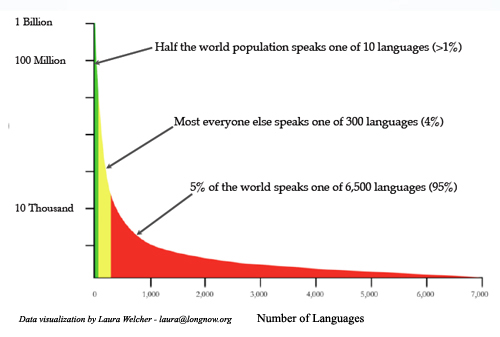
The Rosetta Project is pleased to announce the Parallel Speech Corpus Project, a year-long volunteer-based effort to collect parallel recordings in languages representing at least 95% of the world’s speakers. The resulting corpus will include audio recordings in hundreds of languages of the same set of texts, each accompanied by a transcription. This will provide a platform for creating new educational and preservation-oriented tools as well as technologies that may one day allow artificial systems to comprehend, translate, and generate them.
Continue reading “Building an Audio Collection for All the World’s Languages”
