Journal Haiti: Silly Question–Regional Traffic Management? Strategic Resettlement?

Peace Intelligence
Click to See Full Slide

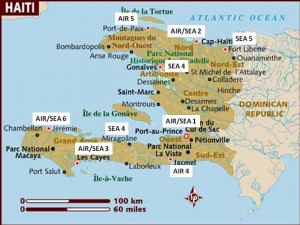
Here are the viable air and sea landing points for Haiti, trying to leave Dominican Republic out of it, they have enough problems.

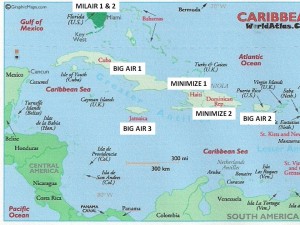
Below are a few “Big Air” triage points, with corresponding seaport triage that can then be migrated to small boats, landing craft, etcetera.

So here is the silly question…has anybody thought to set up a regional traffic management plan that triages big air into little air and big boats into small boats?

Click to See Full Slide

Has anyone set up a bottom-up Range of Needs Table?

Has anyone convened a Haitian Population Resettlement Council that goes straight to moving 400,000 to new zones where free lumber, bricks, cement and so on can be brought in by landing craft?

This would appear to be a huge opportunity to think before acting, and to then execute several strategic moves that lift Haiti out of poverty rather than just covering up the mess in the short term.  Civil Affairs Brigade could really make a difference here, along with STRONG ANGEL  It is very rugged terrain but the ocean is open and people can be moved by landing craft and ambhibious ships.   IOHO.

Continue reading “Journal Haiti: Silly Question–Regional Traffic Management? Strategic Resettlement?”

Journal: Haiti Update 22 January 2010 AM

Peace Intelligence

In Need of Port Repairs, Haiti Relocating 400,000

PORT-AU-PRINCE, Haiti  —  Haitian officials are planning a massive relocation of 400,000 people from makeshift camps to the outskirts of the capital as the U.S. government tackles repairs to the damaged main port — dual efforts to help residents survive the aftermath of the catastrophic earthquake.

The plan to temporarily relocate thousands is aimed at staving off the spread of disease at hundreds of squalid settlements across the city where homeless families have no sanitation and live under tents, tarps or nothing at all.

As aid begins to flow, Haiti considers fate of millions of homeless

Haiti's main port reopens for relief vessels: Haiti's relief pipeline shifted from the air to the sea as the U.S. military opened the island's main port

Phi Beta Iota: The port “re-opening” is so severely over-stated as to call into question the sanity of those implying this to the media (if they did–if not, this should be publicly corrected.  One pier with cracks handling one truck at a time and extremely limited fuel bunkerage is not “open.” ) All of this was known when we posted CAB 21 Peace Jumper Sequence of Events.  The US military appears to be treating this as a casual “one thing at a time” series of decisions instead of doing what we suggested in the first place: get a grip on reality, open two C-130 airfields, do massive airdrops of water, food, plastic, and lumber, and think creatively–for example, roll out every Sea Bee, Red Hat, and Army engineering unit, ramp up the second port on the far end of the island and start moving people in that direction, finish Route 9 the way we promised and then reneged ten years ago, triage all cargo at point of loading (push the information perimeter out and create a needs-driven bottom-up Reverse TIPFID).  And so on.  False reassurances at this point are going to assure a plague-ridden calamity in the next few weeks. From where we sit it is obvious the US Intelligence Community is as useless in Haiti as it has been in Afghanistan.  It's time for DoD to try something new, what we have is not working.  Haiti is an open source information problem.  Haiti is also a Strategic Communications and Multinational Engagement challenge, a rare opportunity to test drive STRONG ANGEL  for real and set the stage for truly multinational Stabilization & Reconstruciton operations on a come as you are basis.

Journal: Haiti Rolling Update

See also:

Review: Catastrophe & Culture–The Anthropology of Disaster

Review: The Upside of Down–Catastrophe, Creativity, and the Renewal of Civilization

Worth a Look: Book Reviews on Leadership for Epoch B

Worth a Look: Book Reviews on Stabilization & Reconstruction

Journal: Intelligence & Innovation Support to Strategy, Planning, Programming, Budgeting, & Acquisition

Analysis, Budgets & Funding, Collaboration Zones, Communities of Practice, Ethics, Geospatial, History, InfoOps (IO), Information Operations (IO), Key Players, Methods & Process, Mobile, Policies, Policy, Real Time, Reform, Strategy, Technologies, Threats, Tools, True Cost
Robert David STEELE Vivas

Chuck Spinney is still the best “real” engineer in this town–almost everyone else is staggering after fifty years of government-specification cost-plus engineering.  Also, as Chuck explores in the piece on Complexity to Avoid Accountability is Expensive we in the “requirements” business are as much to blame–Service connivance with complexity has killed acquisition from both a financial inputs and a war-fighting relevance outcome point of view.  The Services have forgotten the basics of requirements definition and multi-mission interoperability and supportability.

The Marine Corps Intelligence Center (MCIC) was created by General Al Gray, USMC (Ret), then Commandant of the Marine Corps, for three reasons:

1.  Intelligence support to constabulary and expeditionary operations from the three major services was abysmal to non-existent.

2.  Intelligence  support to the Service level planners and programmers striving to interact with other Services, the Unified Commands, and the Joint Staff was non-existent–this was the case with respect to policy, acquisition, and operations.  The cluster-feel over Haiti and the total inadequacy of our 24-48 hour response tells us nothing has changed, in part because we still cannot do a “come as you are” joint inter-agency anything.

Continue reading “Journal: Intelligence & Innovation Support to Strategy, Planning, Programming, Budgeting, & Acquisition”

Worth a Look: iPhone First Aid Application

Peace Intelligence

Haiti: Man Says iPhone Helped Him Treat His Wounds While Trapped In Rubble

This story's been getting a lot of attention in recent hours. Here's how Wired magazine begins its version of a tale about modern technology coming through in a crisis

Message From Dan:

“Consulted this app, while trapped under Hotel Montana in Haiti earthquake, to treat excessive bleeding and shock. Help me stay alive till I was rescued 64 hours later. God saved me, and this app was one of the tools He gave me.”

The app is Pocket First Aid & CPR from Jive Media. I checked with Jive founder Doug Kent about it, and he e-mailed that “all of the content is loaded upon installation, including the videos and illustrations. Internet access is not needed to access any of the features.”

Journal: Haiti Update 21 January 2010 PM

Peace Intelligence

Haiti: The View From Here

Everyone's seen the gruesome images on the news, and I guess I could try to get creative and come up with some string of awful words to describe the state and conditions of the city and its people, which would not suffice, so there's really only one way to describe it: fucked. It's completely, unbelievably fucked. The whole country is outdoors.

Every block — collapsed buildings, every street — refugees, every gas station crammed with people shouting and jockeying to fill up makeshift gas cans. And yes, the fallen bodies with faces covered with rags or cardboard, everywhere. It doesn't end.

It's day five, people are getting more and more desperate, and the vast scale of the tragedy is unimaginable: today, food was personally distributed to 200,000 people out of more than a million who have been affected and in need.

Phi Beta Iota: The best estimate available from published sources is that no more than one fifth of the population is getting water and food on any given day.  This would be a good time to re-visit air drops of water, food, plastic sheeting and cord as well as lumber–spreading the drops will spread the population and reduce density in the city.  IOHO.

Journal: Al Qaeda, Yemen, Somalia, and USG

08 Wild Cards, Cultural Intelligence, Government, Law Enforcement, Military, Peace Intelligence
Berto Jongman Recommends...

Welcome to Qaedastan: Yemen's coming explosion will make today's problems seem tame.

Full Story Online

Yemen has so many dire problems that it's easy to be overwhelmed. Al Qaeda is growing in prominence, a Shiite rebellion is expanding in the north, and the threat of secession is renewed in the south. There's a brewing fight over what comes after President Ali Abdullah Saleh, age 67, who has ruled Yemen for 31 years; the country's elites are locked in a closed-door struggle to take power once he departs. Finally, and perhaps most intractably, Yemen is an environmental and resource catastrophe in the making. The country's water table is nearly depleted from years of agricultural malpractice, and its oil reserves are rapidly dwindling. This comes just when unemployment is soaring and an explosive birthrate promises only more young, jobless citizens in the coming years.

Testimony of Gregory D. Johnson, PhD Candidate, Near Eastern Studies, Princeton University, Before the Senate Foreign Relations Committee January 20, 2010

Too many problems of too severe a nature to be dealth with in isolation from one another.  “Yemen and its challenges have to be understood and dealt with as a whole.”

AQAP in Yemen and the Christmas Day Terrorist Attack  By Gregory D. Johnsen

Al Qaeda in Yemen and Somalia: A Ticking Time Bomb: Report to the Committee on Foreign Relations, United States Senate, January 21, 2010

Standard party line “prep” for invading both countries.  Most interesting tid-bit: 36 American convicts reached Yemen, ostensibly to study Arabic.  Given the number of convicts the USA produces, most jailed for marijuana possession, and in combination with the bankruptcy of the USA and the meltdown of its social and physical infrastructure, we read this in a much more catastrophic homeland manner than might be the case in the cozy ambiance of Capitol Hill.  Al Qaeda is no longer the center of gravity–domestic anger easily converted into violence is the center of gravity.

See also:

Continue reading “Journal: Al Qaeda, Yemen, Somalia, and USG”

Reference: BGen McMaster at ODNI on Afghanistan

04 Inter-State Conflict, 05 Civil War, 08 Wild Cards, Director of National Intelligence et al (IC), DoD, Government, Memoranda, Military, Non-Governmental, Peace Intelligence

Memo corrected to remove (Ret).  BGen McMaster was promoted to his present rank on 29 June 2009 after being twice passed over (2006, 2007), presumably for having the integrity to be outspoken.  He is the author of the widely-admired book Dereliction of Duty: Johnson, McNamara, the Joint Chiefs of Staff, and the Lies That Led to Vietnam.

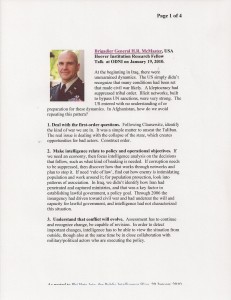
Nine key factors are examined by BGen McMaster in his talk to the Office of the Director of National Intelligence (ODNI).  Answers question on why we were so unprepared.  Final paragraph of trip report:

Can’t get much from a database and IT networks, but contractors keep pushing and we keep buying.   But what really need is experts from anywhere, context, and also need to ask the soldiers!  Make Phebe Marr a general!  Also pay attention to: Charles Tripp, R. Kadeiri, Sarah Chayes, Barnett R. Rubin and Ahmed Rashid, Michael Howard, Frontline piece on Children of the Taliban, Fariad Ali Han on borders.  Educate analysts (and self-educate) on the place, don’t waste time training them on the process.