Remember something called the War on Poverty? The Great Society?
President Lyndon Johnson declared it and announced it in 1965. Since then, the federal government and state governments have poured staggering amounts of dollars into the program.
How many dollars? Does anyone know?
In his 1992 book, Paved With Good Intentions, Jared Taylor puts the figure (1965-1992) at $2.5 trillion. So, for the sake of argument, let’s accept that.
Yet, by 1992 (and to an even greater degree since then), poverty had accelerated in America. Had gotten much, much worse.
So the logical question was and is: where did all that money go?
MEB remains, in our view, the greatest US-based information broker of all time, along with Reva Basch now fully retired. Below is her 13 November 2013 presentation to the Special Library Association.
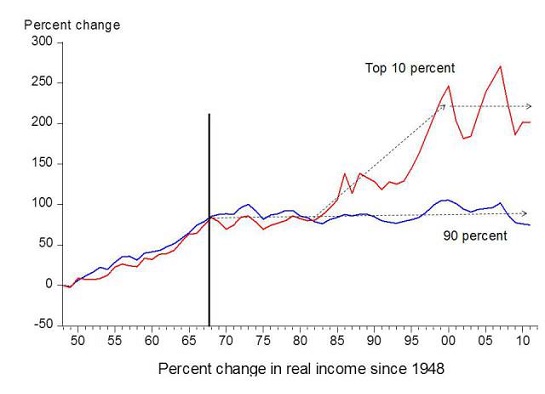
Inflating serial asset bubbles is no substitute for rising real incomes.
Why are we stuck with an economy that only generates serial credit/asset bubbles that crash with catastrophic consequences? Ths answer is actually fairly straightforward.
Click on Image to Enlarge
Let's start with the ideal conditions for an economy that depends on consumer spending.
1. Rising real income, i.e. after adjusting for inflation/currency depreciation, wages/salaries have more purchasing power every year.
2. An expanding pool of new households, i.e. young people who move away from home or graduate from college, get a job and start their own household. New households buy homes, vehicles, furniture, appliances, kitchenware, tools, etc., driving consumption far more than established households.
Neither of these conditions apply to today's economy. Income for the bottom 90% has been stagnant for forty years, and has declined 7% in real terms since 2000.
Two months ago, hundreds of thousands of Chileans somberly marked the 40th anniversary of their nation’s September 11th terrorist event. It was on that date in 1973 that the Chilean military, armed with a generous supply of funds and weapons from the United States, and assisted by the CIA and other operatives, overthrew the democratically-elected government of the moderate socialist Salvador Allende.
Click on Image to Enlarge
Sixteen years of repression, torture and death followed under the fascist Augusto Pinochet, while the flow of hefty profits to US multinationals – IT&T, Anaconda Copper and the like – resumed. Profits, along with concern that people in other nations might get ideas about independence, were the very reason for the coup and even the partial moves toward nationalization instituted by Allende could not be tolerated by the US business class.
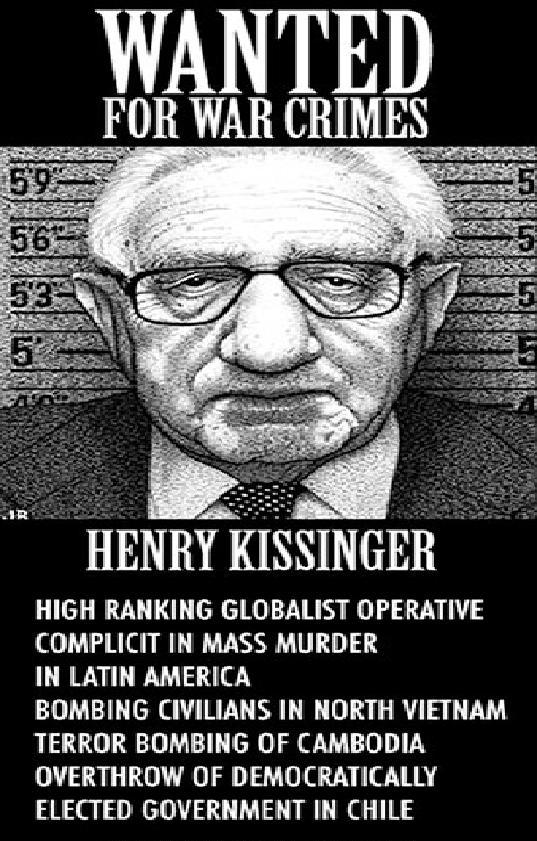
Henry Kissinger was national security advisor and one of the principle architects – perhaps the principle architect – of the coup in Chile. US-instigated coups were nothing new in 1973, certainly not in Latin America, and Kissinger and his boss Richard Nixon were carrying on a violent tradition that spanned the breadth of the 20th century and continues in the 21st – see, for example, Venezuela in 2002 (failed) and Honduras in 2009 (successful).
Where possible, such as in Guatemala in 1954 and Brazil in 1964, coups were the preferred method for dealing with popular insurgencies. In other instances, direct invasion by US forces such as happened on numerous occasions in Nicaragua, the Dominican Republic and many other places, was the fallback option.
The coup in Santiago occurred as US aggression in Indochina was finally winding down after more than a decade. From 1969 through 1973, it was Kissinger again, along with Nixon, who oversaw the slaughter in Vietnam, Cambodia and Laos.
Click on Image to Enlarge
It is impossible to know with precision how many were killed during those four years; all the victims were considered enemies, including the vast majority who were non-combatants, and the US has never been much interested in calculating the deaths of enemies.
Estimates of Indochinese killed by the US for the war as a whole start at four million and are likely more, perhaps far more. It can thus be reasonably extrapolated that probably more than a million, and certainly hundreds of thousands, were killed while Kissinger and Nixon were in power.
In addition, countless thousands of Indochinese have died in the years since from the affects of the massive doses of Agent Orange and other Chemical Weapons of Mass Destruction unleashed by the US. Many of us here know (or, sadly, knew) soldiers who suffered from exposure to such chemicals; multiply their numbers by 1,000 or 10,000 or 50,000 – again, it’s impossible to know with accuracy – and we can begin to understand the impact on those who live in and on the land that was so thoroughly poisoned as a matter of US policy.
Studies by a variety of organizations including the United Nations also indicate that at least 25,000 people have died in Indochina since war’s end from unexploded US bombs that pocket the countryside, with an equivalent number maimed. As with Agent Orange, deaths and ruined lives from such explosions continue to this day. So 40 years on, the war quite literally goes on for the people of Indochina, and it is likely it will go on for decades more.
Near the end of his time in office, Kissinger and his new boss Gerald Ford pre-approved the Indonesian dictator Suharto’s invasion of East Timor in 1975, an illegal act of aggression again carried out with weapons made in and furnished by the US.
“News Use across Social Media Platforms” confirms what I have suspected for a while. The mobile generation has some interesting behavior patterns with regard to news. Among the factoids that the Pew outfit has boiled down to numbers are:
ITEM: YouTube viewers are not using the service to get news. Maybe that explains why experiments with Thomson Reuters proved to be somewhat disappointing.
ITEM: Google Plus is less popular than Reddit, Twitter, and Facebook as a source of news. The push back about Google Plus as a prerequisite for YouTube comments may have more importance than some realize.
ITEM: Facebook is an important source of news. As the demographics of Facebook shift, the importance of news may suggest that Facebook has morphed into a more mature service.
The most interesting “fact” in the report is the apparent importance of Reddit, a service which points to public posts on a range of issues. The Reddit service offers a search function, but I find consistently disappointing. In fact, most of the unusual collections of links and comments are essentially unfindable.
WASHINGTON, November 7, 2013 — U.S. Secretary of State John Kerry desperately needs a win on the Afghanistan war. Unfortunately, however, it appears increasingly unlikely he will get one.
Click on Image to Enlarge
Despite repeated visits and discussions, Kerry has so far failed to secure a clean Bilateral Security Agreement with Afghan President Hamid Karzai. Without an agreement, all U.S. and NATO forces – including the approximately 10,000 that the Pentagon wants to keep in country – would have to leave the country next year.
The immediate sticking point is on whether U.S. troops will receive immunity for misdeeds during the deployment, but the larger issue centers on respect, sovereignty and judicial non-interference.
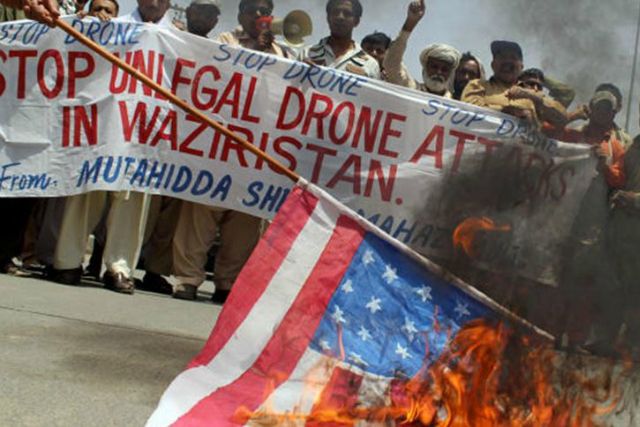
Local populations are overwhelmingly against immunity for U.S. troops. In Afghanistan, most cases currently slide without reprimand or justice. This includes countless stories of abuse accompanying night raids, which Karzai has repeatedly attempted to ban. As is the case in Iraq, the Philippines and elsewhere, local populations want accountability within their own courts for U.S. troops who commit abuses in their countries. Americans would assuredly want the same treatment for foreign troops on U.S. soil.
After 12 years at war with Afghanistan, we continue to miss the mark on four fronts: strategy, cost, accountability and perception.