My colleague Robert Soden was absolutely right: Tomnod is definitely iRevolution material. This is why I reached out to the group a few days ago to explore the possibility of using their technology to crowdsource the analysis of satellite imagery for Somalia. You can read more about that project here. In this blog post, however, is to highlight the amazing work they’ve been doing with National Geographic in search of Genghis Khan’s tomb.
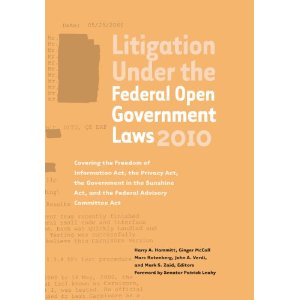
5.0 out of 5 stars Critical USEFUL Reference, Handbook, Citizen Manual,August 22, 2011
I'm exploring a major campaign to expose illegal actions across the Defense Office of Hearings and Appeals and the Defense Intelligence Agency in particular, and in talking to the Electronic Privacy Information Center (EPIC) leadership got a chance to understand just how vital and USEFUL this guide is.
Senator Patrick Leahy, co-sponsor of the OPEN Government Act of 2007, and many others are on record as considering this the single most indispensable tool in any citizen's toolkit.
For myself, having seen the capricious, arbitrary, and often unethical and even abusive manner in which DIA Personnel “cooks the books” and manipulates job announcements and screening decisions, and having been personally privy to enormous abuse by the Director of the Defense Office of Hearings and Appeals and a specifc group of his subordinates, consider this manual essential to my own search for justice.
Although I will use it more to inform myself so I can assist the specialist lawyers in making the most of what I know in their probing inquires at DIA and DOHA, I certainly recommend it to any citizen that has a specific concern that is not getting a fair hearing.
I also recommend the publisher and experts that put it together, the Electronic Privacy Information Center (EPIC). Many folks do not realize that they have been one of the leading champions of open government, and have also been one of the leading champions in exposing fraud, waste, and abuse that has been concealed by secrecy.
The US Government, in my view, as a general observation, is out of control and no longer representative of We the People. This is the handbook for citizens to use in holding every branch of the federal government accountable for its misbehavior and its dereliction of duty in failing to represent the public interest as opposed to the interest of its very big stakeholders who are recipients of the tax dollar rather than contributors to the treasury of the Republic.
Arm yourself with this knowledge, and go into battle confident in the righteousness of your cause.
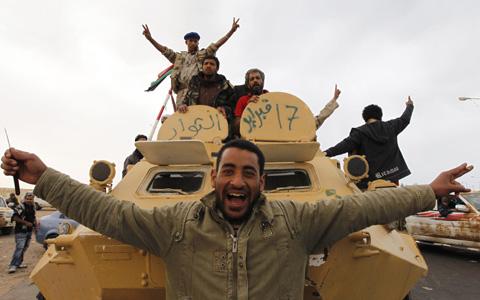
But experts are wondering who is this opposition and who are the rebels fighting Ghadafi’s forces?
. . . . . . .
Marc Ginsberg, former U.S. Ambassador to Morocco, says the Libyan opposition is made up of different personalities and groups.
“It’s a sort of ‘Star War' assembly of characters and people who are clearly patriots, very decent people – I’m sure – journalists, opposition military officials who have broken with the regime, former diplomats – and then you’ve got Islamists,” said Ginsberg. “The Benghazi section of Libya was basically an opposition stronghold to Gadhafi and it has a very strong Islamist character to it. So while there are very good people who are part of this opposition coalition, we really can’t say that we know for sure what their capacity is to govern Libya.”
. . . . . .
“The 20-somethings are turning away from Islamists,” she said. “Now you do have an Islamic opposition and you always will have an Islamic extremism in the region. But this is not an Islamic movement. And it is not led by Islamists and it is not demanding the setting up of an Islamic Republic.
Item 1 is an insightful essay by Patrick Seale outlining the common characteristics of the political instabilities and revolutionary pressures now sweeping Europe and the Middle East. Although Seale uses the term Global Intifada to describe these instabilities, the term Intifada evolved out of the Palestinian struggle against occupation. He suggests the instabilities may be following a more general dynamic. The common causal factors he describes in the second paragraph also bring to mind a very loose comparison of the unrest unleashed in 2011 to the explosion of revolutions in 1848 across Europe. That many of Seale's common factors also exist in varying degrees in the United States makes one wonder why the politics of rage in the US remain confined to the right side of political spectrum. Item 2, “The World Consequences of US Decline,” is an equally insightful essay by Immanuel Wallerstein that suggests obliquely that this may be a temporary condition.
Status check on Brazil's specialized police units trying to supplant illicit drug governance in the favelas. Per an upcoming law, these units will be in place for 25 years. “Many communities previously relied on the drug gangs for services from water to wireless internet, and critics have pointed out that the state has been slow to replace them.”
Phi Beta Iota: The program has been successful in applying ruthless pervasive special violence to displace the drug gangs and insert permanent police presence. The program has FAILED in two respects: it has not been accompanied by the rapid provision of normal services from water to wireless; and it has not provided for the education of the people, something that requires call centers and free cell access to the Internet (they don't have the time to sit in a classroom for N years).
In their own words:
“People in the favela don't believe in themselves. What is really needed in the long term is more education.”
Yes, we are watching something melt down. But I'd argue the thing that's dying is not business itself, but a financial parasite — a speculative marketplace that no longer funds business but instead seeks to extract value from healthy commerce. More a funds vampire than an infuser of needed capital, the investment industry has been exposed as a drag on business. The future of commerce looks bright to me because it may be unencumbered by the weight of this non-productive capital.
. . . . . . .
Once we accept the fact that the money and banks we have grown accustomed to using are not the only ways to generate capital, we liberate ourselves and our businesses from a finance industry that has enjoyed a monopoly over our commerce for much too long. They have not only abused our trust through corrupt self-dealing, but abused their privilege through systemic usury. Businesses are only obligated to support their employees, owners, and customers — not an entire finance industry.
Secretary of Defense Panetta used an invitation to the National War College as an opportunity to lobby against cutting the defense budget more than the $350 billion he has already agreed to. In the absence of any informed or probing questions, Panetta's extreme rhetoric has also oozed into new Washington DC hysteria resulting from reports about a new round of Pentagon budget cuts. Even the most severe version of the cuts being bandied about would leave DOD quite flush with money in historic terms.
The invitation came to me from Secretary of Defense Leon Panetta's public affairs office to attend a “conversation” with Panetta and Secretary of State Hilary Clinton at the prestigious National Defense University in Washington. Although I knew it wasn't me they wanted to talk to, I sat in the audience to hear Panetta and Clinton in action, especially on the subject of my prime interest: the defense budget.