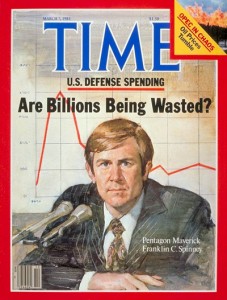
The House of Representatives will soon be debating the new Department of Defense (DoD) appropriations bill. It's expensive – $649 billion, close to another post-World War II high. The bill covers almost all of DoD's expenses for fiscal year 2012 – both routine expenses, such as basic payroll, training and weapons acquisition (known as the “base” budget), and war spending – for Afghanistan, Iraq and elsewhere.
Pretending reform and frugality, members of the House Appropriations Committee – Democrats and Republicans alike – packed the bill with pork and gimmicks.
The bill would spend $17 billion more than last year. But House appropriators are calling this increase a cut because it's less than the original defense budget request President Obama sent to Congress in February. That request was made irrelevant by the president's subsequent decision to reduce long-term security spending by $400 billion.
In addition to pretending frugality, the committee apes reform. It explicitly denies the existence of earmarks in the bill, saying in its own committee report, “Neither the bill nor the report contains any congressional earmarks, limited tax benefits, or limited tariff benefits as defined in clause 9 of rule XXI.”
Phi Beta Iota: There is nothing wrong with the US Government–or the economy–that could not be corrected quickly if the public-private sector partnership restored integrity as a non-negotiable starting point. This is what woke George Soros up–he finally realized that the degree of legalized corruption negated all reasonable operating assumptions for doing business.
I've enjoyed The War Nerd for years. Great, colorful writing. The author of the column, “Gary Brecher,” was never on the same page as me when it came to warfare. However, that's changed.
He now thinks, and makes an excellent case for global guerrilla thinking. In short: that blood and guts warfare is counter productive and that systems disruption (hiting network systempunkts/nodes to generate high ROI‘s and publicity) is a potential path to long term victory for guerrillas. In short: in the modern context, if you keep the blood/guts to a min, and keep the cost ratio massively in your favor while staying alive, you will eventually win.
To demonstrate this, he has a great article on how the IRA eventually adopted systems disruption:
“In 1994, they took the idea of non-lethal warfare a notch up by doing one of the most revolutionary things any guerrilla army has ever done: IRA mortar teams dropped shells on the runways at Heathrow Airport, totally stopping air traffic… but the shells weren’t even designed to explode. Intentional duds. That’s amazing; I’ve never heard of anything like that. It shows how far they’d come by that stage, away from the simple Al Qaeda maximum-blood crap I bought into in that earlier article. In contemporary urban guerrilla warfare, at least in Western Europe, killing civvies is counterproductive. What you want to do, what the IRA had mastered by the 1990s, was messing with the incredibly fragile and expensive networks that keep a huge city going. Interrupt them and you cost the enemy billions of dollars, and they don’t even have any gory corpses to shake in your faces. Fucking brilliant, and I was too dumb to see it!
Can the US Have an Expansionary Fiscal Contraction?
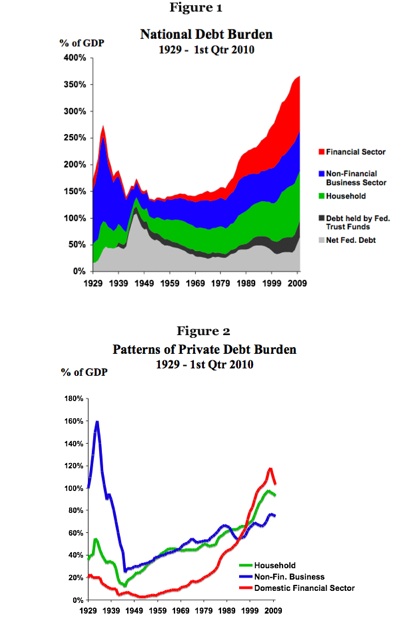
All … the attached essay was written by Simon Johnson, Ronald Kurtz Professor of Entrepreneurship, MIT Sloan School of Management; Senior Fellow, Peterson Institute for International Economics; and co-founder of Baseline Scenario. Johnson used to be Chief Economist of IMF and is, IMO, one of the sanest voices in economics. It summarizes his recent testimony to the Joint Economic Commitee of Congress. The question is — Should we reduce federal debt to slow the build up of private debt? He lays out 4 reasons why such a contractionary fiscal policy will create even worse problems.
Click on Image to Enlarge
His penultimate paragraph places the real issue — who is going to pay for the liquidation of the private bubble (see chart below, which I compiled from Fed. Reserve data) into context (the red typing is mine to clarify the ambiguity in his double use of debt). Also, I urge you to read his testimony (you can download it from the link indicated below) — it is more detailed and he has a brief discussion about how the cost of the financial meltdown (looming private debt liquidations — particularly the bubbles of debt in the financial and household sectors — which Fig 2 shows has not really begun to bite) are being shifted to the middle class. Note, the rise in the light gray area in Figure 1 is the spike in federal debt that has taken place since the meltdown.
What happened to the global economy and what we can do about it
Could The US Have An “Expansionary Fiscal Contraction”?
By Simon Johnson. My full written testimony to Tuesday’s hearing of the Joint Economic Committee of Congress is available here.
The US has a large budget deficit and a debt-to-GDP ratio that, in most projections, continues to rise over time. Some House and Senate Republicans are arguing strongly that this situation calls for large and immediate cuts to government spending, for example as part of any agreement to increase the federal government’s debt ceiling.
The Joint Economic Committee of Congress held a hearing on Tuesday to discuss whether such spending cuts would be “contractionary” or “expansionary” for the economy in the short-run. My assessment, after participating as a witness at the hearing, is that large immediate spending cuts would tend to slow the economy (a webcast of the hearing is here).
Hub Culture is a global collaboration network with over 25,000+ members distributed across 110 countries. Their stated mission to expand collective consciousness is driven by the blend of online workspaces for knowledge sharing with offline Pavilions for meeting and connecting – all powered by their digital currency, Ven. Below is an interview with Hub Culture’s Founding Director, Stan Stalnaker.
What compelled you to create Ven?
For us it was a matter of practicality – with a global, diverse community, we found that no single currency could offer a single pricing structure for global inventory in Hub Culture. Our members needed a global wallet – as simple to use in Rio as Shanghai. As a social network, we thought linking this system to the social profile of our users would help them share and create value. We needed a simple, transparent way for our members to exchange value and favors, and the answer was Ven. It has been a learning experience for us. The currency has evolved and grown since its debut in the summer of 2007, and we have discovered ways to make it more useful for our members and the planet at large.
You’ve said Ven can be thought of as ‘green money’? Why?
Today Ven is the only digital currency to be priced from a basket of currencies, commodities and carbon futures. These components give the Ven advantages of other currencies: the basket encourages price stability on a forward basis, and the link to commodities grounds value in hard assets. The introduction of carbon to the basket is helping us think about how money can serve better social purposes – in this case to support and stimulate demand for carbon credits and social impact development, driving offsets for every transaction used with Ven. This is how the idea of ‘green money’ developed with Ven – because its carbon linkages are able to play a role in this area. I really like the idea that Ven is green, social and efficient, with a mission to improve the lives of its users and the communities that use it.
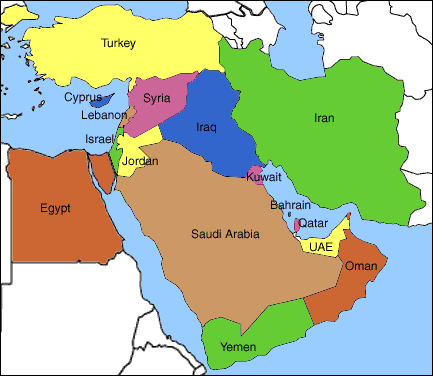
CNN has evidently become a wholly-owned subsidiary of the US Department of Defense (which has militarized the wimpish Department of State), much like BBC is a largely-owned subsidiary of the CIA. Today CNN is “selling,” with a straight face, absolute garbage to the effect that Iran considers Syria a satellite state and is “actively” engaged in advising and supplying the armed crack-down on dissidents. On the fringes there is no doubt slight evidence of Iranian concern, but this massive lie to the public leaves out several facts:
1) 85% or so of Syria is populated by Sunnis who hate Shi'ites and dictators–whether secular or theocratic–more than the hate the USA.
Click on Image to Enlarge
2) Assad not only owns the guns, they were made in the USA and he has received strong support from the USA and Israel for decades, while also supporting with rendition and torture the fraudulent USA “war on terror.”
3) This is a revolution for dignity and liberty, not necessarily for democracy, but most assuredly not in any way associated with nor justifying undermining in relation to the “war on terror. General Clark has told us the military-industrial complex, which is now out of control and unresponsive to White House or Congressional direction, plans to take out seven countries in five years. The insane, costly, unconstitutional, and criminal plan was actually laid out in a book, Endgame–The Blueprint for Victory in the War on Terror. What is being done “in our name” lacks intelligence and integrity and is well over the line toward crimes against humanity that should be confronted and stopped. War is not the solution; US troops out of Afghanistan and into Libya and Syria and Iran is not the solution. It will make matters worse.
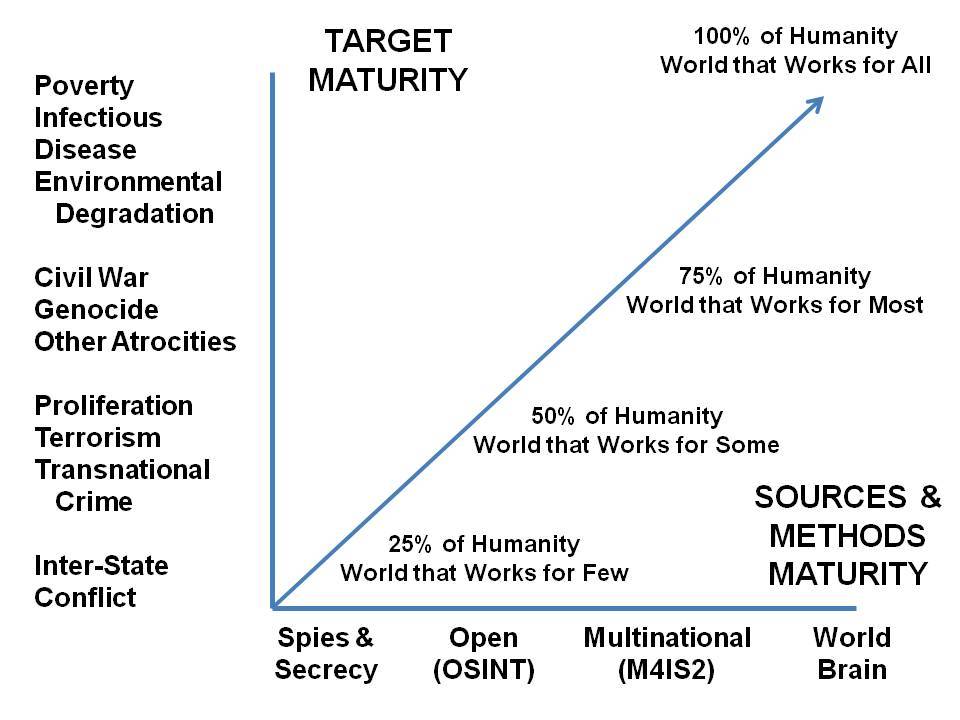
Click on Image to Enlarge
Phi Beta Iota: Turkey, Iran, and Egypt are the center of gravity for a non-violent and mature campaign to stabilize and reconstruct the Middle East. The US will not be part of the solution as long as it allows the military-industrial complex to jump in, and as long as the Department of State is as inept and uninformed as it is. The US Government lacks intelligence and integrity. It is time for the public to act on the wisdom of Norman Cousins:
Government is not built to perceive great truths; only people can perceive great truths. Governments specialize in small and intermediate truths. They have to be instructed by their people in great truths. And the particular truth in which they need instruction today is that new means for meeting the largest problems of the world have to be created.
We reiterate our faith in the importance of the Assisi Inter-Faith Summit, and our coincident concern that the Catholic Church hierarchy is blowing off the importance of intelligence with integrity. Our views and related context are at: Event: 26 Oct 2011 Assisi Italy Pope, Peace, & Prayer — 5th Inter-Faith Event Since 1986 — Terms of Reference…. The Sunni-Shi-ite schism is matched by the Hindu-Muslim conflict in India. Secular corruption and a lack of intelligence with integrity among governments and corporations is in our view the “root” problem that the inter-faith summit must acknowledge and address. A commitment by the faiths to non-violent truth & reoconciliation, with a global focus on transparency for truth and trust as an outcome, is the next “big step” for mankind.
Ron Shaich, the founder and chairman of Panera Bread, has sculpted his company into one of the most successful small restaurant chains in the country. He's also done something no other chain has done before.
By creating a unique, pay-what-you-can model at three “Panera Cares” cafes around the country — and more are coming soon — he has proven an idea that seems revolutionary for a large corporation, but is actually very simple: trust people; they'll often surprise you.
. . . . . . .
“It worked,” Ron said. “20 percent would leave more than the suggested donation, 60 percent would leave the suggested amount, and 20 percent would leave less.”
Businesses are being sold incredibly expensive advertising campaigns that are disguised as “no risk” ways to acquire new customers. In reality, there’s a lot of risk. With a newspaper ad, the maximum you can lose is the amount you paid for the ad. With Groupon, your potential losses can increase with every Groupon customer who walks through the door and put the existence of your business at risk.
Groupon is not an Internet marketing business so much as it is the equivalent of a loan sharking business. The $21,000 that the business in this example gets for running a Groupon is essentially a very, very expensive loan. They get the cash up front, but pay for it with deep discounts over time. (This post applies to Groupon operations in the United States and Canada; it’s different in other parts of the world.)
In many cases, running a Groupon can be a terrible financial decision for merchants. Groupon’s financials also raise questions about its ongoing viability. Buying Groupon stock could be as bad a deal for investors as running a Groupon offer is for merchants.







 Why Groupon Is Poised For Collapse