Phi Beta Iota: Buried in the small print are severe shortcomings in intelligence support to strategy, policy, acquisition, and operations around the world; TRANSCOM thinking that Guam comprises a long-haul strategy; the Arctic uncovered and the Antarctic ignored; and at the very end, a tiny mention of the alternative concept of joint inter-agency commands–and of course no mention at all of the key concepts of Network-Enabled Capabilities, OSE (technical solution) and M4IS2 (human solution). The new National Security Advisor is inheriting a gawd-awful mess that is out of control, out of money, out of imagination and out of integrity.
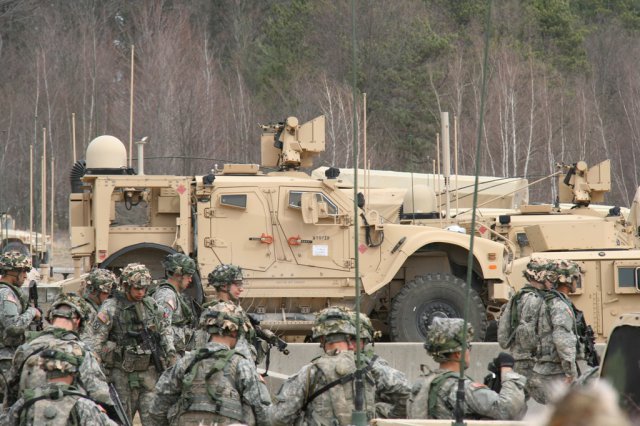
FORT DRUM, N.Y. (May 31, 2013) — As the U.S. mission in Afghanistan evolves from full spectrum combat operations to a support role in helping Afghan forces take hold of their country's security, unit commanders emphasize the need for network mobility.
Warfighter Information Network-Tactical, or WIN-T, Increment 2, the Army's improved tactical network communications backbone, was designed to fulfill such a mission.
“As we reduce our presence in Afghanistan, it is absolutely critical that we continue to understand what is happening around us, to understand the operational environment,” said Col. Sam Whitehurst, commander of the 3rd Brigade Combat Team, 10th Mountain Division (Light Infantry), during a recent training exercise at Fort Drum, in preparation for his unit's possible deployment to Afghanistan. “My ability to take the information that I am hearing from my team leaders, and then share it with all of our Afghan partners, so they can correspondingly help confirm or deny that information and share what they are seeing, is one of the most critical elements as we go forward into Afghanistan over the next year.”
The mobile WIN-T Increment 2 network is being fielded as part of the Army's new capability sets. Capability Set 13, or CS 13, is the first of these fully-integrated fielding efforts, which are scalable and tailorable in design to support the changing requirements of current and future missions. CS 13 includes radios, satellite systems, software applications, smartphone-like devices and other network components that provide connectivity from the stationary command post to the commander on-the-move to the dismounted Soldier. WIN-T Increment 2 is the tactical communications network backbone that binds the capability sets together.
Every dying Empire has its truth telling prophet and America had its own with Chalmers Johnson. Johnson correctly compared the decay of the American empire, with its well over 600 overseas military bases, with the fall of the Roman Empire whereas the Senate becomes a wealthy corporate club and irrelevant compared to the ruling Military Industrial Congressional Complex
Chalmers Johnson was a truth teller and prophet in a political environment where few would stand up to the interests and secrecy of the Pentagon and the intelligence community ~ and since his passing in November of 2010, many of his prophetic fears have been realized in the Obama administration.
Johnson, author of Blowback, Sorrows of Empire and Nemesis,The Last Days of the American Republic, talks in this video interview about the similarities in the decline of the Roman and Soviet empires and the signs that the U.S. empire is exhibiting the very same symptoms ~ overextension, corruption and the inability to reform. (Watch at least the first 20 minutes and also the very end where he predicts an economic collapse)
Johnson’ s main points were; The United States is treading the same three steps as the former Soviet Union;
Inability to deal with corporate corruption.
Imperial over-stretch is leading to fiscal insolvency ( 600 plus bases throughout the world )
Inability to reform, thus accelerating the inevitable fall.
The brutal murder of an off-duty British soldier in broad daylight in the southeast London district of Woolwich raises new questions about the British government's national security strategy, at home and abroad. Officials have highlighted the danger of “self-radicalizing” cells inspired by Internet extremism, but this ignores overwhelming evidence that major UK terror plots have been incubated by the banned al-Qaeda-linked group formerly known as Al Muhajiroun.
Equally, it is no surprise that the attackers had been seen earlier on the radar of MI5, the UK's domestic counter-intelligence and security agency. While Al Muhajiroun's emir, Syrian cleric Omar Bakri Mohammed – currently self-exiled to Tripoli in northern Lebanon – has previously claimed “public immunity” due to murky connections with British intelligence, compelling evidence suggests such connections might still be operational in the context of foreign policy imperatives linked to oil and gas interests.
I strongly agree with [former US CIA Director] R. James Woolsey and [a former CIA analyst and Executive Director of the Task Force on National and Homeland Security, an Advisory Board to Congress] Dr. Peter Vincent Pry that the electromagnetic pulse (EMP) threat to the U.S. demands our strongest attention (“How North Korea Could Cripple the U.S.,” op-ed, May 21).
Could anything have checked America’s mad rush to war in Iraq in 2003, driven as it was by a cabal of neoconmen intent on cynically manipulating the trauma of 9-11 to achieve a different agenda?
Perhaps (1) if Colin Powell had the courage to resign on principle rather than allowing himself to be pressured into giving his disgraceful imitation of Adlai Stevenson's performance at the UN during the Cuban Missile Crisis, or almost certainly (2) if the UK Prime Minister Tony Blair sided with France, Germany, and Russia and the majority of Europeans in opposing the Iraq war. Of course, no one will ever know, but Powell enjoyed immense moral stature at the time, and without his cheerleading, the veneer of Bush’s and Cheney’s moral authority would certainly have been far weaker. The case of Blair, aka Bush’s poodle, is more complex: If the UK sided with Europe, Bush would have been isolated and the march to war very likely might well have been still born.
But a large number, perhaps a majority, of the English people do not see themselves as being Europeans. And the English elites, like Blair, trust instead in using the UK’s “special relationship” with the US to punch above their weight in world affairs. Viewed narrowly, the UK-US special relationship has roots in WWII, but the UK’s proud sense of separateness from Europe reaches back at least a 1000 years in history and is grounded in its island geography. The English have never resolved the question: Are they part of Europe? The UK’s tepid membership in the EU illustrates the point.
The below op-ed by Immanuel Wallerstein argues that European question is again coming to forefront of British politics and pressure to leave the EU is mounting. Moreover, the question is being complicated by the growing regional tensions in Northern Ireland, Wales, and especially Scotland.