Peter Drucker, the founder of the discipline of modern management, asserted that making knowledge workers productive was the key to economic survival for the developed economies. Though knowledge workers use their minds to make a living, are they ever taught to use their minds more effectively? This webinar discusses my decade-old mindfulness program at the Drucker School of Management designed to teach managers to manage themselves.
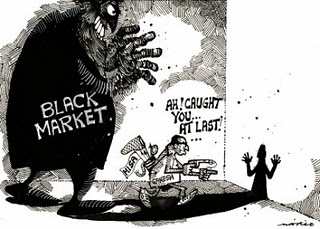
Forget China: the $10 trillion global black market is the world's fastest growing economy — and its future.
Robert Neuwirth
Foreign Policy, 28 October 2011
It wasn't a matter of technology. David is not an inventor or an engineer, and his insights into his country's electrical problems had nothing to do with fancy photovoltaics or turbines to harness the harmattan or any other alternative sources of energy. Instead, 7,000 miles from home, using a language he could hardly speak, he did what traders have always done: made a deal. He contracted with a Chinese firm near Guangzhou to produce small diesel-powered generators under his uncle's brand name, Aakoo, and shipped them home to Nigeria, where power is often scarce. David's deal, struck four years ago, was not massive — but it made a solid profit and put him on a strong footing for success as a transnational merchant. Like almost all the transactions between Nigerian traders and Chinese manufacturers, it was also sub rosa: under the radar, outside of the view or control of government, part of the unheralded alternative economic universe of System D.
Phi Beta Iota: The old estimate was $2 trillion a year, of which half went to bribes paid to government officials. To put this in a larger context, governments have failed to adapt and failed to represent the bulk of their populations — they have been captured at the upper levels by lobbyists, “experts” and the elite 1%, and at lower levels by common one to one bribes. Hence, in the new economy, the 99% are routing around government, and creating their own hybrid forms of governance, generally driven by information and reality instead of ideology and greed. It can be said that the illegal economy is more honest than the “legalized crime” economy.
Below is a brilliant synopsis of America's defeat in Iraq. The author Patrick Seale, whom I had the pleasure of meeting last summer, is one of the leading authorities on the Middle East. Seale lays out the costs incurred and the unintended grand-strategic consequences of the US invasion of Iraq, and he reminds of us of its fraudulent origins. Contrast Seale's analysis with the self-serving pap peddled by Fredrick Kagan et al. in Weekly Standard that caused Col. XXX to do his atomic puke (distributed in my previous blaster).
The most disturbing point made by Seale, at least to me, is his observation that the people and politics of the United States show no signs of wanting to determine who is responsible for the Iraq catastrophe or to hold them to account. Without accountability and punitive as well as corrective action, the very idea of a representative republic becomes a sham, and the Constitution becomes a sick joke. Given the escalating danger in the Middle East, not mention our dangerous economic times, the absence of any self-correcting mechanism in the political OODA loops of people or government in the United States is a scary thing indeed, not only to the United States but also for the entire world — think of US politics as no-nothingism with nukes.
Can America chance course? Nothing is less likely. It is widely predicted that if the Republican Mitt Romney wins the White House, the pro-Israeli neocons will be back in power in Washington. Their target this time will be Iran.
Phi Beta Iota: A superb article that names names. It is very likely that Occupy Wall Street is going to blow its one chance to demand an Electoral Reform Act of 2012, and that the next “president” will again be a puppet to Israel, extremist influences, and Wall Street. Romney is a suit – a corrupt suit. Obama is the same. The US Government no longer represents the US public, but Occupy Wall Street is so busy doing intense kum-ba-ya they are ignoring the one thing everyone can agree on: it's time to dump the two-party tyranny in the toilet and reset US democracy with open ballot access and the other nine elements of the Electoral Reform Act of 2012.
Stanley Kober is a research fellow in foreign policy studies at the Cato Institute.
Executive Summary
America's intelligence agencies should devote their resources to the most serious security threats, principally international terrorism and adverse political trends. Instead, the Clinton administration has diverted the intelligence community to economic espionage.
The economic espionage mission is based on faulty assumptions and damages relations with governments whose cooperation we may need in dealing with significant security threats. Indeed, Washington's use of the Central Intelligence Agency for economic spying has already led to ugly incidents with Japan and France. The focus on commercial espionage also creates a myopic perspective from which developments such as massive corruption in another country are seen as merely economic factors, rather than harbingers of political instability.
There are more than enough bona fide security problems in the world to command the full attention of the intelligence community. The most serious is international terrorism. Penetrating and neutralizing shadowy and secretive terrorist organizations will pose a daunting task for the intelligence agencies. There are also disturbing political trends that warrant close scrutiny, including the continuing turbulence in Russia; China's emergence as an assertive, if not abrasive, great power; and early signs of a Beijing-Moscow axis motivated by hostility toward the United States.
It is essential, not only that the intelligence agencies focus their efforts on such actual or potential security problems, but that policymakers listen to the agencies' assessments, especially when those assessments raise questions about the wisdom of current U.S. policy. Unfortunately, the Clinton administration all too often seems indifferent if not hostile to such valuable early warnings.
Phi Beta Iota: There are some gems in here, for example, the US policy of demanding weak encryption in commerce so NSA does not have to work hard, only stupid. NSA is a monstrous tragic comedy, an expensive albatross that corrupts US intelligence in the extreme. The essay is wrong-headed on other point, not least of which is the raw fact that what our politicians and appointed policy people do every day in the way of treason against the public interest is THE greatest threat to the Constitution and the Republic.
Occupy Wall Street is an exceptional sociocultural hack. Grabbing eyes & hearts, they’re making it OK to protest again in America. After 911 the normative pressure around dissent & protest shifted, making it very un-American to disagree with and or show criticism of The U S of A. Occupy is quickly becoming view-fodder for the mainstream media. Spin it any way you like but OWS is grabbing the spotlight globally. Expect the election cycle to raise it as a common talking point – a good reason Occupy can safely find heat indoors for the Winter, come back swinging in Spring. This normative shift allows the many many folks who aren’t yet willing or simply can’t come sleep in the streets to be active & connected sympathizers helping spread the word, defend the narrative, and get downtown at 2am on a Thursday to stand against an expected police action. Social media invites participation at all scales.
As the Obama administration winds down its troop surge in Afghanistan, it’s adopted a new political strategy for ending the war. And that new strategy represents a tacit concession that the best the surge could accomplish was rescuing Afghanistan from from the brink of total failure.
What was the surge for, anyway? In one sense, as explained by President Obama, it was merely designed to stop the Afghanistan war from deteriorating. But Obama’s generals promised that it would do more — that it would whup the Taliban into suing for peace. And in the broadest sense of all, it would contribute to the Obama team’s ultimate objective for the region: to “disrupt, dismantle and defeat” al-Qaida.
Judged in the narrowest sense, then, the surge worked. Afghanistan is no longer spiraling into greater violence. But it’s failed to accomplish anything beyond that.
Phi Beta Iota: We've learned to expect a complete lack of integrity in our political, operational, and intelligence leaders. This is so “deja vu” of Viet-Nam. There is no accountability for failure in the US Government.
Britain’s Metropolitan Police have purchased a system which can identify, track and possibly shut off every cell phone in a 10-square kilometer area. The Orwellian system has raised concerns over potential abuses and violations of privacy.
The system, produced by the company Datong, uses a special transmitter, which emits a signal masquerading that of a regular mobile network, reports The Guardian newspaper. It forces all phones in the target area to release their identification codes for both devices and SIM cards they use. It can also track those mobile phones in real time.
Other equipment the company produces can intercept communications, including text messages, and force the devices to shut off from the network, presumably to prevent the use of mobile phones to trigger bombs.
In addition to the Met Police, Datong lists among its clients organizations like the UK Ministry of Defence, the US Secret Service and Special Operations Command, as well as security and defense forces in the Middle Eastern countries.
Human rights activists believe the system capable of blanket and indiscriminate surveillance violates privacy.
“It raises a number of serious civil liberties concerns and clarification is urgently needed on when and where this technology has been deployed, and what data has been gathered,” Nick Pickles, director of privacy and civil liberties campaign group Big Brother Watch said. “Such invasive surveillance must be tightly regulated, authorized at the highest level and only used in the most serious of investigations. It should be absolutely clear that only data directly relating to targets of investigations is monitored or stored.”
Lawyer Jonathan Lennon, who specializes in cases involving covert intelligence and Regulation of Investigatory Powers Act (RIPA), which mandates how the authorities can intercept private communication, says the system may not comply with the legislation.
“There needs to be clarification on whether interception of multiple people's communications – when you can't even necessarily identify who the people are – is complaint with the act,” he said. “It may be another case of the technology racing ahead of the legislation. Because if this technology now allows multiple tracking and intercept to take place at the same time, I would have thought that was not what parliament had in mind when it drafted RIPA.”
Neither the Metropolitan Police nor Datong commented to the newspaper on how the system classified as “Listed X” is used and whether or not it can be deployed during large protests and demonstrations or riots.
Phi Beta Iota: Autonomous Internet is clearly needed, but so also must Occupy Wall Street learn how to pre-plan and execute “dead hand” procedures when digital communications are shut down.