In my obligatory post about Wikileaks as the story du jour, I point to the great set of questions Dan Gillmor has posted in his column at Salon. These are especially lucid. I like especially Dan’s point about the character of the communications that were leaked, that many of the messages are gossip. Journalists are dutifully reporting “facts” gleaned from the leaked material without necessarily digging deeper, verifying and analyzing. Of course, they don’t have time – the information environment moves too quickly, he who hesitates is lost, accuracy be damned.
Then again, journalism is so often about facts, not truth. Facts are always suspect, personal interpretations are often incorrect, memories are often wildly inaccurate. History is, no doubt, filled with wrong facts and bad interpretations that, regardless, are accepted as somehow “true.”
The high-minded interpretation of this and other leaks, that people need to know what is being said and done by their representatives in government, especially in a “democratic society,” is worth examining. We’re not really a democracy; government by rule or consensus of a majority of the people doesn’t scale, and it would be difficult for the average citizen to commit the time required to be conversant in depth with all the issues that a complex government must consider.
Do we benefit by sharing more facts with more people? (Dan notes that 3 million or so in government have the clearance to read most of the documents leaked – this seems like a lot of people to be keeping secrets… is the “secret” designation really all that meaningful, in this case?) But to my question – I think there’s a benefit in knowing more about government operations, but I’m less clear that this sort of leak increases knowledge vs. noise.
I’m certain about one thing: we shouldn’t assume that the leaked documents alone reveal secrets that are accurate and true. They’re just more pieces of a very complex puzzle.
From Skilluminati Research [quoting another person]:
Last night I watched Human Resources and I was impressed enough to pass it along. It's a documentary about Social Control, examining the history, the philosophy and ultimately the pathology of elite power. The movie is a full two hours and you can download a copy of the video file right here
(http://www.megaupload.com/?d=FC6BGEOM).
Overall, Human Resources is rough around the edges but still overloaded with gems. Set aside some time to digest this — and take notes.
Scott Noble does an admirable job of fitting ten hours of material into two. I also appreciated the space he gives to all the people he interviews…there's a metric ton of ideas here and he lets almost all of them unfold and breathe at their own pace. The footage itself is very low-fi and some of the interviews feel like they drag on for too long, or wander in circles. Impressively, those moments are few and far between. Noble can't cover everything, but the scope of this movie alone makes it the most ambitious entry in this strange genre so far, more complete than The Century of the Self and less hysterical than the Zeitgeist franchise.
The film really clicks in the final act, when the focus turns toward the CIA's MK experimentation. I was surprised and grateful to find an extended interview with Dr. Colin Ross, who takes pains to note that “CIA MK” is actually a misleading generalization, obscuring a larger network of projects involving the Army, Naval Intelligence and several other, more opaque agencies. There's a lot of rewindable moments here, tread slowly.
When the perfect documentary about Social Control finally arrives, I'm guessing it will be built on this precise blueprint. This film might be
full of cosmetic flaws, but his argument is (mostly) methodical and devastating. A toast to Scott Noble.
As we all observe with stunning detachment the symbiotic continuance of Bush-Obama Democratic-Republican support to the Wall Street looting of America led by Goldman Sachs, whose executives continue to “own” the Department of the Treasury and the Bank of New York (Federal Reserve), I believe it helpful to itemize some legitimate grievances that could inspire State by State nullification of federal mandates and regulations, and perhaps a few secessions, with Cascadia, Vermont, Hawaii, and Alaska being well positioned to abandon a compact that no longer serves the United STATES of America, nor We the People.
I am indebted to Kirkpatrick Sale, author of Human Scale and founder of the Middlebury Institute, for teaching me about the urgency and relevance of the secessionist movements, and the detailed reflections that they have published, reflections that I point to here for the common good.
Core Point: Liberty can only survive if political power is returned from the banks and corporations that have corrupted the federal government, to local communities and States. The American Empire is no longer a nation or a republic, but has become a tyrant aggressive abroad and despotic at home.
The Burlington Declaration of 2006 (5 points)
Core Point: Any political entity has the right to separate itself from a larger body of which it is a part and peaceably to establish its independence as a free and legitimate state in the eyes of the world. Governments are instituted among peoples, deriving their just powers power from the consent of the governed, and whenever any form of government becomes destructive of the legitimate goals of life, liberty, prosperity, and self-determination, it is the right of the people in democratic fashion to aleter or abolish it, and to institute new government in such form as to them shall seem most likely to effect their safety and happiness.
The Logic of Secession: Three Tines to a Trident (A Manifesto by Kirkpatrick Sale)
Core Point: In the face of a rigged game in which two parties have conspired to corrupt, manipulate, and generally monopolize power, third party politics will not work. Only secession will allow for the emergence of a restored Republic once the federal government and its two-party tyranny are made irrelevant (and starved of revenue).
In Defense of Vermont's Secession from the Union (A Manifesto by Keith Brunner)
Core Point: Vermont was its own country before it joined the Union, and nothing in the Constitution of the United STATES of America precludes secession from this voluntary compact [Lincoln violated the Constitution in multiple ways, most Americans simply have not learned the truth of the matter]. The American Empire is economically, politically, cultural, and especially environmentally unsustainable, and far from fixing itself, is just getting worse. When a government of people who have no moral authority are in the possession of enough nuclear weapons to destroy the world many times over, in the position to dominate the global economy for their own interests, and continually and foolishly pace the needs of the “economic system” above the needs of the natural world, the time for action cannot be put off any longer.
In sound support of the above, I have itemized a list of the behaviors and conditions that have inspired anti-Americanism. Each is, without exception, a betrayal of the public trust and grounds for abolishing the present political criminal enterprise that has hijacked the federal government and the public treasury on behalf of its banking and corporate masters. Each of these high crimes and misdemeanors justifying impeachment is derived from one or more works on non-fiction.
A harvest of lies and a complete lack of intelligence
Always, without exception, failure to invest in peace in the aftermath of war
Axis of Evil #1: poverty, disease, and ignorance
Axis of Evil #2: US support for 42 of 44 dictators, idiocy on the other two (Cuba, North Korea)
Scientists have partially reversed age-related degeneration in mice, an achievement that suggests a new approach for tackling similar disorders in people.
By tweaking a gene, the researchers reversed brain disease and restored the sense of smell and fertility in prematurely aged mice. Previous experiments with calorie restriction and other methods have shown that aspects of aging can be slowed. This appears to be the first time that some age-related problems in animals have actually been reversed.
Phi Beta Iota: Utterly fascinating in isolation. However, in the context of the fragmentation of knowledge and the incoherence of policy, this kind of development is frightening in the absence of a draconian move away from stove-pipe and inherently corrupt (again, integrity is about coherence, not honor per se) governance, and toward comprehensive design that nurtures all humans, all minds, all the time.
Rather than seeking to stabilize Pakistan, General David Petraeus has been irresponsibly lighting matches with his shortsighted use of Special Forces and drone strikes
by Fred Branfman
EXCERPT 1: But rather than seeking to stabilize Pakistan, General David Petraeus has, incredibly, been irresponsibly lighting matches through his shortsighted and relentless effort to secure Afghanistan by using U.S. forces and drone strikes, and pressuring the Pakistani Army to attack Taliban “sanctuaries” in Pakistan’s northwest provinces. Wajid Shamsul Hasan, Pakistan's High Commissioner to London for the past 16 years and a pillar of the Establishment, has recently stated that U.S. drone and gunship attacks in Pakistan have “set the country on fire” and threatened that such acts could eventually lead to attacks on U.S. personnel in Pakistan. Petraeus has disastrously miscalculated. The more “progress” he tries to show in Afghanistan, the more he weakens the U.S. position in far more important Pakistan.
EXCERPT 2: The single most important — yet surprisingly ignored — revelation of Bob Woodward's new book, Obama's Wars, is that Petraeus and the Obama team never discussed how their strategy for attacking Taliban sanctuaries in Pakistan was weakening the Pakistani state. Woodward also makes clear that it is Petraeus, not Obama, who is driving U.S. policy in “Af-Pak.” CIA Director Leon Panetta declared that “no Democratic president can go against military advice, especially if he asked for it. So just do it. Do what they say,” according to the book. Petraeus’ power derives from America’s unconscious need for a military hero and his perceived and overblown success in Iraq. But this perception has blinded normally sensible observers to his disastrous performance in Pakistan since becoming Centcom commander in October 2008.
Tip of the Hat to John Steiner via E-Mail.
Phi Beta Iota: the author has pulled together a number of linked references and this is a useful article narrowly focused. He missed the larger picture, the fact that Obama has no strategy and no brain trust (the emphasis being on brains in touch with reality). Obama will get his Wall Street reward on his present course, but he is neither leading nor serving the nation with his ideologically passive-aggressive incoherence across the board–nothing serious on all ten threats to humanity, nothing serious on all twelve core policies, an intelligence community that is pathologically expensive and ineffective, and a Pentagon that is so out of control as to be a cancer on the public blood, treasure, and spirit. these are all good people trapped in a bad system–they desperately need a “wake-up call” and we are not sure that is achievable at this point.
November 30, 2010 – Treasures of Connecticut Libraries allows libraries to digitize, for free, up to 100 items in their collection, and then to upload their collection to a CONTENTdm site managed by the state library in Hartford. This collaboration is providing a relatively inexpensive model for libraries that want to expand awareness of their collections and demonstrate their value to a wider public.
We found this information on Library Journal in their article, “In Connecticut, a Small Model of Collaboration.” The project now has 26 participating libraries and their partners, and the searchable collection includes historical photographs, maps, postcards, videos and more.
Fascinating article, including leaks in the pipeline (banks), whistleblowers, censorship, his story, trying to stop leaks, spying, untrustful competitors, secrecy, war, field of intelligence, etc. … “our primary defense isn’t law, but technology…courage is contagious” (p.8) — JAS
Following is an excerpt from page 5 regarding moving in the direction of ethical business — JAS
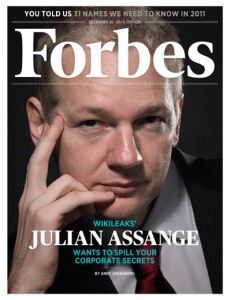
Forbes Cover Story
What do you think WikiLeaks mean for business? How do businesses need to adjust to a world where WikiLeaks exists?
WikiLeaks means it’s easier to run a good business and harder to run a bad business, and all CEOs should be encouraged by this. I think about the case in China where milk powder companies started cutting the protein in milk powder with plastics. That happened at a number of separate manufacturers.
Let’s say you want to run a good company. It’s nice to have an ethical workplace. Your employees are much less likely to screw you over if they’re not screwing other people over.
Then one company starts cutting their milk powder with melamine, and becomes more profitable. You can follow suit, or slowly go bankrupt and the one that’s cutting its milk powder will take you over. That’s the worst of all possible outcomes.
The other possibility is that the first one to cut its milk powder is exposed. Then you don’t have to cut your milk powder. There’s a threat of regulation that produces self-regulation.
It just means that it’s easier for honest CEOs to run an honest business, if the dishonest businesses are more effected negatively by leaks than honest businesses. That’s the whole idea. In the struggle between open and honest companies and dishonest and closed companies, we’re creating a tremendous reputational tax on the unethical companies.
No one wants to have their own things leaked. It pains us when we have internal leaks. But across any given industry, it is both good for the whole industry to have those leaks and it’s especially good for the good players.
But aside from the market as a whole, how should companies change their behavior understanding that leaks will increase?
Do things to encourage leaks from dishonest competitors. Be as open and honest as possible. Treat your employees well.
I think it’s extremely positive. You end up with a situation where honest companies producing quality products are more competitive than dishonest companies producing bad products. And companies that treat their employees well do better than those that treat them badly.
Would you call yourself a free market proponent?
Absolutely. I have mixed attitudes towards capitalism, but I love markets. Having lived and worked in many countries, I can see the tremendous vibrancy in, say, the Malaysian telecom sector compared to U.S. sector. In the U.S. everything is vertically integrated and sewn up, so you don’t have a free market. In Malaysia, you have a broad spectrum of players, and you can see the benefits for all as a result.
How do your leaks fit into that?
To put it simply, in order for there to be a market, there has to be information. A perfect market requires perfect information.
There’s the famous lemon example in the used car market. It’s hard for buyers to tell lemons from good cars, and sellers can’t get a good price, even when they have a good car.
By making it easier to see where the problems are inside of companies, we identify the lemons. That means there’s a better market for good companies. For a market to be free, people have to know who they’re dealing with.
You’ve developed a reputation as anti-establishment and anti-institution.
Not at all. Creating a well-run establishment is a difficult thing to do, and I’ve been in countries where institutions are in a state of collapse, so I understand the difficulty of running a company. Institutions don’t come from nowhere.
It’s not correct to put me in any one philosophical or economic camp, because I’ve learned from many. But one is American libertarianism, market libertarianism. So as far as markets are concerned I’m a libertarian, but I have enough expertise in politics and history to understand that a free market ends up as monopoly unless you force them to be free.
WikiLeaks is designed to make capitalism more free and ethical.
But in the meantime, there could be a lot of pain from these scandals, obviously.
Pain for the guilty.
Do you derive pleasure from these scandals that you expose and the companies you shame?
It’s tremendously satisfying work to see reforms being engaged in and stimulating those reforms. To see opportunists and abusers brought to account.