David Isenberg: The True Cost (Locally) of Military Strikes Against Iranian Nuclear Targets + Iran Nuclear Meta-RECAP

05 Iran, 08 Wild Cards, Corruption, IO Deeds of War, Military
David Isenberg

The Myth of “Surgical Strikes” on Iran

By David Isenberg

TIME Battleland | October 18, 2012

For all the years that the world has focused on the confrontation between Western nations and Iran, oceans of ink have been spilled over many aspects of its nuclear program — the quantity and quality of its enriched uranium, various UN Security Council resolutions, the number of Iranian centrifuges, IAEA safeguards, compliance with the Non-Proliferation Treaty, diplomatic negotiations, red lines, U.S. and Israeli attack scenarios, possible Iranian responses, the impact of a nuclear Iran, and so on.

Yet, almost nothing has been written about one critical factor: the impact on Iranian civilians, if the U.S. and/or the Israelis were to attack Iran’s nuclear facilities.

That vacuum has now been filled, thanks to a recent lengthy report — The Ayatollah’s Nuclear Gamble: The Human Cost of Military Strikes Against Iran’s Nuclear Facilities. It was authored by Khosrow Semnani, an Iranian-American industrialist and philanthropist with extensive experience in the industrial management of nuclear waste and chemicals.

The University of Utah’s Hinckley Institute of Politics and Omid for Iran, a nonprofit organization based in Salt Lake City, Utah, published the assessment. Author Semnani has provided support for conferences and educational initiatives in the United States.

The report examined various military options against different sites but regardless – perhaps it shouldn’t come as a surprise — the news was horrifyingly bad for Iraqi civilians. Iran insists its nuclear-development efforts are for peaceful purposes, and that it has no desire to build atomic weapons.


Continue reading “David Isenberg: The True Cost (Locally) of Military Strikes Against Iranian Nuclear Targets + Iran Nuclear Meta-RECAP”

Smart Planet: Google Data Center Interior

Commerce

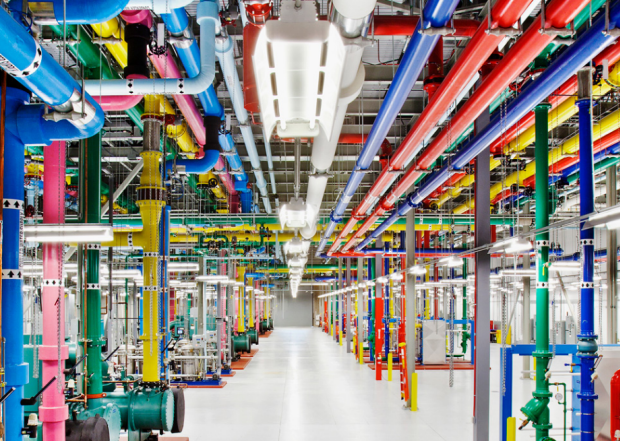
An inside look at Google’s data centers

By Kirsten Korosec | October 17, 2012

Google has long kept details about its data centers–everything from the number of servers and design of the building to its energy use and –from the prying eyes of the public. Very few people, with the exception of its critical data center employees, have actually stepped foot into one of these facilities.

For the first time, Google has lifted the veil on its data centers to give folks a peek inside its facilities via a “virtual visit.” Google’s new site Where the Internet Lives provides an inside view of its data centers, including dozens of amazingly cool photos from Connie Zhou (pictured here) as well as information about the technology in these facilities and how the company protects your data.

Click on Image to Enlarge

Google began sharing some information about its data centers in the past year, including its best practices and some energy consumption information. This latest sharing session goes far beyond its previous efforts with its photos, interviews, a video tour and even its Google street view feature, which allows user to explore the company’s Lenoir, North Carolina data center.

Google went one step further and let Steven Levy, a reporter from Wired behind the curtain.

All of this transparency matters as data centers, racing to keep up with our emails, video and Internet searches, gobble up an increasing amount of energy and store more of our private information. Security and energy efficiency are its two big challenges. Google has combated the latter with a host of solutions, such as creating a seawater-cooled data center in Finland and more simple innovations like turning up the thermostat in its data centers.

Photos: Google/Connie Zhou

Mini-Me: Eustace Mullins Books & Videos — a Deep Look Into the Origins of Western Financial Crime & Terror with Politicians as the Best of the Servant Class

Collective Intelligence, Commerce, Commercial Intelligence, Corruption, Cultural Intelligence
Who? Mini-Me?

Huh?

First read Wikipedia / Eustace Mullins

EXTRACT:

A central theme of Mullins' book is that the Federal Reserve allows bankers to monetize debt, creating it out of nothing by book entry, and thus they have enormous leverage over everyone else. Near the end of the book, he said of the Federal Reserve:

The Federal Reserve System is not Federal; it has no reserves; and it is not a system, but rather, a criminal syndicate. It is the product of criminal syndicalist activity of an international consortium of dynastic families comprising what the author terms “The World Order”. The Federal Reserve system is a central bank operating in the United States. Although the student will find no such definition of a central bank in the textbooks of any university, the author has defined a central bank as follows: It is the dominant financial power of the country which harbors it. It is entirely private-owned, although it seeks to give the appearance of a governmental institution. It has the right to print and issue money, the traditional prerogative of monarchs. It is set up to provide financing for wars. It functions as a money monopoly having total power over all the money and credit of the people.

Then watch this YouTube (58:19) Eustace Mullins – The New World Order (Full Length)

Eustace Mullins (1923-2010), America's foremost bank examiner, appears for the first time in a full studio production interview with “The Mouth of the South,” Bobby Lee. Mullins, a renowned author, lecturer and scholar reveals over 50 years of intensive research in an incredible true story and documentation of the conspiracy against the patriotic, hard working families of middle America.

Eustace Mullins can rightly be called not only America's premier populist historian, but he is a titanic figure on the landscape of American and world history, as a consequence of his monumental contributions to the arena of political, economic and philosophical discussion. Debt, Taxation, Inflation, Deflation, Bankruptcy; in the New World Order, there's nothing new under the sun.

More Links (Books, Videos, Online)

Continue reading “Mini-Me: Eustace Mullins Books & Videos — a Deep Look Into the Origins of Western Financial Crime & Terror with Politicians as the Best of the Servant Class”

NIGHTWATCH: Switzerland Prepares for Refugees & Civil Unrest

01 Poverty, 05 Civil War, 07 Other Atrocities, 10 Transnational Crime, Civil Society, Corruption, Government, Ineptitude, Law Enforcement, Military, Policies

Switzerland: In September, Swiss authorities launched a military exercise to test its preparedness to deal with internal civil unrest as well as refugees from the Eurozone crisis, according to international media.

Comment: The Swiss are not prone to overreact to threats. They do not spend defense funds in order to be prepared for potential threats. They prepare for real threats.

The exercise is significant because it means the Swiss have determined that internal civil unrest coupled with refugees from Eurozone countries represent real threats for which their security forces must be prepared. The Swiss understand the meaning and significance of early warning and know about indicators.

NIGHTWATCH KGS Home

Continue reading “NIGHTWATCH: Switzerland Prepares for Refugees & Civil Unrest”

Yoda: Patricia Martin on the Future of Libraries in the Digital Era

Advanced Cyber/IO, Civil Society
Got Crowd? BE the Force!

The Future of Libraries in a Digital Culture

Patricia Martin

Huffington Post, 11 October 2012

EXTRACTS:

Until recently, public libraries had little reason to innovate. Then Google arrived. More disruptive technologies followed, causing an identity crisis for librarians. Now the profession is re-thinking its purpose — a quest that lured a gathering of 350 eager librarians to Telluride, Colorado recently for the R-Squared (Risk and Reward) Conference.

. . . . . . . .

Americans need help navigating a way forward — whether it's to find work or explore a new career path. It's no wonder people are rediscovering their local libraries as a place to begin. That's why libraries need to innovate. Otherwise, they risk becoming an object of nostalgia — the emotional step right before irrelevance. Deadly. Research shows that when taxpayers stop expecting public institutions to transform, they invite entrenchment. Consider the battle to reform public education in America. The same hollowing-out could happen to America's public libraries at a time when we need them most.

There's hope. It's heartening to think that there are more public libraries than McDonald's restaurants in America.

Imagine the impact of their re-animation.

Read full article.

noble gold