What’s the number one reason we riot? The plausible, justifiable motivations of trampled-upon humanfolk to fight back are many—poverty, oppression, disenfranchisement, etc—but the big one is more primal than any of the above. It’s hunger, plain and simple. If there’s a single factor that reliably sparks social unrest, it’s food becoming too scarce or too expensive. So argues a group of complex systems theorists in Cambridge, and it makes sense.
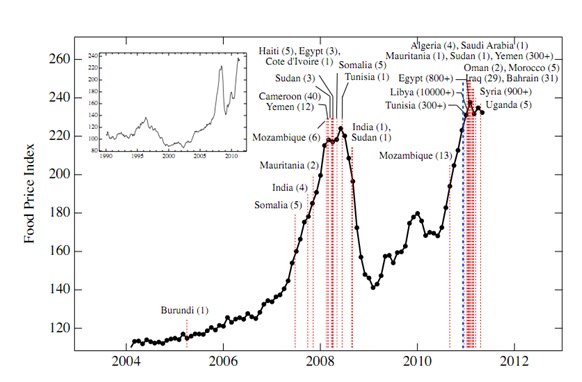
In a 2011 paper, researchers at the Complex Systems Institute unveiled a model that accurately explained why the waves of unrest that swept the world in 2008 and 2011 crashed when they did. The number one determinant was soaring food prices. Their model identified a precise threshold for global food prices that, if breached, would lead to worldwide unrest.
Click on Image to Enlarge
The MIT Technology Review explains how CSI’s model works: “The evidence comes from two sources. The first is data gathered by the United Nations that plots the price of food against time, the so-called food price index of the Food and Agriculture Organisation of the UN. The second is the date of riots around the world, whatever their cause.” Plot the data, and it looks like this:
Pretty simple. Black dots are the food prices, red lines are the riots. In other words, whenever the UN’s food price index, which measures the monthly change in the price of a basket of food commodities, climbs above 210, the conditions ripen for social unrest around the world. CSI doesn’t claim that any breach of 210 immediately leads to riots, obviously; just that the probability that riots will erupt grows much greater. For billions of people around the world, food comprises up to 80% of routine expenses (for rich-world people like you and I, it’s like 15%). When prices jump, people can’t afford anything else; or even food itself. And if you can’t eat—or worse, your family can’t eat—you fight.
I recently finished reading Roger Thompson's Lessons Not Learned: The U.S. Navy's Status Quo Culture (Naval Institute Press, 2007). I urge those who think we enjoy now and will enjoy in the future some sort of superiority on the seas to read this book. You will find tidbits that you contest, but you will also find overwhelming evidence that the biggest, most expensive navy in the world has hollowed itself out thanks to its own rampant hubris and careerism. This has been the case for a long time, and there is nothing on the horizon to indicate any real improvement.
I encountered exactly the kind of behavior Thompson describes when I worked at GAO. I was assigned to look at the Navy's operational testing of its vaunted Aegis air defense system on CG-47-class cruisers. I found that in cooperative, even fudged testing (as described by inaccurate and incomplete test reports) Aegis performed at a mediocre level against the easier targets and extremely poorly against the most stressful targets–such as the extremely low, extremely fast anti-ship cruise missiles that today populate the inventories of Iran, North Korea, China, Syria and others. The Navy was incensed, convened a kangaroo-court hearing at the Seapower Subcommittee of the House Armed Services Committee and declared the problem solved because it won a superficial public relations battle over GAO with the porkers and Navy boosters who densely populated the subcommittee. The Navy proved itself much more adept at PR struggles than it has in anti-mine warfare in real combat since World War II and in anti-submarine exercises over the same period, as Thompson explains in painful detail.
Pierre Sprey wrote a review of Roger Thompson's excellent book; it follows:
Lessons Not Learned: An Appreciation
For a comprehensive, thoughtful and independent-minded critique of today’s U.S. Navy, I know of no work better than Professor Roger Thompson’s Lessons Not Learned: The U.S. Navy’s Status Quo Culture. I recommend the book as essential reading for anyone interested in or professionally involved in naval matters, whether officer, civilian analyst, contemporary historian, defense journalist or navy buff. It is of particular value and importance to those who are courageous enough and patriotic enough to be committed to military reform. The military reform literature is well endowed with strong critiques of American air and ground forces, but is relatively weak in insightful writings on the Navy’s ineffectiveness and waste of men and money. Thompson’s book fills that gap.
Lessons Not Learned is particularly hard-hitting in documenting the evidence for the U.S. Navy’s ongoing and shocking vulnerability to diesel subs and mines. As he makes clear, both weapons systems are nearly ubiquitous in the maritime Third World and the presence of either turns U.S. control of the seas into a delusion. Equally valuable are Prof. Thompson’s blunt comparisons of the strengths and weaknesses of American naval forces vis a vis the strengths of smaller allied forces. Unsurprisingly, these disparities in combat readiness, tactical skills and exercise outcomes prove to be greatest in anti-mine warfare and anti-submarine warfare—though sadly declining American aerial tactical skills are certainly not glossed over.
But Thompson’s most valuable contribution of all is the thread that runs throughout the book: the most crucial weakness of the U.S. Navy is not materiel or money. It is, plain and simply, the closed-mindedness, hubris and rampant careerism of the Navy’s leadership, greatly magnified by a mindless up-or-out personnel system. That leads to an enlisted force with inadequate skills, morale and training plus an officer corps more focused on promotion and plush retirement jobs than on building a navy competent to win wars.
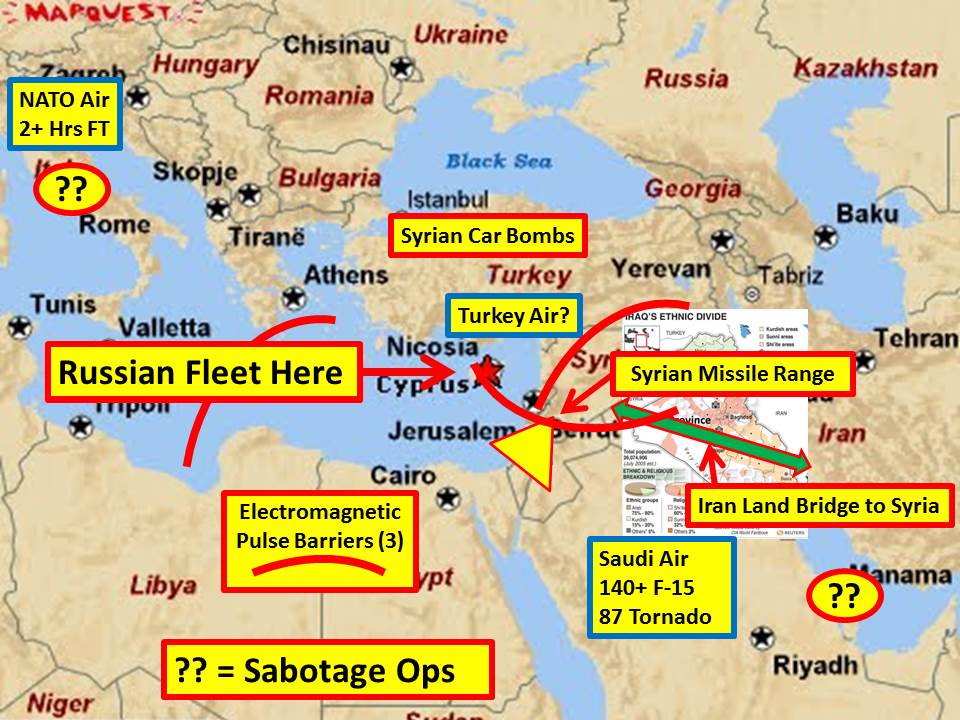
Syria- Russia-European Union: The military-technical cooperation contracts between Russia and Syria have not undergone changes, said Syrian Ambassador to Russia Riyad Haddad. “All agreements signed between Syria and Russia are being implemented without any changes made,” he told the press on Monday.
Haddad was commenting on reports claiming that Russia has frozen S-300 missile systems' shipments to Syria at Israel's request.
Russian Deputy Foreign Minister Sergei Ryabkov said on Tuesday, “We consider these supplies a stabilizing factor and believe such steps will deter some hotheads from considering scenarios that would turn the conflict international with the involvement of outside forces.”
Comment: The timing of the latest Syrian and Russian statements corresponds to the European Union decision to discontinue the ban on weapons aid for the Syrian opposition.
The Russian public statements are not aimed at deterring Israeli attacks, though the Russians said those attacks should halt. According to Israeli press, Israeli experts judge it will take at least a year for the system to be installed; personnel trained and for it to become operational. The new air defense installations will be added to the target lists for the Israeli Air Force.
The Russian statements are aimed at the US and NATO. Various Russian leaders have declared Russia will not allow Syria to go the path of Libya, in which NATO intervention began with a no-fly zone. The announcement is a public statement of commitment of support for Syria that will make it difficult for NATO members to generate the domestic political backing to establish a no-fly zone over Syria. The long war in Afghanistan has made the NATO electorates weary of fighting.
This Russian announcement also reduces the prospects for substantive progress at a US-Russian brokered negotiation sometime in June. No basis for trust or compromise exists among the parties. Russia and Syria can present a united position, but the Syrian opposition entities cannot. US and European goals are not congruent with each other and not with Saudi and Qatari interests.
The US intention apparently is to start a negotiating process, in the expectation that process will lead to substance. After the European Union vote, which in essence permits European states to provide weapons to the Syrian opposition entities, the backdrop of any discussion will be the EU action whose intended effect would be to escalate the fighting. That would seem to remove from the agenda any serious discussion of ways to stop the killing.
[This interview openly discusses criminal activities from the perspective of an admitted criminal. You may find this content distressing, even offensive, but what is described in this interview is real. We know from personal experience is that these activities are happening on websites everywhere, everyday, and perhaps even on your websites. WhiteHat Security brings this information to light for the sole purpose of assisting those who want to protect themselves on their online business.]
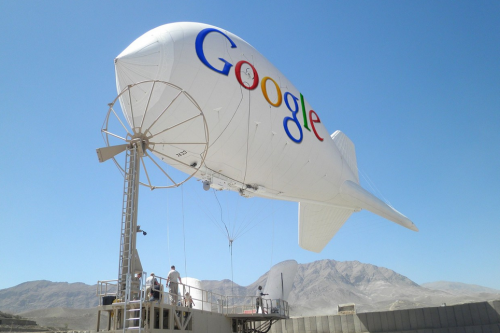
A blimp is a floating airship that does not have any internal supporting framework or keel. The airship is typically filled with helium and is navigated using steerable fans. Google is apparently planning to launch a fleet of Blimps to extend Internet/wifi access across Africa and Asia. Some believe that “these high-flying networks would spend their days floating over areas outside of major cities where Internet access is either scarce or simply nonexistent.” Small-scale prototypes are reportedly being piloted in South Africa “where a base station is broadcasting signals to wireless access boxes in high schools over several kilometres.” The US military has been using similar technology for years.
Google Blimp
Google notes that the technology is “well-suited to provide low cost connectivity to rural communities with poor telecommunications infrastructure, and for expanding coverage of wireless broadband in densely populated urban areas.” Might Google Blimps also be used by Google’s Crisis Response Team in the future? Indeed, Google Blimps could be used to provide Internet access to disaster-affected communities. The blimps could also be used to capture very high-resolution aerial imagery for damage assessment purposes. Simply adding a digital camera to said blimps would do the trick. In fact, they could simply take the fourth-generation cameras used for Google Street View and mount them on the blimps to create Google Sky View. As always, however, these innovations are fraught with privacy and data protection issues. Also, the use of UAVs and balloons for disaster response has been discussed for years already.
Dave McGowan has written the best thing I've seen on the actors at the Boston bombing. I challenge anyone who can claim an IQ above 80 to read this and still believe that this was a genuine attack with real victims, real blood, real terrorists. McGowan's not only a great researcher and writer, he manages to be laugh-out-loud funny at the same time. Of course, given the obvious absurdity of the stories we've been told, humor comes pretty naturally in this situation. There are 6 parts, with lots of photos, all linked on his home page. This is not to be missed!
. . . . . . . .
I need to add that Dave clearly changes his views as he progresses through the six part series. In the first part, he writes:
I need to be very clear here in stating that I am not arguing that no one was injured in the attack and that there was no real suffering. That undoubtedly was not the case.
but by the 6th part, having spent many days wading through photos and news reports, he no longer believes that there are any real victims. He writes:
…these are people who have sold their souls and sold out their country. They are beneath contempt and nothing I have to say about them should really offend anyone.
(Part 1) Debunks major reported injuries with photos of alleged victims, shows how shrapnel allegedly shredded clothes without drawing blood.
How sophisticated traders exploit an obscure USDA rule change to get rich, fleece farmers, and drive up food prices
EXTRACT:
Michael Greenberger, a law professor at the University of Maryland and former director of the division of Trading and Markets at the Commodities Futures Trading Commission, says the change further empowers traders to treat grain markets like “casinos,” and in the long-run the public pays. “It creates biases in markets that drive prices up,” he said. “The average consumer is completely undermined in this entire process.”

 We Are Now One Year Away From Global Riots, Complex Systems Theorists Say