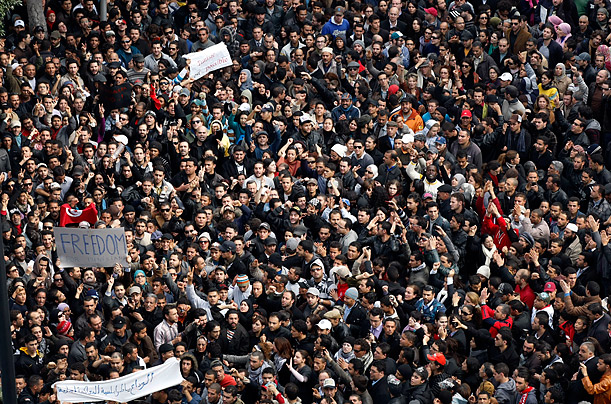
We, the unemployed, the underpaid, the subcontracted, the precarious, the young … demand a change towards a future with dignity. We are fed up of reforms, of being laid off, of the banks which have caused the crisis hardening our mortgages or taking away our houses, of laws limiting our freedom in the interest of the powerful. We blame the political and economic powers of our sad situation and we call for a turn.’
The “common good” is the collection of what no one person owns, but which all people depend upon for life. A simple example is the air we breathe. No one owns it but we would all perish without it. Now the “common good” is being threatened by many different human activities and policies. Some of these include:
The evolving climate crisis that will affect us all. Just a shift of a few degrees in the global temperature could deliver a fatal blow to the “common good” by changing what is now a benign climate into a hostile one that can no longer sustain “life as we know it”.
The periodic business cycle causes many dislocations that are unnecessary but unavoidable given the current banking system.
Less commonly known and generally off the table is the currency and credit formation function and the ramifications of this prime control system.
The implications for all other functions are very poorly understood, and will be a major consideration of the TENETS.
This compound crisis must be dealt with as if it were a life and death matter.
This document provides some guidance for how to enable humanity to act responsibly in a coordinated fashion without deprivation of anyone’s rights. An attempt is made to recognize the sources of control and motivation that exist and how to enable effective response as if our lives depended on it.
In early January the BBC reported that Mohammad Bouazazi, a Tunisian college graduate who illegally sold fruits and vegetables in Sidi Bouzid, had died from his self-inflicted burns. He had set himself on fire by dousing his body with petrol when police confiscated his produce. He didn’t have the proper permits. Public protest had been rare in Tunisia before. When he died, the BBC reported that “a crowd estimated at 5,000 took part in his funeral.” The crowd chanted the same message together, out loud: “Farewell, Mohammad, we will avenge you. We weep for you today, we will make those who caused your death weep.”
Safety copy below the line–note ending on Bush-Obama “crowd control” plans.
Hi All: This is well worth paying attention to, checking out and even sampling. Do see the great endorsements below. Learn more about my old friend and colleague, Jeff Golden, the creator of this remarkable new program. Immense Possibilities is also interactive. As you'll see from the website, Jeff is looking for our input and collaboration. Congratulations to Jeff for creating a new public forum for what's working and for those making a true difference in these challenging times and are offering solutions of great benefit, who so often don¹t make it into mainstream news. May this show become part of the “:new main stream”.
PLEASE SPREAD THE WORD.
Cheers, John
From: Jeff Golden
Dear Friends:
Suppose you found a public television program that brought you stunningly creative people who
¨ Craft brilliant projects that strengthen their communities for hard times to come
¨ Unite people across political and philosophical divides
¨ Connect Millenials, Gen X- and Y-ers, Baby Boomers and Elders in compelling ways
And suppose it was right there on your computer or television every Tuesday evening. Would that be worth your time?
Tuesday evening, May 24, 7:30 pm: Frances Moore Lappé
In the right-hand corner you'll see a box to enter your email address.
If you do that, you¹ll get a message about once a week on what IP is doing. We will not, repeat not, pass your address onto anyone else for any reason. Every message we send to you will have an easy option to unsubscribe.
Hope you'll give IP a try.
IMMENSE POSSIBILITIES is a weekly public television program, followed by an interactive webcast, that pull together the work of Jeff Golden and other social inventors who share a clear set of beliefs, values and goals. If these align with your own, and you share our passion for boosting possibilities that can forge a healthier future than the one that seems likely if we don¹t change and innovate, let's work together.
As someone who spent the better part of 2008 and 2009 in Turkey, I find the attached analysis a very useful summary of Turkish developments. To be sure, I am biased. Turkey is one of my very favorite countries, I love the people, the culture, and food, and I have been fascinated by its ongoing political evolution.
Mr. Heydarian's cogent comparison of Turkey's evolution to the so-called Arab Spring* provides much food for thought, and I find it eyeopening.
* I prefer the term Arab Revolt to Arab Spring, because the forces of counterrevolution seem to be taking over, and like its predecessor in WWI, it might not lead anywhere.
Turkey is emerging as an attractive model for the new generation of democrats in the Middle East and North Africa. Turkey, as a bastion of Islamic moderation, economic dynamism, military might, and foreign policy creativity, has inspired many who envision a prosperous and free Arab world.
Phi Beta Iota: The USA is part of the autocratic corrupt system against which the Arabs are revolting. It is neither a leader nor a model–it is an obstacle for the simple reason that the US Government lacks intelligence and integrity, and therefore has nothing to offer in the way of non-zero strategic analytics acceptable to Brazil, China, India, Indonesia, and everyone else. The US Government is morally and intellectually bankrupt.
Networked tribes, systems disruption, and the emerging bazaar of violence. Resilient Communities, decentralized platforms, and self-organizing futures.
The most likely scenario for the next decade starts with the resumption of global economic depression (D2). Economies shrink. Wealth evaporates as former “assets” become worthless. Commodities fall (even energy) due to declines in economic activity. Currencies gyrate, explode, and/or evaporate.
In this environment, sovereigns will begin to default as the industrial nation-state model runs out of gas. Developed nation-states will find themselves crushed between bailouts of their cronies and excess spending (i.e. social spending (EU), national security spending (US), or mercantilist over-investment (China). Developing nations will just implode.
Things will continue on this track until one of two things happen:
things really begin to fail (complete system breakdown) or
new, better economic and social systems become viable as replacements to our broken one.
I'm betting on new economic and social systems. Part of that bet, and something many people now get, is accomplished through the establishment of self-reliant resilient communities. However, resilient communities aren't a sufficient replacement, in and of themselves (unless you want to turn back the clock to the 1800s). By themselves, they don't represent a superior alternative to a failing and flailing global system. Something else is needed, but what?
It's simple. What's needed are (note the plural here), virtual global economic systems built on a sound footing (i.e. better and more sensible rules than we currently have), prosperous participants, and a hard currency. Systems that people can flee to when currencies become scarce (deflation) or worthless (inflation) or nation-state political systems fail (corruption/crime) or flail (repression).
My advice to you: when you see a system that looks like the one outlined above, start to diversify your economic activity into it as soon as is practicable.
Terrorists To Protest Organizers: Lessons Learned From The Demise Of bin Laden and The Future Of U.S. National Security
Phi Beta Iota: Below the line is a very ably crafted press release from the Project for National Security Reform (PNSR) led by Jim Locher and Dennis Blair, long-time champions of inter-agency reform or “Beyond Goldwater-Nicols.” This is a brilliant contribution to the dialog that points out that we no longer have money to win UGLY, we now have to win smart. That is what we, the Phi Beta Iota collective, have been advocating since 1988.