The mounting crisis in the country only attracted notice when a Nigerian student is revealed to have been “trained” in Yemen by al-Qa’ida to detonate explosives in his underpants on plane heading for Detroit. But this botched attack has led to the US and Britain starting to become entangled in one of the more violent countries in the world. The problems of Yemen are social, economic and political, and stretch back to the civil war in Yemen in the 1960s, but Gordon Brown believes solutions can be found by holding a one day summit on Yemen to “tackle extremism.”
Al-Qa’ida in Yemen is small, its active members numbering only 200-300 lightly armed militants in a country of 22 million people who are estimated to own no less than 60 million weapons. Al-Qa’ida has room to operate because central government authority barely extends outside the cities and because it can ally itself with the many opponents of President Ali Abdullah Saleh, who has been in office since the 1970s.
The real motives behind the increasing US involvement in Yemen are obscure, to put it charitably. M.K. Bhadrakuma, retired Indian diplomat, presents a complex and fascinating — and no doubt controversial — hypothesis in this regard. Bhadrakuma, a prolific writer, is an astute observer of the Central and South Asia, and judged by his writings, he is by no means a toady of the Indian government.
Chuck
UPDATED to add critique of the below article by a colleague of Chuck Spinney's (below the fold).
Full Story Online
Obama's Yemeni odyssey targets China
By M K Bhadrakumar Asia Times 9 January 2010
It's all about China
Most important, however, for US global strategies will be the massive gain of control of the port of Aden in Yemen. Britain can vouchsafe that Aden is the gateway to Asia. Control of Aden and the Malacca Strait will put the US in an unassailable position in the “great game” of the Indian Ocean. The sea lanes of the Indian Ocean are literally the jugular veins of China's economy. By controlling them, Washington sends a strong message to Beijing that any notions by the latter that the US is a declining power in Asia would be nothing more than an extravagant indulgence in fantasy.
Professor Walter Dorn is the virtual Dean of peacekeeping intelligence scholarship, going back to the Congo in the 1960's when Swedish SIGINT personnel spoke Swahli fluently and the UN stunned the belligerents with knowledge so-gained. This is the final published version of the article posted earlier in author's final draft.
In the absence of US interest, we are asking Brazil, China, and India to bring it up. Should a UNODIN working group be formed, it will certainly include African Union (AU), Union of South American Nations (UNASUR), and Shanghai Cooperation Organization (SCO) counterpart groups, as the regional networks will do the heavy lifting and be the super-hubs for the UN (this is in contrast to a US DoD-based system in which military-to-military hubs would be established to do two-way reachback among the eight tribes in the respective nations). Both concepts are explored in the new book, INTELLIGENCE FOR EARTH and in two DoD briefings that are also relevant to the QDR.
The QDR slides got me thinking about the fact that DIA could be a really first rate intelligence agency and an effective counter to ODNI and CIA for the SecDef, JCS, and the military services, especially field commanders.
Although badly executed, DIA has two vitally important missions: support to military operations; and support to military strategy formulation. Unfortunately, DIA has always suffered from unimaginative senior leadership and the worst form of military thinking whereby rank trumps truth and an incompetent major trumps a competent lieutenant.
If DIA is going to achieve its potential and rally to provide the best intelligence possible to the SecDef, JCS, and service field commanders it needs to break free from the military hierarchical thinking and its influences on intelligence judgments.
In point of fact DIA has and has always had an excellent group of military and civilian analysts working there although there is a constant churn due to service requirements and limited prospects for civilians.
So what does DIA need? It needs an influx of original (out of the box) strategists who can visualize and articulate the multi-level threats to U.S. National Security, who understand the phenomenon of globalization and its effect on DOD strategic thinking, and can effectively relate such 21st Century phenomenon as trans-national asymmetric warfare to U.S. force and command structures.
Perhaps most importantly, DIA needs to build a capability to exploit the fact that increasing amounts of information relative to DOD concerns that are actually available from open sources. At the same time DIA needs to introduce much more effective information management systems to support its intelligence production.
Frankly, we don’t need more commissions or bureaucracies. We do need intelligence professionals and their managers who are committed to a new culture of quality, cooperation, and accountability.
Talking to veteran counterterrorism officers, I hear a common theme that unites these two disastrous lapses: The CIA has adopted bureaucratic procedures that, while intended to avoid mistakes, may actually heighten the risks. In the words of one CIA veteran, “You have a system that is overwhelmed.”
But those standard agent-handling rules have been violated routinely, in Iraq and now Afghanistan, because senior officials have concluded it's too dangerous outside the wire. “At least 90 percent of all agent meetings are conducted on bases,” estimates one CIA veteran. The agency wants to protect its people, understandably — but the system actually works to increase vulnerability.
The Khost tragedy shows that the CIA needs to take the counterintelligence threat from al-Qaeda more seriously. Intelligence reports over the past year have warned that groups linked with al-Qaeda were sending double agents to penetrate CIA bases in Afghanistan.
The brave CIA officers serving overseas deserve a better system than this.
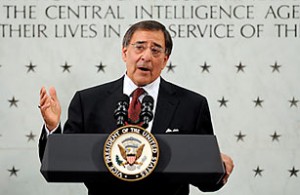
CIA Director Leon Panetta should use these searing events to foster a culture of initiative and accountability at a CIA that wants to do the job — but that needs leadership and reform.
A replay of long-standing criticisms of CIA's short-tours, lack of memory, refusal to take counterintelligence seriously, and general ineptitude outside the Embassy cocktail circuits.
A CIA inquiry is focused on two main questions: why the bomber was not more thoroughly screened and where he received the training and explosives used in the attack.
The CIA is proud to be on the front lines against al-Qaeda
By Leon Panetta
Sunday, January 10, 2010; A13
. . . . . . .
We have found no consolation, however, in public commentary suggesting that those who gave their lives somehow brought it upon themselves because of “poor tradecraft.” That's like saying Marines who die in a firefight brought it upon themselves because they have poor war-fighting skills.
. . . . . . .
From: Robert Steele, KR-594
To: Leon Panetta
Subj: Getting in touch with reality
As someone who scored in the top ten of their 65 person clandestine Ops I and Ops II training, and then went on to achieve five times the regional recruiting average across three tours focused on terrorists and extremists, ultimately serving in three of the four Directorates and being selected for the CIA Mid-Career Course; and as someone who has actually served in the US Marine Corps and in zones of conflict, I beg to differ with your Washington Post Op-Ed.
A number of us have tried to help you, from the day we intuited your selection, a selection I applauded because of your unique background as both a Chief of Staff in the White House (knowing what the President needed to know) and as a Director of the Office of Management and Budget (understanding means in relation to ways and ends).
The death of so many CIA personnel was a failure of tradecraft at multiple levels and also, I am sorry to have to point out, a failure of management. Were you to demand an honest report of the skills and experience of all those associated with this incident, you would learn two things:
EDIT of 9 Jan 10: Note seven comments from retired senior officers.
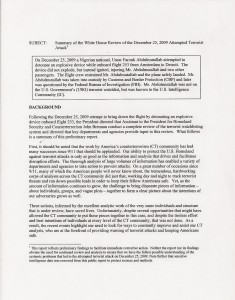
Critique of the CT Summary for the White House
This is a negligent piece of work that fails to include all that is known merely from open sources of information, but more importantly its judgments are misdirected. This incident remains incompletely investigated until the person who video-taped events on the airplane comes forward and is identified.
Where we differ:
1. It was passengers who restrained the individual, not the flight crew, as is stated in the first paragraph.
1) Does not identify the primary error. The Embassy officer (or CIA officer) who interviewed the father did not elevate the matter. The same kind of mistake occurred when the Taliban walked in and offered us Bin Laden in hand-cuffs.
2) The absence of a machine-speed cross-walk among US and UK visa denials is noted, but the weakest link is overlooked. The Department of State either didn’t check their visa files or, as has been remarked, may have failed to get a match because of misspelling. The necessary software is missing. State continues to be the runt in the litter (we have more military musicians than we have diplomats) and until the President gets a grip on the Program 50 budget, State will remain a dead man walking.
3) Another point glossed over: the intelligence community, and CIA in particular, did not increase analytic resources against the threat. Reminds us of George Tenet “declaring war” on terrorism and then being ignored by mandarins who really run the place.
4) “The watchlisting system is not broken” (page 2 bottom bold). Of course it is broken, in any normal meaning of the word “system”. John Brennan is responsible for the watchlisting mess, and this self-serving statement is evidence in favor of his removal. If we are at war, we cannot have gerbils in critical positions (quoting Madeline Albright).
5) “A reorganization of the intelligence or broader counterterrorism coummunity is not required…” at the bottom of page 2. Reorganization, in the sense of moving around blocks on a chart, may not be required, but the entire system is broken and does need both principled redesign and new people the President can trust with the combination of balls and brains and budget authority to get it right. Thirteen years after Aspin-Brown we still have not implemented most of their suggestions; the U.S. intelligence community is still grotesquely out of balance; and the Whole of Government budget is still radically misdirected at the same time that our policies in the Middle East are counterproductive.