Here are the concise references focused on revolution. For corruption, collective intelligence, open space and other methods of non-violent consensus building and emergence, see the lists at the end of this post.
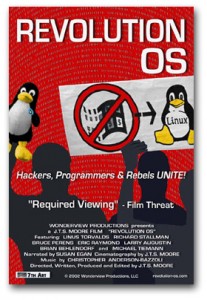
REVOLUTION OS tells the inside story of the hackers who rebelled against the proprietary software model and Microsoft to create GNU/Linux and the Open Source movement.
On June 1, 2001, Microsoft CEO Steve Ballmer said “Linux is a cancer that attaches itself in an intellectual property sense to everything it touches.”
Microsoft fears GNU/Linux, and rightly so. GNU/Linux and the Open Source & Free Software movements arguably represent the greatest threat to Microsoft's way of life. Shot in cinemascope on 35mm film in Silicon Valley, REVOLUTION OS tracks down the key movers and shakers behind Linux, and finds out how and why Linux became such a potent threat.
REVOLUTION OS features interviews with Linus Torvalds, Richard Stallman, Bruce Perens, Eric Raymond, Brian Behlendorf, Michael Tiemann, Larry Augustin, Frank Hecker, and Rob Malda. To view the trailer or the first eight minutes go to the ifilm website for REVOLUTION OS.
Whether consciously or not, most of us subscribe to a PC-centric view of the Internet, in which everything revolves around content that is created or accessed via a PC or Mac. However, that is about to change as mobile increasingly becomes the new paradigm for both creating and consuming content. Quite simply, the Web is about to experience a Copernican moment. Before Copernicus, it was widely believed that everything – including the Sun – revolved around the Earth, rather than the Earth revolving around the Sun. In the same way, it might be quaint one day to believe that everything once revolved around the PC rather than the mobile device.
The easiest way to understand this Copernican moment is to understand the extent to which mobile is becoming the new paradigm for the way we use the Internet. In terms of hours of usage, total content consumed and amount of data created, 2010 was the year of the mobile device. Keep in mind that the average teen now sends more than 3000 text messages each month! And that trend is only accelerating in 2011 as social networking rapidly migrates to the mobile device.
Michael Ostrolenk and Kevin Rollins discuss the role of new media, both social media like facebook and twitter, as well as niche magazines. Ostrolenk says that such forums help new ideas because they “remove barriers to entry and support [new idea] generation.
New data from research firm Common Sense Advisory suggests that if your brand is to achieve truly global reach in our online world, your website must “speak” more than 16 languages.
Common Sense Advisory publishes reports that are designed to help its clients reach a more global audience, so you could be forgiven for thinking it's obvious the firm would stress a statistic that promotes its own services–but actually, if you read through the company's thinking it all makes good sense. As part of its most recent report dubbed “The Top Scoring Global Websites,” CSA looked at a long list of global brand's websites and rated them for a wide range of accessibility scores, including poly-lingual skills.
The fact that 16 languages is recommended to have the most influential global web presence will come as quite a shock for many global brands who just tackle the top few of the world's most spoken languages (in order of number of speakers it goes Mandarin, Spanish, English, Hindi-Urdu, Arabic, Bengali, Portuguese, and Russian) and rely on English being the lingua franca of the Web; the figure will keep growing, too, as Internet penetration reaches more countries around the world. CSA's math suggests that sites that use 11 languages can only reach 80% of the world, and monolingual sites typically capture just 25% of the world's Net users.
Using the 20 different metrics in its analysis (including user experience, meta-navigation, and more) CSA scored Google the highest, with a total score of 9.56 out of 10. Facebook came second with 9.53 and YouTube third with 9.51. Wikipedia scored 9.43, and Samsung and Blackberry weren't far behind, with scores of 9.11 and 9.10.
Doc Searls‘ (et al) “vendor relationship management” (VRM) concept can be useful. Walmart is as it is because it serves a base of passive, faceless consumers – as is the case with “mass” business in general. VRM redefines the relationship of business to consumer by giving the consumer an active role – balancing power in the relationship of business to consumer. Participatory medicine, which is another of my areas of focus, does that with the patient, and is a great working example of VRM thinking. Project VRM hopes to drive the development of tools, and is connected to identity and data portability movements.