Eben Moglen, law professor at Columbia university (NYC) and founder of the Software Freedom Law Center.
Video: FreedomBox v Facebook
Audio: Before and After IP: Ownership of Ideas in the 21st Century (mp3)
Autonomous [Free, Distributed] Internet

The truth at any cost lowers all other costs — curated by former US spy Robert David Steele.
Eben Moglen, law professor at Columbia university (NYC) and founder of the Software Freedom Law Center.
Video: FreedomBox v Facebook
Audio: Before and After IP: Ownership of Ideas in the 21st Century (mp3)
Autonomous [Free, Distributed] Internet

Samuel Rose created Socialsynergyweb.com to help people deal with the complexities of knowledge, understanding, change, human systems, evolution, foresight, cooperation and collaboration, and technology. This business is now integrated into both Forward Foundation and Future Forward Institute.
He is a principal contributor to the Autonomous Internet Road Map.
He is interested in effective knowledge synthesis, and in exploring and developing the concepts of open knowledge, open design, and open business.
He is involved in a growing list of blogs, wikis, social software experiments and developings, including CoummunityWiki, Meatball Wiki, Cooperation Commons Weblog, Smartmobs Weblog.
Past clients have included Howard Rheingold, MacArthur Foundation, MIT Press, Stanford University, USDA, David Korten and People Centered Development Forum, and the Cooperation Commons and Social Media Classroom community.
twitter: @SamRose
Recommended:
see http://p2pfoundation.net/Crisis_Mapping,
part of http://p2pfoundation.net/Category:Geography
and updated via http://delicious.com/mbauwens/P2P-Mapping

Professor Eben Moglen is a long-standing champion of free and open source software and one of the top twelve to twenty-five minds thinking deeply in the English language about the future of the Internet consistent with creating a prosperous world at peace. Among many other accomplishments, including global mind-melds in multiple languages, Professor Moglen is the founding director of the Software Freedom Law Center, and most recently, the FreedomBox Foundation.
See Especially:
Before and After IP: Ownership of Ideas in the 21st Century, Digital Studies Group, CUNY Graduate Center, November 17. 2010 (audio stream). Download: Ogg Vorbis | MP3
I spend a lot of time looking at and writing about disruptive business models, and lately I have been talking about a handful that I think are really meaningful that will continue to mature over time and work their way into lots of other industries. 1) Friending. 2) Getting nothing, but paying for it. 3) Getting something, but not paying for it. 4) David beating Goliath. 5) Adding a third party to two party transactions. Visit Blog for full text accompanying each of the above. Phi Beta Iota: At DEMO Spring 2011 the deep persistent theme was the embedding of social media into everything. This is also one of the themes in Jane McGonigal's book, Reality Is Broken–Why Games Make Us Better and How They Can Change the World.
President, Waterkeeper Alliance; Professor, Pace University
Huffington Post, February 28, 2011 09:54 PM
Regulators Reject Proposal That Would Bring Fox-Style News to Canada
As America's middle class battles for its survival on the Wisconsin barricades — against various Koch Oil surrogates and the corporate toadies at Fox News — fans of enlightenment, democracy and justice can take comfort from a significant victory north of Wisconsin border. Fox News will not be moving into Canada after all! The reason: Canadian regulators today announced they would reject efforts by Canada's right-wing Prime Minister, Stephen Harper, to repeal a law that forbids lying on broadcast news.
Canada's Radio Act requires that “a licenser may not broadcast … any false or misleading news.”
Continue reading “Canadian Citizens Keep Lying on the Air Illegal”
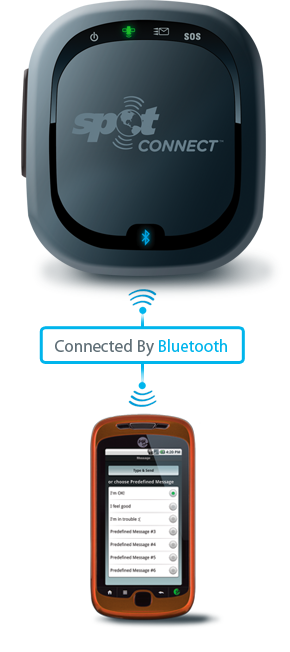
Today’s smartphones provide a level of social connection far beyond what we imagined just a few years ago. But when you go beyond the reach of the grid, your smartphone needs the help of SPOT Connect to keep you in touch with friends, family, and emergency personnel. Simply pair your smartphone with SPOT Connect, and get connected to a global satellite network that lets you send messages and GPS coordinates from virtually anywhere on the planet. Update Twitter and Facebook. Send email and text messages. Request non-emergency help from professional service providers. And in the case of a critical emergency, send an SOS message requesting emergency assistance.
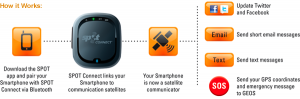
WARNING NOTICE: This $169 device does NOT include the subscription fees associated with SATCOM. There are some “relatively” low cost options, and a small crowd-sourcing effort to buy a satellite that will provide free SATCOM access to Africa, but the pieces are not there yet. See Autonomous Internet for a larger discussion of the possibilities.
Tip of the Hat to Aaron Huslage for this pointer.

 Robert F. Kennedy Jr.