Haitians live in a make-shift camp close to the airport. Port au Prince Haiti was rocked by a massive earthquake, Tuesday January 12, devastating the city and leaving thousands dead. Photo Marco Dormino
31 December 2010
FILE – In this Nov. 13, 2010 file photo, an ambulance worker prepares to remove the corpse of a man lying dead in a portable bathroom of a refugee camp in Port-au-Prince, Haiti. In 2010 crisis has piled upon crisis in Haiti. More than 230,000 are believed to have died in the quake, and more than a million remain homeless. A cholera epidemic broke out in the fall, and in its midst a dysfunctional election was held, its results still unclear. Photo: Ramon Espinosa / AP
In fact, the more we learn about what the plotters were up to, as well as the efforts to stop them, the more troubling the DNI’s ignorance becomes.
Three facts, in particular, have emerged that make this lapse inexcusable.
First, the State Department says the plotters had the U.S. embassy in London in their sites. On Monday, a Foggy Bottom spokesman confirmed that the embassy was on the plotters’ “targeting list.”
Second, according to the Guardian (UK), the alleged would-be terrorists were arrested “after several months of surveillance and monitoring by police and MI5 officers.”
Third, the UK press has reported that the plotters were, at the very least, inspired by the notorious al Qaeda cleric Anwar al Awlaki. … Awlaki is currently one of the most wanted terrorists in the world.
Phi Beta Iota: The DNI has been sand-bagged by three people and himself. Neither John Brennan (kitchen DNI at the White House), Leon Panetta (cheerleader for the CIA), or Michael E. Leiter (lawyer fronting the National Counterterrorism Center) appear to have any direct interest in seeing Jim Clapper succeed. Unfortunately, Jim Clapper has also sand-bagged himself by accepting “business as usual” and contenting himself with improvements on the margins–doing the wrong things righter. There is not a single piece of the US secret world that is working the way it should, in part because the entire mess lacks the legitimacy derived from relevance, and in part because the one thing Jim Clapper could have done on his own authority–the creation of an Open Source Center and an embedded Multinational Decision Support Centre–he has not done. Since the obvious needs to be spelled out, here are the two reasons why the OSC/MDSC are essential: 1) to begin providing the 96% of the decision-support not now provided to everyone including the President but explicitly not provided by classified to anyone below the President including policy, acquisition, and operations action officers; and b) to create the baseline for evaluating the Return on Investment (RoI) for the mis-begotten pieces of the secret world that are not, by any stretch of the imagination, worth the $90 billion a year they are costing us now. If there were one person among the seniors actually capable of making a difference, it should have been Jim Clapper. Happy New Year…
Decision-support (intelligence) is the ultimate objective of information processes. One must carefully distinguish between data which is raw text, signal, or image; information which is collated data of generic interest; and intelligence which is information tailored to support a specific decision…
As noted in an earlier Journal entry (Assessment of the Position of Director of National Intelligence December 27 2010), the Director of National Intelligence (DNI) is an unclaimed orphan among the senior U.S. intelligence managers while the Office of DNI (ODNI) is an unwelcome member of the so-called Intelligence Community (IC). The current DNI, General James Clapper (USAF ret.) is a good man in a bad job. He conspicuously does not have the ear of his most important constituent, the President of the U.S. (POTUS) or the support of the President’s most important intelligence advisor John Brennan. So how can the DNI carve out a niche for himself and his office that will enable him to build a Washington D.C. based constituency that may even include the POTUS ?
Even a cursory examination of the principal agencies of the IC, will reveal that none of them are producing strategic intelligence. CIA maintains that its intelligence analysts (most less than five years in service) are too pressed by the need to develop current intelligence to engage in the in depth analysis and research required to produce strategic intelligence. State INR the only other intelligence center really capable of producing strategic intelligence tells much the same story. The once widely influential National Intelligence Estimates (NIEs), primary vehicles for strategic intelligence, are no longer highly regarded guides to policy formulation.
Yet according to one of the most important thinkers on intelligence analysis, Sherman Kent, strategic intelligence provides, “the knowledge which our highly placed civilians and military men must have to guard the national welfare” (emphasis added). Put another way, strategic intelligence can be described as accurate and comprehensive information that is needed by decision makers to formulate policies or take actions to protect our national interests.
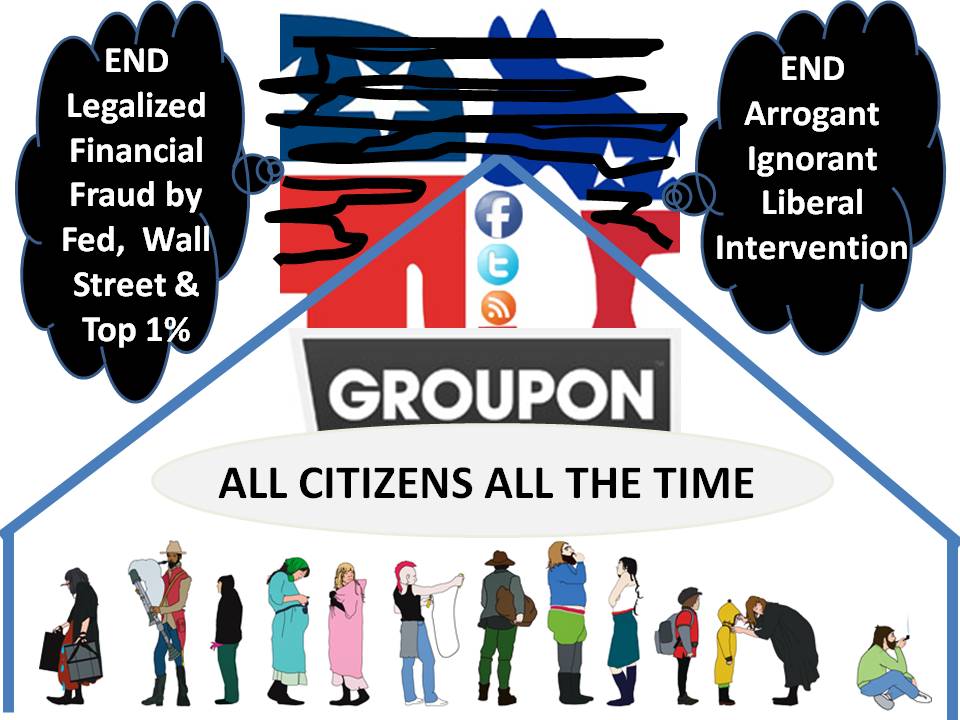
This week's Book post, Infinite Wealth for All, set the stage for this week's Politics post, which focuses on The New Craft of Cyber-Intelligence–a blending of advanced public intelligence and advanced Information Operations (IO). Let's start with a great Mashable piece, 4 Predictions for the Future of Politics and Social Media, from which I have remixed the graphic showing the two-party tyranny sniffing at social media.
This is THE toolbox, available in both long and short versions, we recommend you start with the long and then rapidly migrate to the short. Arno is THE “dean” of OSINT for government, and the “dean” of the advanced librarian discovery movement.
We strongly endorse Arno Reuser as an individual, and recommend his training offerings available directly from him. By-pass the external vendor training link at the Repertorium and send him a direct email.
Seven years ago Tom Atlee, our mentor on collective intelligence and community self-organization for resilience and sustainability, began focusing on “ways of communicating.” Responding to a recent query from us about alternatives to partisan politics or dictatorships, he offered up the below links, each of which has many other links, as food for reflection.