Journal: Learning Styles Concepts and Evidence

04 Education, IO Mapping, IO Multinational, IO Sense-Making

Learning Styles:Concepts and Evidence

Psychological Science in the Public Interest

Abstract

The term “learning styles” refers to the concept that individuals differ in regard to what mode of instruction or study is most effective for them. Proponents of learning-style assessment contend that optimal instruction requires diagnosing individuals' learning style and tailoring instruction accordingly. Assessments of learning style typically ask people to evaluate what sort of information presentation they prefer (e.g., words versus pictures versus speech) and/or what kind of mental activity they find most engaging or congenial (e.g., analysis versus listening), although assessment instruments are extremely diverse. The most common—but not the only—hypothesis about the instructional relevance of learning styles is the meshing hypothesis, according to which instruction is best provided in a format that matches the preferences of the learner (e.g., for a “visual learner,” emphasizing visual presentation of information).

Read rest of Abstract

Phi Beta Iota: Advanced Information Operations (IO) will see the blending of Cognitive Science with Collective Intelligence inside the IO Cube.  While the World Brain and Global are the final outcome, Advanced IO concepts and doctrine are possible now–they merely require the robust integration of intelligence and integrity in tandem, leading to the identification and pursuit of the right things–and recognize that information is a substitute for time, space, capital, labor, and violence.  Sun Tzu meets John Boyd.  Arugah.

Journal: Covert War in Pakistan–Lessons Not Learned

04 Inter-State Conflict, 05 Civil War, 07 Other Atrocities, 08 Wild Cards, 10 Security, 11 Society, Cultural Intelligence, Government, IO Multinational, IO Sense-Making, Military
Thomas Leo Briggs

Something caught my eye while reading a Slate item written by Tom Scocca and posted on December 20, 2010, “Two Ways of Looking at Our Covert War in Pakistan.”

Mr. Scocca wrote:

“There are diplomatic tensions because we are fighting a full-on undeclared war on the territory of a country with which we are an ally, using covert agents as the commanding officers”.

So what’s new?  Didn’t we fight a full-on undeclared war on the territory of Laos from about 1961 to 1973?  Wasn’t Laos an ally while trying to maintain the fig-leaf of neutrality?  Wasn’t the United States government using ‘covert agents as commanding officers’?

Moreover the New York Times published an article by Mark Mazzetti and Dexter Filkins the same day titled “U.S. Military Seeks to Expand Raids in Pakistan”.

In particular I noticed the following that Mazzetti and Filkins attributed to senior military commanders in Afghanistan.

Continue reading “Journal: Covert War in Pakistan–Lessons Not Learned”

Journal: CSIS on IAEA and NATO Intelligence

IO Multinational, IO Secrets, IO Sense-Making
Berto Jongman Recommends...

Shining a Brighter Light on Dark Places: Improving the IAEA’s Use of Intelligence through Cooperation with NATO

By Michael Hertzberg

Center for Strategic & International Studies Dec 21, 2010

One possible improvement to the IAEA’s monitoring and verification regime would be enhancing the IAEA’s use of intelligence by formalizing cooperation with a multilateral security organization such as the North Atlantic Treaty Organization (NATO). Working through NATO, which has established procedures and infrastructure for sharing and disseminating classified information, would avoid many problems that occur in bilateral intelligence-sharing.

Phi Beta Iota: NATO does not have any intelligence collection or processing capabilities of its own; it is completely dependent on what its members choose to provide it–and as with intelligence provided to the UN (e.g. IAEA), this is generally impoverished if not blatantly misleading.  The only viable solution for multinational intelligence is the establishment of a Multinational Decision Support Centre (MDSC) with Regional MDSC, all reliant primarily on Open Source Intelligence (OSINT), but all also having full-spectrum Human Intelligence (HUMINT) capabilities as well as Advanced Information Operations (IO) capabilities.  The Americans must learn that in Epoch B, must must surrender control in order to gain command of the truth.

Search: return of investment for information sys

InfoOps (IO), Intelligence (government), IO Sense-Making, IO Technologies, Methods & Process, Officers Call, Technologies

This search is a VERY important one, and does not yield the correct answer, which is in itself an indictment of information technology.

The correct answer is NEGATIVE, and Paul Strassmann, former Director of Defense Information, is the person who established this fact for the top corporations, although he likes to soft-shoe it and say neutral or negative.   NOT positive.  There is no Return on Investment (RoI) for information technology in and of itself.  He first disclosed this in his keynote luncheon presentation at OSS '96, and then published a book.  Both links are below. Paul Strassmann is one of our heroes–he has NOT been listened to carefully enough, and is in our little black book as a “must have” advisor for any future Information Operations (IO) “break-out” but only if he signs a non-compete and forgoes any association with any of the vendors selling vapor-ware (which is to say, all of them).

1996 Strassmann (US) U.S. Knowledge Assets: Choice Traget for Information Crime

Review: Information Productivity–Assessing Information Management Costs of U. S. Corporations

In Case of DoD Specifically:

2006 General Accountability Office (GAO) Defense Acquisitions DoD Management Approach and Processes Not Well-Suited to Support Development of Global Information Grid

2004 General Accountability Office (GAO) Report: Defense Acquisitiions: The Global Information Grid and Challenges Facing Its Implementation

2002 The New Craft of Intelligence–What Should the T Be Doing to the I in IT?

See Also:

Graphic: Cyber-Threat 101

Graphic: Tony Zinni on 4% “At Best”

Graphic: Jim Bamford on the Human Brain

Journal: Return on Investment Missing from IT World

Journal: Systems Design & “Reverse Innovation”

Journal: Bees’ tiny brains beat computers

Continue reading “Search: return of investment for information sys”

Journal: Denial of Service Attacks on Humanitarian Sites

07 Other Atrocities, 10 Security, 11 Society, Computer/online security, Gift Intelligence, IO Multinational, Non-Governmental
Berto Jongman Recommends...

DDoS Attacks Continue to Plague Human Rights Sites

By: Chloe Albanesius

PC Magazine, 12.22.2010

WikiLeaks and Operation Payback have put distributed denial of service (DDoS) attacks in the news recently, but independent media and human rights Web sites have been battling these attacks on a consistent basis with no easy solution in sight, according to a Wednesday study.

While major sites can fend off a DDoS or recover quickly, smaller sites can be crippled by these attacks, which often hit in conjunction with other attacks like filtering, intrusions, and defacements, according to the Berkman Center for Internet & Society.

“DDoS is an increasingly common Internet phenomenon capable of silencing Internet speech, usually for a brief interval but occasionally for longer,” the report said. “Our report offers advice to independent media and human rights sites likely to be targeted by DDoS but comes to the uncomfortable conclusion that there is no easy solution to these attacks for many of these sites, particularly for attacks that exhaust network bandwidth.”

The report's authors suggest that DDoS attacks will become more common amidst news about similar WikiLeaks and Operation Payback attacks. Even before that, however, DDoS attacks on independent media and human rights sites were quite common during the last year, happening even outside of major events like elections, protests, and military operations.

These sites are being hit with two types of DDoS: application and network. Application attacks exhaust local server resources and can usually be rectified with the help of a skilled system admin. Network attacks, however, exhaust network bandwidth and can usually only be fixed with the (costly) help of a hosting provider.

Read rest of article….

Tom Atlee Proposes distributed-intelligence, crowd-sourcing participatory think tank for popular common-sense policies, unhindered by party affiliations and ideology

Collaboration Zones, Collective Intelligence, Communities of Practice, IO Sense-Making, Mobile, Policies, Threats
Tom Atlee at Phi Beta Iota

Phi Beta Iota: There is no other person we hold in higher esteem than Tom Atlee.  For America the Beautiful, at least, he is this generation's Wise Man.  Below in his own words.  We urge one and all to contribute to his sustenance.

. . . . . . . . . . . . . . . . . . . . . . . . . .

Dear friends,

I have been talking a lot lately with strategists in the Coffee Party movement (CPM).  If you don't know much about the Coffee Party, I urge you to check out their website and Wikipedia's well-referenced short article on them.

While the Coffee Party has definite progressive roots, it also features bright transpartisan energies.  Most Coffee Party members — and co-founder Annabel Park — promote civil dialogue about public issues.  They also promote democracy-building policies, especially ones to address the democracy-degrading influence of money in politics.

I much prefer the Coffee Party's brand of transpartisanship to the more recent No Labels movement whose goal is “to encourage politicians to come together to develop pragmatic and workable solutions.”  Politicians?  What about We, the People? What about citizen deliberations and stakeholder dialogues?  I can't help but wonder what informed citizen deliberative councils would have to say about the issues the No Labels site addresses…

Although I'm still open to evidence to the contrary, it seems to me that No Labels is trying to co-opt the very real frustration most Americans feel for the political polarization and legislative logjam they see every day.  I fear No Labels is cleverly reframing the meme of transpartisanship to rally growing populist energies around a hidden special interest agenda — perhaps building a movement to support a Bloomberg presidential bid in 2012.

Check out “No Labels: What’s Behind “Forward?” Pro-Corporate Economic Policy.”  While I don't agree with everything Jim Cook writes or implies there, I think it is significant that all three No Labels co-founders are professionally involved in promoting corporate interests, and that they advocate tapping Social Security to reduce the debt — when SS is not actually a part of the federal budget, per se, but is a collective retirement account into which workers have paid for decades which has lately been ripped off for budgetary expenditures.  Their budget concerns do not highlight the gigantic portion of the actual budget that goes to military expenditures — to say nothing of the non-budgeted expenditures for the wars in Iraq and Iran which constitute a gigantic part of the federal debt — military expenditures that are greater than all other military budgets in the world combined.  Nor do they feature the many forms of corporate welfare and the option of raising taxes on the hyper-wealthy to the 1950s levels.  Notably, they depend heavily on the Peter G. Peterson Foundation, a very partisan source, as their favorite budgetary reference.

The whole thing doesn't smell right to me. But I do see it as another indicator of how powerful the emerging transpartisan populist trend is, that so much elite attention is being dedicated to co-opting it.

Continue reading “Tom Atlee Proposes distributed-intelligence, crowd-sourcing participatory think tank for popular common-sense policies, unhindered by party affiliations and ideology”

Journal: Wind Power Boondoggle–and the Information Operations (IO) Challenge of Energy and Time in Relation to Policy, Acquisition, and Operations

Advanced Cyber/IO, Analysis, Budgets & Funding, Collective Intelligence, Communities of Practice, Counter-Oppression/Counter-Dictatorship Practices, Earth Intelligence, Ethics, History, InfoOps (IO), Intelligence (government), IO Multinational, IO Sense-Making, Key Players, Methods & Process, Officers Call, Open Government, Peace Intelligence, Policies, Strategy, Threats
Chuck Spinney Recommends...

My good friend Robert Bryce, author of the must-read Power Hungry: The Myths of ‘Green' Energy and the Real Fuels of the Future just launched this little torpedo.

A Wind Power Boonedoggle

T. Boone Pickens badly misjudged the supply and price of natural gas.

By ROBERT BRYCE, Wall Street Journal, 22 December 2010

After 30 months, countless TV appearances, and $80 million spent on an extravagant PR campaign, T.

Boone Pickens has finally admitted the obvious: The wind energy business isn't a very good one.

Read full article….

Click to Enlarge

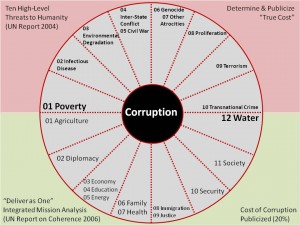
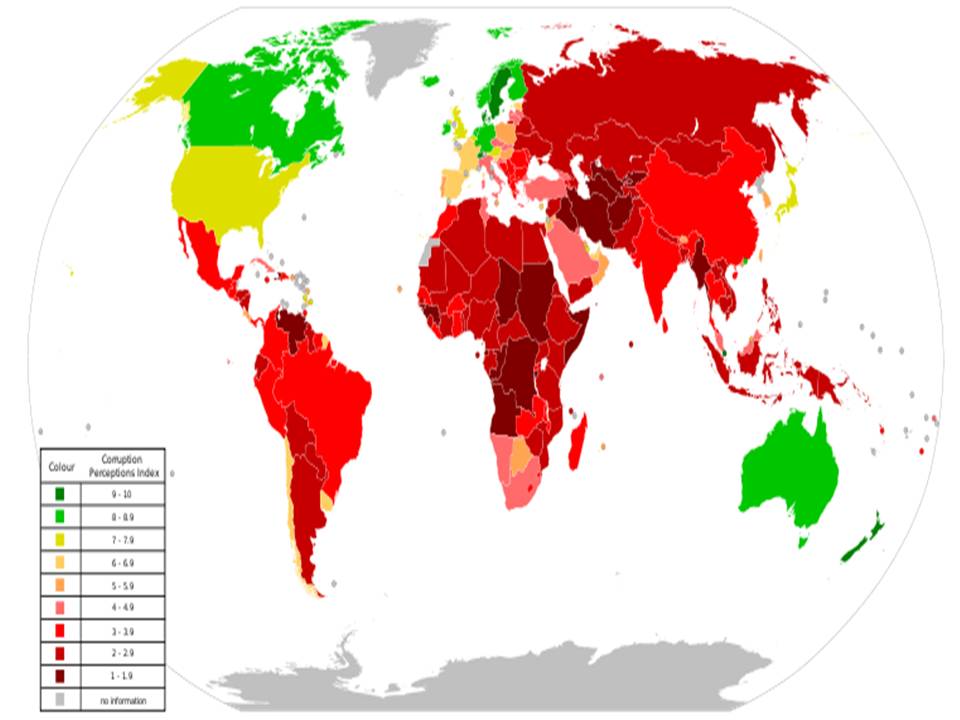
Phi Beta Iota: Buckminster Fuller and Russell Ackoff nailed it–everything has to be evaluated in relation to energy source and cost and time cost, and you have to focus on doing the right things, not doing the wrong things righter.  Where Mr. Pickens went wrong was in sticking with the centralized ownership concept.  Wind power and solar power are best for localized applications.  The central grid–the Industrial Era top down control grid, is DEAD.  Similarly, water and sewage should not be centralized grids demanding massive investments in collection and processing.  The graphic to the right shows corruption in the center–when analytics and decision-making lose their holistic integrity, they inevitably fail to achieve the desired outcome while creating cascading costs everywhere else.  Military spending in the USA is at the beginning of a nose dive–our military leaders would be wise to get a grip sooner than later, and “beat the dive” by making evidence-based decisions (Advanced IO) sooner than later.  Now a really advanced thought: 21st Century national security is about eradicating corruption at home and abroad–this makes possible the creation of a prosperous world at peace.  The breadth of that challenge is in the graphic below.  That is an IO challenge, not a kinetic challenge.  IO must be co-equal to kinetics beginning immediately.  In our humble opinion.

Click to Enlarge

See Also:

Journal: ‘Systemic Corruption’–Daunting Challenge in Globalized Era

Reference: Frog 6 Guidance 2010-2020

Reference: Transparency Killer App Plus “Open Everything” RECAP (Back to 01/2007)

Reference: Cultures of Resistance–A Look at Global Militarization

noble gold