Reference: Internet Freedom–and Control

03 Economy, 04 Education, 07 Other Atrocities, 09 Justice, 11 Society, Autonomous Internet, Counter-Oppression/Counter-Dictatorship Practices, InfoOps (IO), IO Multinational, Methods & Process, Mobile
Click on Image to Enlarge

Freedom on the Net: A Global Assessment of Internet and Digital Media

Freedom House 30 March 2009

As internet and mobile phone use explodes worldwide, governments are adopting new and multiple means for controlling these technologies that go far beyond technical filtering. Freedom on the Net provides a comprehensive look at these emerging tactics, raising concern over trends such as the “outsourcing of censorship” to private companies, the use of surveillance and the manipulation of online conversations by undercover agents. The study covers both repressive countries such as China and Iran and democratic ones such as India and the United Kingdom, finding some degree of internet censorship and control in all 15 nations studied.

Phi Beta Iota: Although somewhat dated, the report is worth a look.  If overlain with the countries where poverty makes Internet access or control moot, the global picture is clear: despots and poverty are coincident with the physical and digital impoverishment of the people.  The emergence on multiple fronts of movement to create the Autonomous Internet using the Open Source Tri-Fecta is encouraging.

The Emergent Open Source Revolution

Advanced Cyber/IO, Analysis, Augmented Reality, Autonomous Internet, Collaboration Zones, Collective Intelligence, Communities of Practice, Counter-Oppression/Counter-Dictatorship Practices, Ethics, info-graphics/data-visualization, InfoOps (IO), Intelligence (government), Methods & Process, Mobile, Open Government, Policies, Real Time, Reform, Strategy, Technologies, Threats, Tools
Amazon Page

REVOLUTION OS tells the inside story of the hackers who rebelled against the proprietary software model and Microsoft to create GNU/Linux and the Open Source movement.

On June 1, 2001, Microsoft CEO Steve Ballmer said “Linux is a cancer that attaches itself in an intellectual property sense to everything it touches.”

Microsoft fears GNU/Linux, and rightly so. GNU/Linux and the Open Source & Free Software movements arguably represent the greatest threat to Microsoft's way of life. Shot in cinemascope on 35mm film in Silicon Valley, REVOLUTION OS tracks down the key movers and shakers behind Linux, and finds out how and why Linux became such a potent threat.

REVOLUTION OS features interviews with Linus Torvalds, Richard Stallman, Bruce Perens, Eric Raymond, Brian Behlendorf, Michael Tiemann, Larry Augustin, Frank Hecker, and Rob Malda. To view the trailer or the first eight minutes go to the ifilm website for REVOLUTION OS.

Two books below the line…

Continue reading “The Emergent Open Source Revolution”

Web’s Copernican Moment – Hand-Held Rules

Advanced Cyber/IO, Autonomous Internet, Civil Society, Collective Intelligence, Commercial Intelligence, Cultural Intelligence, Mobile
Chris Pallaris Recommends

The Web's Copernican Moment

Dominic Basulto on April 4, 2011, 9:57 PM

bigthink

Whether consciously or not, most of us subscribe to a PC-centric view of the Internet, in which everything revolves around content that is created or accessed via a PC or Mac. However, that is about to change as mobile increasingly becomes the new paradigm for both creating and consuming content. Quite simply, the Web is about to experience a Copernican moment. Before Copernicus, it was widely believed that everything – including the Sun – revolved around the Earth, rather than the Earth revolving around the Sun. In the same way, it might be quaint one day to believe that everything once revolved around the PC rather than the mobile device.

The easiest way to understand this Copernican moment is to understand the extent to which mobile is becoming the new paradigm for the way we use the Internet. In terms of hours of usage, total content consumed and amount of data created, 2010 was the year of the mobile device. Keep in mind that the average teen now sends more than 3000 text messages each month! And that trend is only accelerating in 2011 as social networking rapidly migrates to the mobile device.

Read rest of article….

Cyber-IO: A New Form of Governance?

Advanced Cyber/IO, Civil Society, Collective Intelligence, Cultural Intelligence, InfoOps (IO), Methods & Process, Mobile, Technologies
Patrick Meier

Information and Communication Technology in Areas of Limited Statehood: A New Form of Governance?

I recently had the distinct pleasure of participating in a fascination workshop on “Information and Communication Technology in Areas of Limited Statehood: A New Form of Governance?” The workshop was organized by the Frei Universität’s program on Governance in Areas of Limited Statehood and co-directed by Professors Gregor Walter-Drop and Steven Livingston.

. . . . . .

My colleague Gregory Asmolov made the link explicit during his excellent presentation on “Russian Wildfires and Alternative Modes of Governance: The Role of Crowdsourcing in Areas of Limited Statehood.” Here’s a summary:

“Because of it’s geographical size, high degree of corruption, and reliance on an extraction economy, governance by government in Russia is often weak and ineffective. Russian political expert Liliya Shevtzova goes so far as to claim that the current regime is an imitation of governance. The 2010 wildfires demonstrated the limited capacity of the state to provide effective emergency response. Information technologies, and crowdsourcing platforms in particular, fulfill the gap of the limited statehood. At the same time, however, the Russian government is also trying to use ICT to increase its claims to effective governance.”

Read full posting….

Phi Beta Iota: This post is much more than a post.  To the best of our (naturally limited) knowledge, this is the first and the best statement that clearly distinguished among “imitation governance,” spontaneous “self-governance,” and the role that information technology plays in making a mockery of the first and a reality of the second.

Broadband Telefony Near-Zero Cost

Advanced Cyber/IO, Autonomous Internet, Collective Intelligence, InfoOps (IO), Mobile

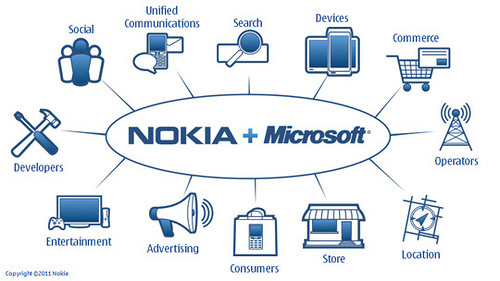
Nokia & Microsoft: White Space Phone?

When Nokia announced that it will drop Symbian for Microsoft’s Windows Mobile, many in the industry were taken by surprise. Now, according to industry insiders, the strategy is becoming clear: Nokia will use Microsoft’s patented “white spaces” radio, enabling wireless devices to use television frequencies.

Click on Image to Enlarge

The two firms have apparently been working on a software defined radio platform for several years. Now the companies are preparing a world-wide rollout of a system that may short circuit the world’s largest carriers.

Microsoft and Nokia are expected to utilize small, WiFi-like access points, expected to cost $250-$500 dollars, rather than cell towers that can cost $250,000. Local access points, using unused television frequencies, penetrate indoors better and can have a range similar to PCS cellular radios – approximately 1-3 miles.

Multiple 6 MHz wide channels will be automatically ganged together in this new system, delivering an effective 2-12 Mbps for end users. Using TD-based LTE or WiMAX radios, with a software defined front end, the Nokia/Microsoft access points connect to the internet directly — like WiFi access points. The phones use VoIP software, similar to Skype, jointly developed by Nokia and Microsoft.

According to some industry observers, the impact of white space phones on today’s two trillion dollar telecommunications industry may be significant. White space phones will not need today’s infrastructure and licensed spectrum. They will not be dependent on phone companies.

The initial thrust for the whitespace phone system is expected to be in the developing world. The joint venture is expected to announce several test markets, including the Seattle area this summer and will test a Visa-enabled SIM card, enabling contactless payments.

Read more….

Safety copy below the line.  Tip of the Hat to Sepp Hasslberger.

Continue reading “Broadband Telefony Near-Zero Cost”

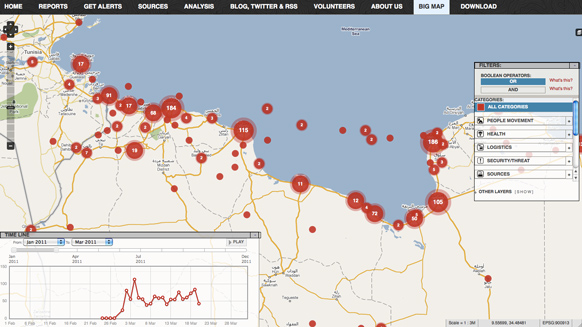
Ushandi Moves Forward with Crisis Mapping Check-In

Advanced Cyber/IO, Analysis, Civil Society, Earth Intelligence, Gift Intelligence, InfoOps (IO), IO Mapping, Mobile, Non-Governmental, Peace Intelligence, Real Time
Michael Ostrolenk Recommends...

Crisis Mapping Meets Check-in

New features could make a Web tool that has helped track events in Japan and the Middle East even more useful.

Monday, March 28, 2011, By David Talbot

MIT Technology Review

EXTRACT:  The new feature is known as “check-in,” also used by social sites like Foursquare—in that case as a way of alerting friends to your presence at a particular location.

Click on Image to Enlarge

For Ushahidi, this is “a pretty powerful step forward,” says Ethan Zuckerman, a board member of the nonprofit, and a senior researcher at the Berkman Center for Internet & Society at Harvard University. “Adding check-in to this equation allows me to pull my data apart from the whole. That makes maps usable for multiple purposes—group reporting as well as tracking of my own movements.”

Enabling such tracking simply requires a GPS-equipped phone to allow a quick log-in to record whereabouts

Public Intelligence Emergent: Citizen Network in Krygzstan to Check and then Counter Rumors

Advanced Cyber/IO, Analysis, Civil Society, Collective Intelligence, Collective Intelligence, Ethics, InfoOps (IO), Methods & Process, Mobile, Officers Call, Open Government, Policies, Reform, Strategy, Threats, Tools

How To Use Technology To Counter Rumors During Crises: Anecdotes from Kyrgyzstan

Patrick Meier | March 26, 2011 at 11:47 pm | Tags: rumors, Skype, SMS, validation | Categories: Crowdsourcing, Digital Activism, New Media | URL: http://wp.me/pecFU-1n8

I just completed a short field mission to Kyrgyzstan with UN colleagues and I’m already looking forward to the next mission. Flipping through several dozen pages of my handwritten notes just now explains why: example after example of the astute resourcefulness and creative uses of information and communication technologies in Kyrgyzstan is inspiring. I learned heaps.

. . . . . . .

The degrees of separation needed to verify a rumor was close to one. In the case of the supposed border attack, one member of the chat group had a contact with the army unit guarding the border crossing in question. They called them on their cell phone and confirmed within minutes that no attack was taking place. As for the rumor about the poisoned humanitarian aid, another member of the chat found the original phone numbers from which these false SMS’s were being sent. They called a personal contact at one of the telecommunication companies and asked whether the owners of these phones were in fact texting from the place where the aid was reportedly poisoned; they weren’t. Meanwhile, another member of the chat group had himself investigated the rumor in person and confirmed that the text messages were false.

Read more….

Continue reading “Public Intelligence Emergent: Citizen Network in Krygzstan to Check and then Counter Rumors”

noble gold