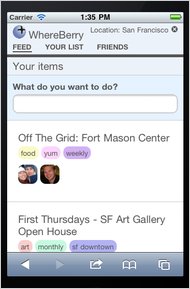
Most social networking services are for sharing what you’ve done in the past or what you’re doing right now. A new one, WhereBerry, is for sharing what you want to do in the future.
On WhereBerry, which opens to the public Tuesday, people post activities they want to do someday, like restaurants they want to try, movies they hope to see or events they plan to attend. Their friends can comment and make plans.
“We’re giving people a single place for all these ideas that float around for people to do,” said Nick Baum, who founded WhereBerry with Bill Ferrell. They are former Google engineers. “If you put them here, you won’t forget about them and the combination of things will make you do a lot more stuff.”
Phi Beta Iota: WhatBerry should be along right behind this. As a collective aggregator this appears to have vastly more potential than its current narrow focus.
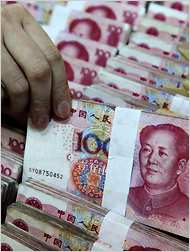
With China overtaking Japan as the world’s second-largest economy last year, there can be no doubt that emerging markets are becoming increasingly powerful.
A new report from the World Bank predicts that by 2025, China, along with five other emerging economies — Brazil, India, Indonesia, South Korea and Russia — will account for more than half of all global growth, up from one-third now.
The report, “Global Development Horizons 2011 — Multipolarity: The New Global Economy,” also anticipates that the dollar will be joined by the euro and the renminbi as dominant international currencies. The Chinese government is already easing currency controls and has taken other steps to help the renminbi become a fully convertible reserve currency, which would make it easier for foreign companies to finance projects in China.
French scientists believe that a planet orbiting the red dwarf star Gliese 581 could sustain life similar to Earth.
Twenty light years away is a small red star. Orbiting this sun are six planets that range in size from slightly smaller than Earth to about the size of Neptune. Several of these planets fall within the star's “Goldilocks” zone, neither too hot from proximity to the star nor too cold from being too far. If a planet is too hot, all water would be steam but if its too cold then it would be ice, neither of which can support life. Luckily, a group of astronomers from the National Centre for Scientific Research in France believe that the fourth planet – unimaginatively labeled Gliese 581d – is just right.
Gold rising further except for profit taking bursts. China is buying all the gold it can get, and unloading all the paper dollars it can dump.. Other countries, including Russia are buying gold. I can see the Yuan or RMB playing a larger role as a global currency, but most people are too ignorant of China to accept the Yuan quickly or easily. The Swiss have a huge mass of gold well stashed, so I can see the Swiss franc playing a larger role. It's hard to make a forecast for the Euro, although it will almost certainly survive the US dollar. It's also possible that the Swiss might make a deal with the EU that would result in the Euro being backed by Swiss gold. Now that the head of the IMF has been burned at the stake, his very good brain is of no further use. The EU is scrambled eggs right now. Sarko can't survive without a miracle. India's potential will take a very long time to organize and get rolling; I went to school there and it's a seething cesspit. It's time for the US to get out of foreign wars, but unlikely that it will because of the weapons market. Obama seems impotent. The Pentagon and its corporate backers and partners seems to be deciding policy. I'm not happy about Petraeus at the agency. I think the USG and the US are totally hosed. Desperate for a new demon. Good time for Lee Kuan-yew to retire. Wise of him. The immediate future does not look good. War and more war. Civil war. Revolution. Take your pick. The cupboard is bare. It's all been looted. What a mess America has made since 1945. Moments of glory, decades of folly and stupidity…. Israel and the Palestinians are a parody of the world as a whole.
I think the last real ingots of gold in Manhattan were in the basement of the Twin Towers. The Fed and the Treasury don't dare be transparent or audited, because whatever real (solid) gold they ever had was moved to Malta and other offshore or mountain stashes long ago, replaced with Play-Dough. Christ, even the Bureau of Engraving and Printing stops now and then to change engraving plates and produce “Presidential dollars” to be used as bribes by the White House (ever since Truman); we have that from a guy who is now retired after running the shop since 1945. The satellite imagery boys, where I have sources, dream of being about to electronically penetrate the earth to a depth of 100 feet or more from satellites but when I last checked 3 or 4 years ago they were still dreaming. They fiddle with HAARP trying to achieve earth-penetration, and only end up causing huge earthquakes and tsunamis; measurements already show the poles have begun to shift partly due to melting ice masses, but also due to fiddling with HAARP. The Fukushima quake and tsunami have been attributed to fiddling with HAARP, possibly the Sumatra disaster as well. Not all scientists are smart and prescient. We're damn lucky they haven't already blown us to smithereens, while scratching their backsides. Never forget that the Fed has always existed as a fraud by intent and design. President Wilson commented years after enabling the Fed in 1913: “I have destroyed my country.”
I had the distinct pleasure of being interviewed for this report on Harnessing Social Media Tools to Fight Corruption (PDF). The study was prepared by Dana Bekri, Brynne Dunn, Isik Oguzertem, Yan Su and Shivani Upreti as part of a final project for their degree from the Department of International Development at the London School of Economics and Political Science (LSE). The report was prepared for Transparency International (TI).
As part of this project, the authors compiled a very useful database of projects that apply social tools to create greater transparency and accountability around corruption issues. The authors recommend that TI draw on this list of projects to catalyze an active network of civil society initiatives that challenge corruption. The report also includes an interesting section on Mobilizing Volunteers and considers the role of volunteer networks as important in the fight against corruption. The authors write that,
“As an essential expression of citizenship and democracy, the past 25 years have seen rapid growth in the practice of volunteering worldwide. One study reports approximately 20.8 million volunteers in 37 countries, contributing US$ 400 billion to the world economy. The increasing enthusiasm of individuals to serve a cause while improving their own skills complements key goals of civil society organisations to build a strong volunteer force.”
This of course relates directly to the Standby Volunteer Task Force (SBTF), so I’m always keen to learn more about lessons learned and best practices in catalyzing a thriving volunteer network.
Do let me know if you’d like to get in touch with the authors, I’d be happy to provide an introduction via email.


 The World Economic Order, Circa 2025