Libya, appears to me to be a US-UK venture, having little to do with Gaddafy. Rather, in significant part it is driven by the goal of squelching potential and logical French influence in the in the Middle East and its leadership in accommodating (establishing the terms of integration) Islam in Europe and the West.
Mr Malloch-Brown is one of the few legitimate contenders to Anglo statesmanship in this era. But I find the following to be misleading in trying to make the case that this was a worthy mission, but too hard to bring off diplomatically. I believe these to be talking points.
Phi Beta Iota: The sweeping public movements across North Africa and the Middle East are if anything an indictment of what one author calls the “fifty-year wound” and a validation of what another author calls the “unconquerable world.” Vastly more benevolent strategic imperatives, such as Ambassador Mark Palmer's vision for providing all 44 dictators with an exit strategy (42 of them “best pals” of the USA at this time), have been ignored.
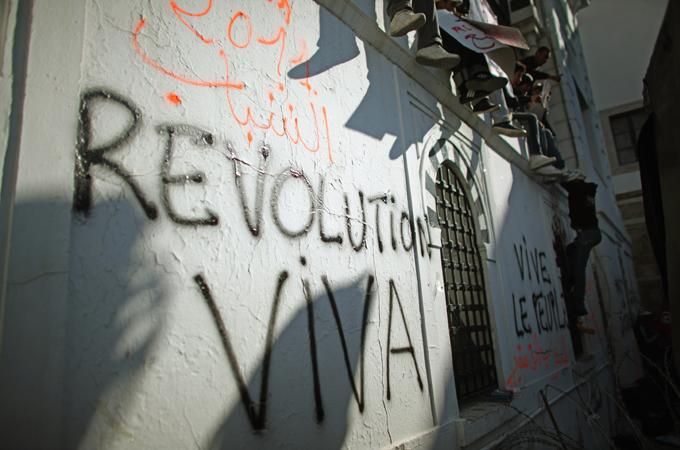
Revolutions are caused by human agency; not telecommunications technologies, scholar argues.
To listen to the hype about social networking websites and the Egyptian revolution, one would think it was Silicon Valley and not the Egyptian people who overthrew Mubarak.
Via its technologies, the West imagines itself to have been the real agent in the uprising. Since the internet developed out of a US Defense Department research project, it could be said the Pentagon did it, along with Egyptian youth imitating wired hipsters from London and Los Angeles.
Most narratives of globalisation are fantastically Eurocentric, stories of Western white men burdened with responsibility for interconnecting the world, by colonising it, providing it with economic theories and finance, and inventing communications technologies. Of course globalisation is about flows of people as well, about diasporas and cultural fusion.
But neither version is particularly useful for organising resistance to the local dictatorship. In any case, the internet was turned off at decisive moments in the Egyptian uprising, and it was ordinary Egyptians, mothers and fathers, daughters and sons, who toppled the regime, not the hybrid youth of the global professional classes.
Nothing new about globalisation
Are there other tales of globalisation, perhaps those told by rebels and guerrillas?
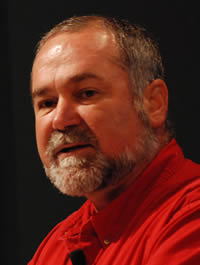
Robert David STEELE Vivas Click Here to See Personal Page
ROBERT STEELE: Revolution is about the combination of three things: grotesque imbalance combined with evolutionary psychology of a public to the point that the cognitive dissonance is paradigm shattering; a precipitant or catalyst, and the Davies J-Curve, a “sense” on the part of sufficient numbers that there is light ahead, that they might actually win.
When they come–relatively infrequently–revolutions are best supported with information and civil affairs capabilities. A massive public intelligence effort to help the people, the true custodians of their own commons, understand where the wealth is, where the opportunities are, whom to hold accountable; combined with a precision civil affairs effort, ideally manned by individuals who are ethnically and spiritually homogeneous with those they are helping, are the two best things well-intentioned external powers can provide.
Along with precision information–which no government is capable of today for failure to invest in the open source tri-fecta–comes precision stabilization & reconstruction assistance, of 21st Century Civil Affairs–a civil affairs cadre for a multiniational endeavor that is C4I heavy, truly multinational, and focused on delivering just enough just in time “peace from above.” That too is beyond the capability of any government today, not for lack of capacity, but for lack of mind-set.
2012 is a year of Awakening. The traditional colonial powers can remain comatose as they are now, or they can push the “re-set” button and actually participate in what could be the greatest renaissance of humanity in modern history.
A really uplifting new documentary, “I AM”, has just hit theaters featuring my dear friend, Marc Barasch. This film, based in significant part on Marc's insights into empathy, altruism and social healing from his seminal book, Field Notes on the Compassionate Life is taking off. A previous DVD by Marc, The Compassionate Life: Walking the Path of Kindness, is available online.
It made the top ten list of indie films this week and last, after a successful launch on the coasts. It will also be shown at the Conference on World Affairs in Boulder next month.
Tom Shadyac, Jim Carey director and the film¹s creator, has been touring with the film, as noted in indieWIREŒs profile of the film's strategy earlier this week. The film takes on Washington next weekend followed by Boston before expanding to other markets.
Along with Marc's truly inspiring segments, it features Archbishop Desmond Tutu, Noam Chomsky, Howard Zinn, David Suzuki, Lynn McTaggert, Ray Anderson and other luminaries. The “through-line” of this entertaining documentary is
Shadayac personal journey, following a serious accident, to discover “what's wrong with the world and what we can do about it” — a quest which he has said was triggered, in part, by Marc's own literary and life pilgrimage.
They are working on this, we anticipate a fix being in place shortly.
A word of praise for WordPress: astonishing public service, works quietly in the background with substance while others take the limelight. A service to humanity whose contribution will one day be acknowledged more broadly.