Chuck Spinney: Israeli Micro-Management of Gaza Malnutrition

01 Agriculture, 06 Family, 06 Genocide, 07 Health, 07 Other Atrocities, 08 Wild Cards, 09 Justice, 11 Society
Chuck Spinney

Below is a BBC report of and Israeli “calorie” study drafted in support of Israel blockade policies for Gaza.  To Israel's credit, an Israeli human rights group forced the release of this report, but it does nevertheless raise a question: What kind of government would authorize work on such a methodical report on this subject in the first place?

“In her reporting of the Eichmann trial for The New Yorker, which evolved into Eichmann in Jerusalem: A Report on the Banality of Evil (1963), Hannah Arendt coined the phrase “the banality of evil” to describe Eichmann. She raised the question of whether evil is radical or simply a function of thoughtlessness, a tendency of ordinary people to obey orders and conform to mass opinion without a critical evaluation of the consequences of their actions and inaction.” (wikipedia)

Read the calorie study (Israeli study of Gaza food consumption to support blockade policy) as well BBC report below, and ask yourself how would you behave if someone was even thinking about doing this to you.  Would you fight back with any weapons at your disposal or meekly submit?

 BBC, 17 October 2012 Last updated at 21:51 GMT

Israel forced to release study on Gaza blockade

An Israeli court has forced the release of government research detailing the number of calories Palestinians in Gaza need to consume to avoid malnutrition.

The study was commissioned after Israel tightened its blockade of the territory after Hamas came to power in June 2007.

. . . . . . .

‘Daily humanitarian portion'

The Israeli human rights group Gisha, which campaigns against Israel's Gaza blockade, fought a long legal battle to get the Israeli ministry of defence to release this document.

Dated from 2008 and entitled, Food Consumption in the Gaza Strip – The Red Lines, it is a detailed study of how many calories Palestinians needed to eat to avoid malnutrition.

How can Israel claim that it is not responsible for civilian life in Gaza – when it controls even the type and quantity of food that Palestinian residents of Gaza are permitted to consume?”

Read full article.

Continue reading “Chuck Spinney: Israeli Micro-Management of Gaza Malnutrition”

Mini-Me: CIA Station Chief – Drone War Creating More Enemies Than We Destroy

07 Other Atrocities, 08 Wild Cards, 09 Justice, 10 Security, 11 Society, Corruption, Government, IO Deeds of War, Peace Intelligence
Who? Mini-Me?

Huh?

Drone War Creating More Enemies Than it Destroys

New American, 20 October 2012

EXTRACT:

Reuters explains that “Western diplomats in Sanaa say al Qaeda is a threat to Yemen and the rest of the world.” An argument can be made that a bigger threat to the world is the United States’ daily drone attacks that destroy our own dedication to the rule of law and serve as effective recruiting tool for those seeking revenge for the killing.

The former CIA Pakistan station chief agrees. Speaking of the rapid expansion of the drone war in Yemen, Robert Grenier told the Guardian (U.K.):

That brings you to a place where young men, who are typically armed, are in the same area and may hold these militants in a certain form of high regard. If you strike them indiscriminately you are running the risk of creating a terrific amount of popular anger. They have tribes and clans and large families. Now all of a sudden you have a big problem…. I am very concerned about the creation of a larger terrorist safe haven in Yemen.

And:

We have gone a long way down the road of creating a situation where we are creating more enemies than we are removing from the battlefield. We are already there with regards to Pakistan and Afghanistan.

Read full article with many links.

Continue reading “Mini-Me: CIA Station Chief – Drone War Creating More Enemies Than We Destroy”

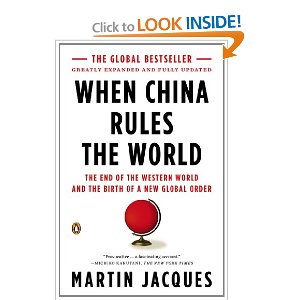
Worth a Look / Listen: When China Rules the World (Book, Audio Lecture)

02 China, Worth A Look
Amazon Page

Reed Business Information: A convincing economic, political and cultural analysis of waning Western dominance and the rise of China and a new paradigm of modernity. Jacques (The Politics of Thatcherism) takes the pulse of the nation poised to become, by virtue of its scale and staggering rate of growth, the biggest market in the world. Jacques points to the decline of American hegemony and outlines specific elements of China's rising global power and how these are likely to influence international relations in the future. He imagines a world where China's distinct brand of modernity, rooted firmly in its ancient culture and traditions, will have a profound influence on attitudes toward work, family and even politics that will become a counterbalance to and eventually reverse the one-way flow of Westernization. He suggests that while China's economic prosperity may not necessarily translate into democracy, China's increased self-confidence is allowing it to project its political and cultural identity ever more widely as time goes on. As comprehensive as it is compelling, this brilliant book is crucial reading for anyone interested in understanding where the we are and where we are going.

40-Minute Audio of 18 Oct 2012

Tip of the Hat to Contributing Editor Berto Jongman.

Phi Beta Iota:  The book and the presentation both suffer from the halting British method, and from a lack of the larger context in which Brazil, India, Indonesia, and Russia at least, but also Iran, Nigeria, and Turkey, have their own growth and influence.  The two key points in favor of the book are its compelling indictment of the failure of the West to think holistically, and its equally compelling depiction of China as a political-economic-cultural entity that is coherent and also consistent at a scale beyond Western imagination — Chinese culture, in the author's view, is more enabling of diversity.  “One Country, Many Systems” in which sovereignty might be extended to many countries (Taiwan first, Argentina later) without imposing communist or statist mores on the new provinces.  The author calls this a “civilization state.”  In contrast to the West, China does not export its values with violence, but focuses instead on soft power that invites others to embrace the values of the Middle Kingdom.  This is a more stable and hence more sustainable form of universalism.  China will shape the world economic order, not the world political order.  China will redefine trade by being the main trading partner for most others; China will redefine finance both in aid and in China's alternative remittances and transfers bypassing the dollar and SWIFT system); and China will redefine culture, nurturing a world of cultures that are not force-fit toward the Western model.


Chuck Spinney – Cogent Analysis pf Arab Spring Seven Key Challenges Not Available from CIA or Department of State – Plus Personal Appeal for Contributions to Keep CounterPunch Going

05 Iran, 08 Wild Cards, Civil Society, Cultural Intelligence, Ethics, Government, IO Deeds of Peace, Knowledge, Military, Peace Intelligence
Chuck Spinney

Jeffrey St Claire, the editor at Counterpunch has given me permission to distribute the attached essay, “The Arab Spring at the Crossroads,” by  Esam Al-Amin.  It was published in the subscription edition of Counterpunch and is not available at the CP website.  Al-Amin, who I do not know, has written a very informative summary of the crosscurrents now shaping the Arab world.  This is a subject of very great importance to the welfare of all Americans.  I urge you to read it carefully.

In addition to being informative, Al-Amin's essay is a prime example of the quality of the information now available in what the mainstream media likes to call the alternative press.  This brings me to my second reason for writing this blaster.  Counterpunch is having a rare fundraising drive and I am taking what for me is an unprecedented action of urging you to contribute.  I think it is important to support alternative news/opinion outlets like Antiwar.com, Truthout, Alternet, and especially, since I am biased, Counterpunch. (Truth in advertising: I counted the late editor Alex Cockburn and still count his co-editor Jeffrey St Claire as friends.)

So, I urge you read the essay below — you can determine whether or not you think it stands on its own merits.  If you feel this is the kind of info worth paying a little for, I encourage you to think about purchasing a subscription or a gift sub for a friend or relative or sending a small tax-deductible donation to  CP's secure sever.  The Counterpunchers promise they won’t contact you to shake you down for more money or sell your name to any lists–not Karl Rove’s and especially not MoveOn’s. To contribute by phone you can call Becky or Deva toll free at: 1-800-840-3683

Chuck Spinney

Please Contribute to CounterPunch.  Printable Document:  Esam Al-Amin on Arab Spring Seven Challenges (9 Page Doc)

The Arab Spring at the Crossroads

Seven Key Challenges

By Esam Al-Amin

CounterPunch Volume 19 Number 17, >October 1-15, 2012, published October 2, 2012

Ever since Napoléon Bonaparte invaded Egypt in 1798, the relationship between the West and the Arab-Muslim East has been contentious and convoluted. Although this military leader of the first French Republic conquered Egypt for strategic reasons in his rivalry with the British and the Ottomans, the Muslim Arabs of the region – later dubbed “the Middle East” by an American naval officer – felt vulnerable, exposed, and weak.

Continue reading “Chuck Spinney – Cogent Analysis pf Arab Spring Seven Key Challenges Not Available from CIA or Department of State – Plus Personal Appeal for Contributions to Keep CounterPunch Going”

David Isenberg: The True Cost (Locally) of Military Strikes Against Iranian Nuclear Targets + Iran Nuclear Meta-RECAP

05 Iran, 08 Wild Cards, Corruption, IO Deeds of War, Military
David Isenberg

The Myth of “Surgical Strikes” on Iran

By David Isenberg

TIME Battleland | October 18, 2012

For all the years that the world has focused on the confrontation between Western nations and Iran, oceans of ink have been spilled over many aspects of its nuclear program — the quantity and quality of its enriched uranium, various UN Security Council resolutions, the number of Iranian centrifuges, IAEA safeguards, compliance with the Non-Proliferation Treaty, diplomatic negotiations, red lines, U.S. and Israeli attack scenarios, possible Iranian responses, the impact of a nuclear Iran, and so on.

Yet, almost nothing has been written about one critical factor: the impact on Iranian civilians, if the U.S. and/or the Israelis were to attack Iran’s nuclear facilities.

That vacuum has now been filled, thanks to a recent lengthy report — The Ayatollah’s Nuclear Gamble: The Human Cost of Military Strikes Against Iran’s Nuclear Facilities. It was authored by Khosrow Semnani, an Iranian-American industrialist and philanthropist with extensive experience in the industrial management of nuclear waste and chemicals.

The University of Utah’s Hinckley Institute of Politics and Omid for Iran, a nonprofit organization based in Salt Lake City, Utah, published the assessment. Author Semnani has provided support for conferences and educational initiatives in the United States.

The report examined various military options against different sites but regardless – perhaps it shouldn’t come as a surprise — the news was horrifyingly bad for Iraqi civilians. Iran insists its nuclear-development efforts are for peaceful purposes, and that it has no desire to build atomic weapons.

Continue reading “David Isenberg: The True Cost (Locally) of Military Strikes Against Iranian Nuclear Targets + Iran Nuclear Meta-RECAP”

Berto Jongman: New World Order (Banks) Facing Challenge from New New World Order (BRICS+)

01 Brazil, 02 China, 03 Economy, 03 India, 06 Russia, 08 Wild Cards, 11 Society, Commerce, Commercial Intelligence, Ethics, Government, Law Enforcement
Berto Jongman

Being read in Europe.

Swiss Study Shows 147 Technocratic “Super Entities” Rule the World

Susanne Posel
Infowars.com
October 10, 2012

Click on Image to Enlarge

The Swiss Federal Institute (SFI) in Zurich released a study entitled “The Network of Global Corporate Control” that proves a small consortiums of corporations – mainly banks – run the world. A mere 147 corporations which form a “super entity” have control 40% of the world’s wealth; which is the real economy. These mega-corporations are at the center of the global economy. The banks found to be most influential include:

• Barclays
• Goldman Sachs
• JPMorgan Chase & Co
• Vanguard Group
• UBS
• Deutsche Bank
• Bank of New York Melon Corp
• Morgan Stanley
• Bank of America Corp
• Société Générale

However as the connections to the controlling groups are networked throughout the world, they become the catalyst for global financial collapse.

Continue reading “Berto Jongman: New World Order (Banks) Facing Challenge from New New World Order (BRICS+)”

Yoda: Muslim Rebels and Philippine Government Agree on Peace

01 Poverty, 03 Economy, 05 Civil War, 08 Wild Cards, 10 Security, 11 Society, Civil Society, Cultural Intelligence, Ethics, Government, IO Deeds of Peace, Law Enforcement, Military, Officers Call, Peace Intelligence
Got Crowd? BE the Force!

Good news this is.

Philippines, Muslim rebels agree on peace pact

EILEEN NG, Associated Press, JIM GOMEZ, Associated Press | Sunday, October 7, 2012 | Updated: Sunday, October 7, 2012 8:44pm

MANILA, Philippines (AP) — The Philippine government and the country's largest Muslim rebel group have reached a preliminary peace deal that is a major breakthrough toward ending a decades-long insurgency that killed tens of thousands and held back development in the south.

Philippine President Benigno Aquino III said the “framework agreement” calling for an autonomous region for minority Muslims in the predominantly Roman Catholic nation was an assurance the Moro Islamic Liberation Front insurgents will no longer aim to secede.

The agreement, announced Sunday and to be signed Oct. 15 in Manila, spells out principles on major issues, including the extent of power, revenues and territory of the Muslim region. If all goes well, a final peace deal could be reached by 2016, when Aquino's six-year term ends, officials said.

“This framework agreement paves the way for final and enduring peace in Mindanao,” Aquino said, referring to the southern Philippine region and homeland of the country's Muslims. “This means that the hands that once held rifles will be put to use tilling land, selling produce, manning work stations and opening doorways of opportunity.”

He cautioned that “the work does not end here” and that details of the accord still need to be worked out. Those talks are expected to be tough but doable, officials and rebels said.

Rebel vice chairman Ghadzali Jaafar said the agreement provides a huge relief to people who have long suffered from war and are “now hoping the day would come when there will be no need to bear arms.”

Continue reading “Yoda: Muslim Rebels and Philippine Government Agree on Peace”

noble gold