Koko: Russia’s President Wants Educational Games

06 Russia, Academia, Advanced Cyber/IO, Articles & Chapters, Civil Society, Cultural Intelligence, Government, Policies
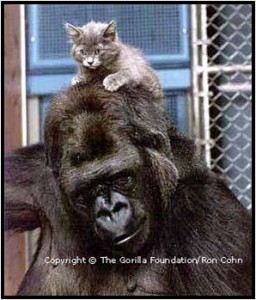
Koko

Russia's President is on to something, with the observation that the best history games would not focus on what was, but on what might have been had true cost information been embedded at each point in time.

Russia's prez wants educational World of Warcraft history game

DVICE.com, 29 July 2011

While the Chinese love World of Warcraft so much they're using them as punishment in labor camps, Russia's President Dmitry Medvedev wants to make a similar game to teach people about Russian history.

Somebody give this guy a chest-bump and a double high-five. Unlike most Presidents, Medvedev is a young guy. He's in tune with pop culture and “what's in” and “cool” and aims to aggressively use new mediums such as MMORPGs as an educational tool.
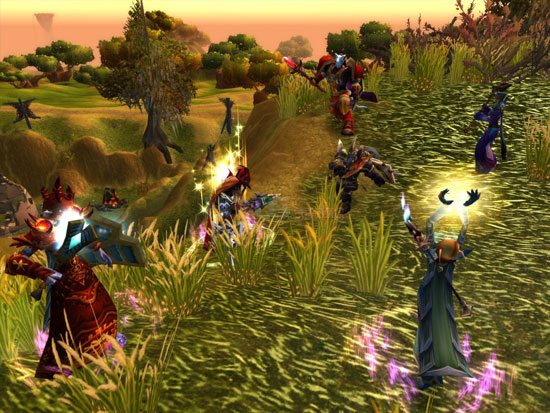
Click on Image to Enlarge

Speaking at a gathering of Russia's cultural and science councils, Medvedev said:

“I've checked what our youth are playing with, and most games are pseudo-historical and fantasy-based.”“Take ‘World of Warcraft.' … It's not all about destruction. It has a subtext about developing human civilization.”

“We could try to make something similar if it's so popular — not globally, perhaps, but at the domestic level.”

Medvedev's idea comes as Russia prepares to celebrate its 1,150th anniversary of statehood next year.

Using video games to drill historical facts into heads? If we had a WoW knock-off when we were still in high school, maybe we'd have been less apt to cutting class to hang underneath the football field bleachers where the “evil” lurked.


Dolphin: DARPA Runs Amok in Afghanistan

07 Other Atrocities, 08 Wild Cards, 10 Security, Analysis, Corruption, Cultural Intelligence, Government, Intelligence (government), IO Impotency, Military, Real Time, Waste (materials, food, etc)

More lipstick on a pig, anyone?

The plethora and pace of the development of these one-off “solutions”
is killing me ….the collective defense and intelligence community
apparently can't keep up with themselves in order to prove who is more
irrelevant…. we continue to throw good money after bad.

Will this ever end?

Exclusive: Inside Darpa’s Secret Afghan Spy Machine

Noah Shachtman

WIRED, 21 July 2011

The Pentagon’s top researchers have rushed a classified and controversial intelligence program into Afghanistan. Known as “Nexus 7,” and previously undisclosed as a war-zone surveillance effort, it ties together everything from spy radars to fruit prices in order to glean clues about Afghan instability.

The program has been pushed hard by the leadership of the Defense Advanced Research Projects Agency. They see Nexus 7 as both a breakthrough data-analysis tool and an opportunity to move beyond its traditional, long-range research role and into a more active wartime mission.

But those efforts are drawing fire from some frontline intel operators who see Nexus 7 as little more than a glorified grad-school project, wasting tens of millions on duplicative technology that has nothing to do with stopping the Taliban.

“There are no models and there are no algorithms,” says one person familiar with the program, echoing numerous others who spoke on condition of anonymity because they are not authorized to discuss the program publicly. Just “200 lines of buggy Python code to do what imagery analysts do every day.”

Read full article….

Phi Beta Iota:  The mind boggles at the idiocy of “reality mining” where the only reality that can be “computed” is digital, and actual reality is  a 15th century pre-analog illiterate society.  The comments at the end of the article are earthy and on target.  The US Government in the aggregate has lost both its intelligence and its integrity.

Chuck Spinney: The Afgan Misadventure in One Paragraph

03 Economy, 04 Inter-State Conflict, 05 Civil War, 07 Other Atrocities, 08 Wild Cards, 10 Security, 11 Society, Budgets & Funding, Corruption, Cultural Intelligence, Government, IO Deeds of War, IO Impotency, Military, Officers Call, Power Behind-the-Scenes/Special Interests, Secrecy & Politics of Secrecy, Strategy, Waste (materials, food, etc)
Chuck Spinney

First, the paragraph:

“The enterprise has proved to be a model of how not to go about such things, breaking all the rules of grand strategy: getting in without having any idea of how to get out; almost wilful misdiagnosis of the challenges; changing objectives, and no coherent or consistent plan; mission creep on an heroic scale; disunity of political and military command, also on an heroic scale; diversion of attention and resources [to Iraq] at a critical stage in the adventure; poor choice of local allies, who rapidly became more of a problem than a solution; unwillingness to co-opt the neighbours into the project, and thus address the mission-critical problem of external sanctuary and support; military advice, long on institutional self-interest, but woefully short on serious objective analysis of the problems of pacifying a broken country with largely non-existent institutions of government and security; weak political leadership, notably in subjecting to proper scrutiny militarily heavy approaches, and in explaining to the increasingly, and now decisively, sceptical domestic press and public the benefits of expending so much treasure and blood.”

Sir Sherard Cowper-Coles
British ambassador in Kabul and as special envoy to Afghanistan and Pakistan

The Afghan misadventure

By Lionel Barber, Financial Times, 22/07/11

Phi Beta Iota:  A full reading of “The Afghan misadventure” by Lionel Barber is highly recommended.  The ends with several lessons not understood in Washington, and a marvelous description of NATO as a “tethered goat.”  He also recommends these three books:

Please respect FT.com's ts&cs and copyright policy which allow you to: share links; copy content for personal use; & redistribute limited extracts. Email ftsales.support@ft.com to buy additional rights or use this link to reference the article – http://www.ft.com/cms/s/2/0feac042-b395-11e0-b56c-00144feabdc0.html#ixzz1SxSELLAY

Cables From Kabul: The Inside Story of the West’s Afghanistan Campaign, by Sherard Cowper-Coles, Harper Press, 352 pages

The Wars of Afghanistan: Messianic Terrorism, Tribal Conflicts and the Failures of Great Powers, by Peter Tomsen, PublicAffairs, 912 pages

Dead Men Risen: The Welsh Guards and the Real Story of Britain’s War in Afghanistan, by Toby Harnden, Quercus, 640 pages

John Robb: Resilience 101 – Close the loop…all of them

Advanced Cyber/IO, Blog Wisdom, Communities of Practice, Earth Intelligence, Ethics, Key Players, Policies, Threats
John Robb

RESILIENT PRODUCTION: Close The Loop!

Reslient, local production can reach amazing levels of capacity and efficiency by obsessively closing loops.  How do you close loops?  Simply:

  1. Turn the waste of one production process into the fuel/input required to operate another.
  2. Do that again and again and again until there is nothing left to reuse.
  3. All along the way, find ways to take the good parts out of each process.  It could be food in one.  Heating/cooling in another.  Fresh water in a third.

For example.  Let's say you want to produce vegitables and fish.  If you did it in a disconnected way, you would be hit with expenses (both monetary and time) at each step in the process.  You would need to fertilize the plants.  Feed the fish.  Clean the water.  It gets expensive early.

If you connected the production systems together, by closing the loops, you would have an aquaponics system.  In an aquaponics system, the fish waste feeds bacteria which in turn produces fertilizer for the plants and fresh water for the fish.  The food the plants produce generate excess that feeds the fish.  With a tiny bit of automation and design, the entire thing operates seemlessly.  Loop closed!  The biggest chore is collecting the bounty.

Closing loops can turn problems into opportunties.  Waste into bounty.

Paul Fernhout: Comments on Integrity at Scale

Advanced Cyber/IO, Analysis, Blog Wisdom, Budgets & Funding, Collective Intelligence, Communities of Practice, Counter-Oppression/Counter-Dictatorship Practices, Cultural Intelligence, Earth Intelligence, Ethics, Key Players, Policies, Serious Games, Threats
Paul Fernhout

Just from the topics, it seems like a more coherent version of this stuff I wrote in 2004:  Achieving the Star Trek Society.

“This essay shows how a total of $14000 billion up front and at least another $2085 billion per year can be made available for creative investment in the USA by adopting a post-scarcity worldview. This money can help further fund a virtuous cycle of more creative and more cost saving efforts, as well as better education. It calls for the non-profit sector to help shape a new mythology of wealth and to take the lead in getting the average person as well as decision makers to make the shift in worldview to their own long term benefit. … Let us consider ways to free up money for the non-profit sector (or
reducing working hours) by cutting wasteful government and consumer
spending in these areas with (annual estimate of easy savings):

Continue reading “Paul Fernhout: Comments on Integrity at Scale”

Chuck Spinney: From Bad to Worse in Afghanistan

03 Economy, 04 Inter-State Conflict, 05 Civil War, 07 Other Atrocities, 08 Wild Cards, 10 Security, 11 Society, Corruption, Government, IO Impotency, Military, Peace Intelligence
Chuck Spinney

From bad to worse in Afghanistan

Peter Eichstaedt

McClatchy News – 20/07/11

KABUL, AFGHANISTAN The assassination of President Hamid Karzai’s half brother, Ahmed Wali Karzai, along with the recent attack on the Intercontinental Hotel in the heart of the capital in Kabul, underscore the increasingly fragile security situation in Afghanistan.

Both events occurred soon after U.S. President Barack Obama announced his intention to begin withdrawing 30,000 “surge” troops beginning this month, with a goal of removing all American forces by the end of 2014.

With the death of Osama bin Laden and claims that his terror network had been crippled in Afghanistan, the president suggested the United States and its international partners had done all they could in the country.

Afghans would have to assume responsibility for security in Afghanistan, the president said.

The hotel attack, however, immediately raised questions about the Afghan military’s capabilities, with eight terrorists successfully overwhelming one of the most secure places in the capital. It was only after NATO helicopters were called in after an all-night firefight that the siege was brought to an end.

While many complain the assault laid bare the weakness of Afghanistan’s security forces, with some guards reportedly fleeing after the first shots were fired, others note that their response was about as good as could have been expected, given the Afghan forces’ level of equipment and training.

What the attack on the hotel did show was the pervasive presence of the Taliban and their growing alliance with other anti-government forces all across the country.

These insurgents in recent months have steadily ratcheted up the size, frequency and effectiveness of these attacks, while showing an alarming ability to penetrate seemingly impenetrable places.

Recent events included the wholesale escape of nearly 500 Talban captives from a prison in the southern province of Kandahar; the dramatic attack on the defence ministry headquarters in Kabul; and the suicide attack on a high-level military meeting in the northern Takhar province that killed one of Afghanistan’s best commanders and injured a NATO general.

Indeed, the list seems to grow daily.

Read full article….

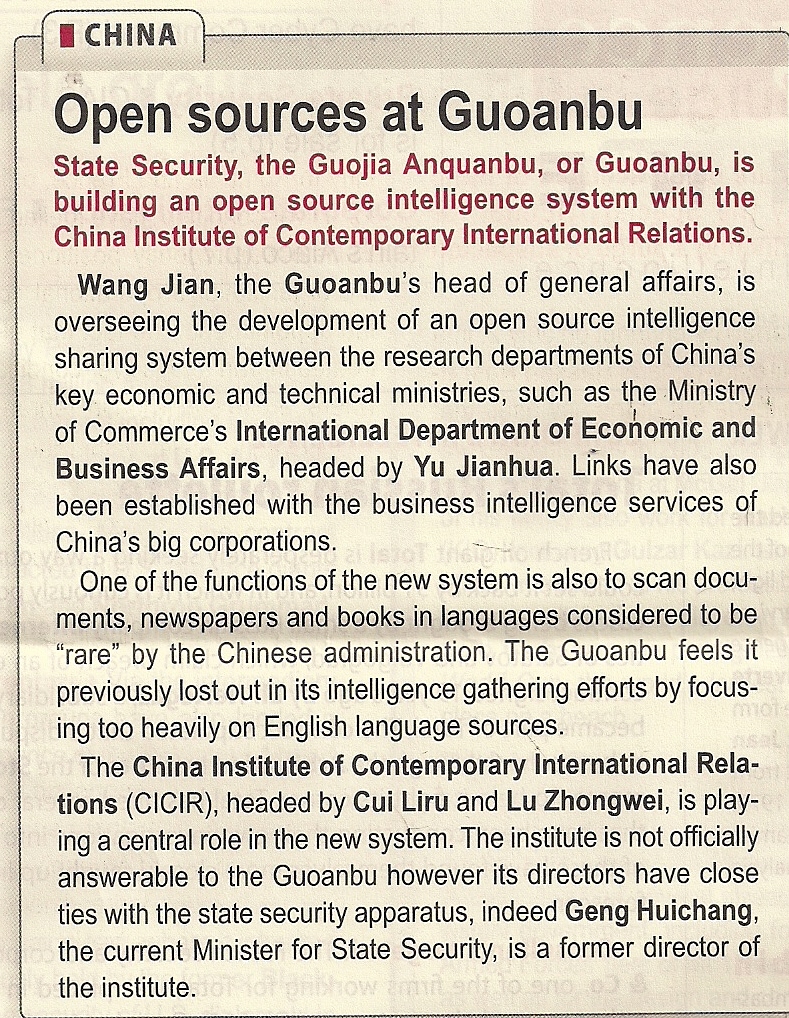
Chinese Create New Open Source Intelligence System

02 China, Advanced Cyber/IO, Cultural Intelligence, Government
Click on Image to Enlarge

Intelligence Online No. 645 July 14, 2011

Phi Beta Iota:  Intelligence Online is the one subscription we cannot live without.  See their other offerings as well.  Reading between the lines, it would appear the Chinese no longer feel “behind” the English-language world, and are doing what the English-language world should have been doing since 1988: focusing on reality as it is depicted in all other languages.

noble gold