Neal Rauhauser: Cost of Secrecy versus Diplomacy

02 Diplomacy, 03 Economy, Ethics, Government, IO Deeds of War
Neal Rauhauser
Neal Rauhauser

Budget Comparison

Usually when we get information about black programs it's the result of two or more errors on the part of Congressmen. One will give a budget for a certain area, another will describe black ops as a percentage of that number, and then we get the actual figure. This time thanks to Edward Snowden we get a 178 page report that ended up in the hands of the Washington Post.

That figure of $52.6 billion is eye catching, since it's roughly equal to that of the State Department's whole operating budget. Also interesting that it's doubled in the last eight years, while Congress forced an 18% cut on the State Department in 2011. This has been widely viewed as a method to sabotage Hillary Clinton's presidential chances in 2016, no matter what the cost to the U.S. might be in the mean time.

I've written about the State Department Witch Hunt over Benghazi, which we recently learned to be an effort by the far right fringe to disrupt and discredit the Obama administration, again without regard to what harm they might be doing to overall U.S. interests.

The executive branch faces a crapflood of, well … crap and our emaciated State Department faces an intractable problem in the Mideast, but the inability to get on top of issues has left the whole region sliding towards chaos. If you're an end of days nut that might seem like a good thing, but most Americans would prefer that we not get dragged into another quagmire.

I am disheartened by what I see. Winning elections matters little when a disloyal fringe abuse any gap they find in our government's checks and balances, dragging us one step closer to collapse with each passing day. Our isolationist tendencies are finally starting to kick in and that ought to be followed by some attention to economic development here at home, but if we end up with some regional conflagration in the Mideast we'll be forced to do something on the basis of longstanding alliances. This will be a triple down on the misadventures of Afghanistan and Iraq, and it's being made to happen against the will of the majority of the American people.


View video.


Jean Lievens: Millennials and the “Sharing” Economy

01 Poverty, 03 Economy, 11 Society, Civil Society, Collective Intelligence, Commercial Intelligence, Cultural Intelligence, Gift Intelligence
Jean Lievens
Jean Lievens

A new generation of cash-strapped ‘millennials' have very different expectations about jobs, credit and money. As Michelle Fleury reports, they are using the internet for a new ‘sharing economy'.

The cash-strapped millennials using ‘sharing economy'

The ‘millennials' are the generation that came of age after the 2008 financial crisis.

Cash-strapped and internet-savvy, they have very different expectations about jobs, credit and money.

Part of the new ‘sharing economy', they have taken to the idea of sharing rather than buying with a vengeance.

Michelle Fleury reports from New York.

See video.

Rickard Falkvinge: The First Global Civil War (Over Civil Liberties)

03 Economy, 05 Civil War, 07 Other Atrocities, 11 Society, Civil Society, Commerce, Cultural Intelligence, Government, Law Enforcement, Media, Peace Intelligence
Rickard Falkvinge
Rickard Falkvinge

The First Global Civil War

Civil Liberties – Lionel Dricot:Manning, Snowden, Assange, Miranda, The Guardian. With each passing day, we receive confirmation of a truth that many would prefer to ignore: we are at war. An undeclared, relatively quiet war, but nonetheless a war.

Unlike a conventional war, a civil war has no well defined front, nor belligerents clearly identifiable by the color of their uniform. Each camp is everywhere, in the same city, the same area, or ​​the same family.

On one hand, there is the class in power. Rich, powerful, they are used to control, they are alien to questions. They simply make decisions and are firmly convinced to do so in the public interest. They have many supporters that are neither rich nor powerful. But they fear any change. Or have strong habits. Or personal interests. Or have the fear of losing some of their properties. Or they simply don’t have the intellectual ability to understand the ongoing revolution.

On the other hand, there is the digital generation. From all sexes, all ages, all cultures, all geographic locations. They talk to each other, exchange experiences. Discovering their differences, they seek common ground while calling into question the deep faith and values ​​of their parents. I call them a “generation” but they are from all ages.

This population has developed values ​​of its own and an uncommon analytical intelligence. They use all the tools available to quickly pinpoint contradictions, ask relevant questions, lift the veil of false appearances. Across thousands of miles, its members can feel empathy towards all humans.

A Growing Gap

Continue reading “Rickard Falkvinge: The First Global Civil War (Over Civil Liberties)”

Eagle: Charles Hugh Smith on Speculative Credit Bubbles and Human Misery Created by Complicity of Corrupt Governments and Central Banks

01 Poverty, 03 Economy, 07 Other Atrocities, 09 Justice, 11 Society, Commerce, Commercial Intelligence, Corruption, Federal Reserve, Government, Idiocy, Law Enforcement, World Bank
300 Million Talons...
300 Million Talons…

The Immense (and Needless) Human Misery Caused by Speculative Credit Bubbles   (August 27, 2013)

Financialization and the Neocolonial Model of credit-based exploitation leave immense human suffering in their wake when speculative credit bubbles inevitably implode.

Discussions of the global financial crisis tend to be bloodless accounts of policy and “growth.” This detachment masks the immense and totally needless human misery created by financial engineering. A correspondent with first-hand knowledge of the situation in Cyprus filed this account:

“RE: the Cyprus economic crisis, the politicians are unbowed by the chaos they caused, still behaving as they have always done, preaching populist platitudes, corrupt as ever, unapologetic. A poll showed that 99% of Cypriots believe their government is corrupt.Yesterday, the former president, Demetris Christofias, appeared before a tribunal investigating the causes of the economic collapse. He tried to force the tribunal to do what he told them, saying, “I am not just any witness, I was the President of the Republic for 5 years”. They told him where to get off and he stormed out.

Little hope for this country. Money leaving. Best talent leaving. Foreign investment in a planned energy hub has been hijacked by the politicians. Cyprus is returning back to what it always was: a tourist destination run by shopkeepers and farmers.Sad days. Most people feel betrayed by the politicians and big powers.”

This report highlights a key dynamic of speculative credit/banking bubbles: they require the complicity of central banks and the state. Speculative bubbles based solely on cash have very short lifespans, as the bubble bursts violently as soon as the gamblers' cash has been sucked into the vortex.

Read full report


General and Ambassador Karl Eikenberry on the Persistent Failure of US Understanding in Afghanistan

02 Diplomacy, 03 Economy, 08 Wild Cards, 09 Justice, 10 Security, 11 Society, Corruption, Director of National Intelligence et al (IC), DoD, Government, Idiocy, Ineptitude, IO Deeds of War, Lessons, Military, Officers Call, Peace Intelligence
Karl W. Eikenberry
Karl W. Eikenberry

使用谷歌翻译在下一列的顶部。

गूगल अगले स्तंभ के शीर्ष पर अनुवाद का प्रयोग करें.

Google sonraki sütunun üstünde Çevir kullanın.

Используйте Google Translate на вершине соседней колонке.

گوگل اگلے کالم میں سب سے اوپر ترجمہ کا استعمال کریں.

Emphasis below added by Milt Bearden, former CIA chief in Pakistan also responsible for the field aspects of the CIA's covert support against Soviet forces in Afghanistan.

Foreign Affairs, September/October 2013

ESSAY

The Limits of Counterinsurgency Doctrine in Afghanistan
The Other Side of the COIN

Karl W. Eikenberry

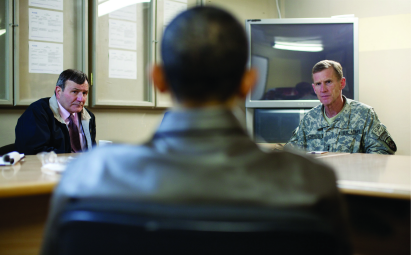
Eikenberry, Obama, and General Stanley McChrystal in Afghanistan, March 2010. (Pete Souza / White House)

KARL W. EIKENBERRY is William J. Perry Fellow in International Security at the Center for International Security and Cooperation at the Freeman Spogli Institute for International Studies at Stanford University. He served as Commanding General of the Combined Forces Command–Afghanistan from 2005 to 2007 and as U.S. Ambassador to Afghanistan from 2009 to 2011.

Since 9/11, two consecutive U.S. administrations have labored mightily to help Afghanistan create a state inhospitable to terrorist organizations with transnational aspirations and capabilities. The goal has been clear enough, but its attainment has proved vexing. Officials have struggled to define the necessary attributes of a stable post-Taliban Afghan state and to agree on the best means for achieving them. This is not surprising. The U.S. intervention required improvisation in a distant, mountainous land with de jure, but not de facto, sovereignty; a traumatized and divided population; and staggering political, economic, and social problems. Achieving even minimal strategic objectives in such a context was never going to be quick, easy, or cheap.

Of the various strategies that the United States has employed in Afghanistan over the past dozen years, the 2009 troop surge was by far the most ambitious and expensive. Counterinsurgency (COIN) doctrine was at the heart of the Afghan surge. Rediscovered by the U.S. military during the wars in Afghanistan and Iraq, counterinsurgency was updated and codified in 2006 in Field Manual 3-24, jointly published by the U.S. Army and the Marines. The revised
doctrine placed high confidence in the infallibility of military leadership at all levels of engagement (from privates to generals) with the indigenous population throughout the conflict zone. Military doctrine provides guidelines that inform how armed forces contribute to campaigns, operations, and battles. Contingent on context, military doctrine is
meant to be suggestive, not prescriptive.

Broadly stated, modern COIN doctrine stresses the need to protect civilian populations, eliminate insurgent leaders and infrastructure, and help establish a legitimate and accountable host-nation government able to deliver essential human services. Field Manual 3-24 also makes clear the extensive length and expense of COIN campaigns:  “Insurgencies are protracted by nature. Thus, COIN operations always demand considerable expenditures of time and resources.

Continue reading “General and Ambassador Karl Eikenberry on the Persistent Failure of US Understanding in Afghanistan”

Greg Palast: Larry Summers the Sum of All Evil — the “End-Game” Memo Proposing the Destruction of Financial Regulation Across the Globe

03 Economy, 07 Other Atrocities, 10 Transnational Crime, 11 Society, Commerce, Corruption, Government, Law Enforcement, Media
Greg Palast
Greg Palast

Larry Summers and the Secret “End-Game” Memo

By Greg Palast for Vice Magazine

When a little birdie dropped the End Game memo through my window, its content was so explosive, so sick and plain evil, I just couldn't believe it.

The Memo confirmed every conspiracy freak's fantasy:  that in the late 1990s, the top US Treasury officials secretly conspired with a small cabal of banker big-shots to rip apart financial regulation across the planet.  When you see 26.3% unemployment in Spain, desperation and hunger in Greece, riots in Indonesia and Detroit in bankruptcy, go back to this End Game memo, the genesis of the blood and tears.

The Treasury official playing the bankers' secret End Game was Larry Summers.  Today, Summers is Barack Obama's leading choice for Chairman of the US Federal Reserve, the world's central bank.  If the confidential memo is authentic, then Summers shouldn't be serving on the Fed, he should be serving hard time in some dungeon reserved for the criminally insane of the finance world.

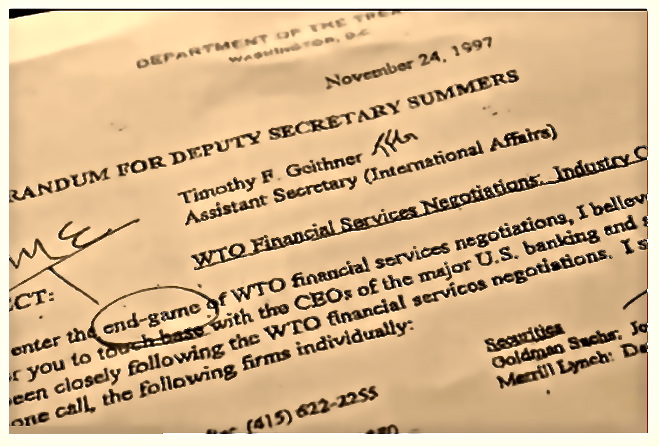
Click on Image to Enlarge

The memo is authentic.

To get that confirmation, I would have to fly to Geneva  and wangle a meeting with the Secretary General of the World Trade Organization, Pascal Lamy.  I did.  Lamy, the Generalissimo of Globalization, told me,

“The WTO was not created as some dark cabal of multinationals secretly cooking plots against the people…. We don't have cigar-smoking, rich, crazy bankers negotiating.”

Then I showed him the memo.

It begins with Summers’ flunky, Timothy Geithner, reminding his boss to call the then most powerful CEOs on the planet and get them to order their lobbyist armies to march:

“As we enter the end-game of the WTO financial services negotiations, I believe it would be a good idea for you to touch base with the CEOs….”

To avoid Summers having to call his office to get the phone numbers (which, under US law, would have to appear on public logs), Geithner listed their private lines.  And here they are:

Continue reading “Greg Palast: Larry Summers the Sum of All Evil — the “End-Game” Memo Proposing the Destruction of Financial Regulation Across the Globe”

Kevin Barrett: US ‘Aid’ Destroys Egypt’s Economy, Democracy

02 Diplomacy, 03 Economy, 04 Inter-State Conflict, 05 Civil War, 07 Other Atrocities, 10 Security, 11 Society, Civil Society, Corruption, Cultural Intelligence, Government, IO Deeds of War, Military, Peace Intelligence
Kevin Barrett
Kevin Barrett

US ‘Aid’ Destroys Egypt’s Economy, Democracy

American President Obama says he deplores the Egyptian junta’s decision to massacre peaceful protesters and declare martial law.

If he deplores it so much, why is he paying for it?

It is no secret that Egyptian strongman el-Sisi and the soldiers he is sending to slaughter protesters are on the US payroll.

According to official estimates, US taxpayers give the Egyptian military 1.3 billion dollars per year in direct military aid. When various forms of indirect aid are taken into account, including money from US puppet states in the Persian Gulf, the real annual total is in the billions.


This lavish US funding has allowed Egypt’s military to balloon into a monster that controls between one-quarter and one-third of the Egyptian economy. That is why Egypt is economically moribund.

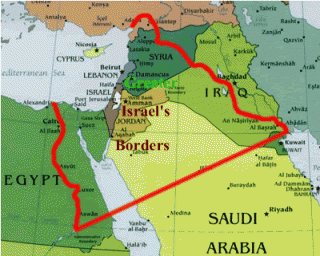
Click on Image to Enlarge

Military spending kills economies, as shown by Dr. Robert Reuschlein of RealEconomy.com. Money wasted on militaries, which are non-productive organizations, is stolen from the productive sector. In societies with large militaries, the best scientists, engineers, and other experts stop producing valuable goods and services, and spend their lives figuring out how to destroy things and kill people. And poorer people, instead of becoming productive citizens, are trained to mindlessly obey orders and kill on command. Many of them suffer severe psychological damage that renders them non-productive.

In Egypt, the military’s economic hegemony creates even more problems.

Egypt has inherited a millennia-old authoritarian bureaucratic tradition. Pharaohs, emirs, presidents-for-life, and generals serve as dictators, and their bureaucratic lackeys have the high-status, high-paying jobs. Productive people are considered mere peasants and tradesmen, inferior in status to the bureaucrats.

British colonialism, which imposed a new layer of foreign bureaucracy, worsened the problem. Bright young Egyptians were trained to believe they were owed government jobs when they graduated from college. Widespread belief that “the government owes me a high-paying non-productive job” persists in Egypt. And the military officers and their cronies are the biggest and most bloated parasites.

Continue reading “Kevin Barrett: US ‘Aid’ Destroys Egypt’s Economy, Democracy”

noble gold