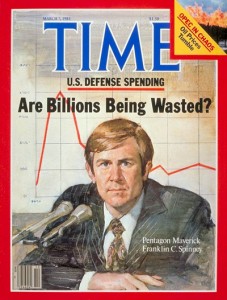
Journal: What’s Wrong with American defense….

03 Economy, 04 Inter-State Conflict, 07 Other Atrocities, 10 Security, 11 Society, Analysis, Budgets & Funding, Commerce, Commercial Intelligence, Corporations, Corruption, Cultural Intelligence, Government, History, InfoOps (IO), Methods & Process, Military, Officers Call, Politics of Science & Science of Politics, Secrecy & Politics of Secrecy, Standards, Strategy, Technologies

Chuck Spinney Recommends...

Phi Beta Iota: Notes summarizing the 59 minute video are below the line.

….Watch this!!!!!  My good friend Pierre Sprey interviews Bill Hartung on Book TV about Hartung's new book, Prophets of War: Lockheed Martin and the Making of the Military-Industrial Complex.

The book is a history of the largest military contractor in U.S. history, Lockheed Martin.  Hartung argues that with 25 billion dollars annually in Defense Department contracts, Lockheed Martin's reach into American life is extensive and largely unknown, including creation of satellites used to spy on the phone calls of American citizens.  He discusses the company's size, scope and influence with Pierre Sprey, father of the A-10 and F-16 military aircraft and a well-known thorn in the Pentagon's side.  Chuck

William Hartung

Mr. Hartung is the director of the Arms and Security Initiative at the New America Foundation.  He is the author of How Much are You Making on the War Daddy? and And Weapons for All.  He's written for the Washington Post, the New York Times, the Los Angeles Times and The Nation magazine.

NOTE:  Title leads to Words, WATCH leads to the actual playing of the video.

After Words: William Hartung, "Prophets of War," hosted by Pierre Sprey

Summary of the 59 minute back and forth CSPAN BookTV Interview:

Continue reading “Journal: What’s Wrong with American defense….”

Journal: It’s a Depression–and It is NOT Getting Better….

03 Economy, Collaboration Zones, Communities of Practice, IO Sense-Making, Key Players
Chuck Spinney Recommends...

“End of the Recession? Who's Kidding Whom?”

Immanuel Wallerstein<

Commentary No. 296, Jan. 1, 2011

The media are telling us that the economic “crisis” is over, and that the world-economy is once more back to its normal mode of growth and profit. On December 30, Le Monde summed up this mood in one of its usual brilliant headlines: “The United States wants to believe in an economic upturn.” Exactly, they “want to believe” it, and not only people in the United States. But is it so?

First of all, as I have been saying repeatedly, we are not in a recession but in a depression. Most economists tend to have formal definitions of these terms, based primarily on rising prices in stock markets. They use these criteria to demonstrate growth and profit. And politicians in power are happy to exploit this nonsense. But neither growth nor profit is the appropriate measures.

Read full article….

Journal: Detriot in Ruins–End of Empire From 1960’s…

03 Economy, 04 Education, 05 Energy, 09 Justice, 11 Society, Budgets & Funding, Commercial Intelligence, Communities of Practice, Corporations, Corruption, Cultural Intelligence, info-graphics/data-visualization, IO Sense-Making, Money, Banks & Concentrated Wealth, Power Behind-the-Scenes/Special Interests, Waste (materials, food, etc)
Who, Me?

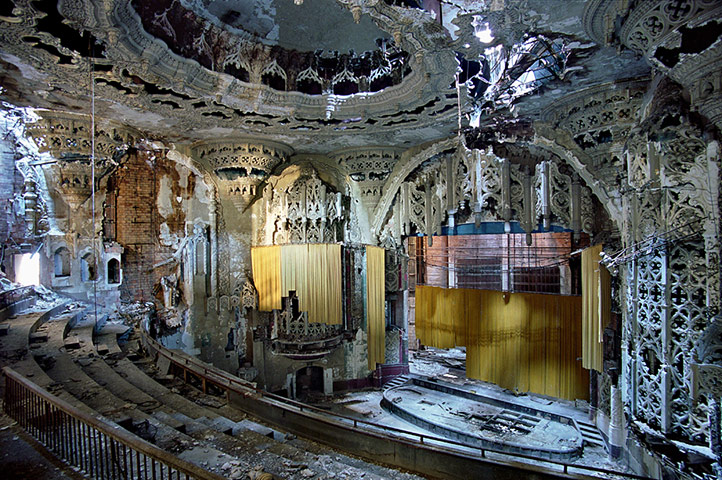
Detroit in ruins: the photographs of Yves Marchand and Romain Meffre

Guardian, Sunday 2 January 2011

Sean O'Hagan

Article

Photo Gallery Direct

In downtown Detroit, the streets are lined with abandoned hotels and swimming pools, ruined movie houses and schools, all evidence of the motor city's painful decline. The photographs of Yves Marchand and Romain Meffre capture what remains of a once-great city – and hint at the wider story of post-industrial America

. . . . . . .

Click to Enlarge

Cumulatively, the photographs are a powerful and disturbing testament to the glory and the destructive cost of American capitalism: the centre of a once-thriving metropolis in the most powerful nation on earth has become a ghost town of decaying buildings and streets. There is a formal beauty here too, though, reminiscent of Robert Polidori's images of post-hurricane Katrina New Orleans. “It seems like Detroit has just been left to die,” says Marchand, “Many times we would enter huge art deco buildings with once-beautiful chandeliers, ornate columns and extraordinary frescoes, and everything was crumbling and covered in dust, and the sense that you had entered a lost world was almost overwhelming. In a very real way, Detroit is a lost world – or at least a lost city where the magnificence of its past is everywhere evident.”

. . . . . . .

Click to Enlarge

The Ruins of Detroit tells the city's story so far in one starkly beautiful photograph after another, all of which add up to nothing less than an end-of-empire narrative. Or as Sugrue puts it: “The abandoned factories, the eerily vacant schools, the rotting houses, and gutted skyscrapers that Yves Marchand and Romain Meffre chronicle are the artefacts of Detroit's astonishing rise as a global capital of capitalism and its even more extraordinary descent into ruin, a place where the boundaries between the American dream and the American nightmare, between prosperity and poverty, between the permanent and the ephemeral are powerfully and painfully visible. No place epitomises the creative and destructive forces of modernity more than Detroit, past and present.”

Journal: In Money-Changers We Trust

03 Economy, 07 Other Atrocities, Budgets & Funding, Commerce, Corruption, Cultural Intelligence, Government, Money, Banks & Concentrated Wealth, Power Behind-the-Scenes/Special Interests, Secrecy & Politics of Secrecy

Chuck Spinney Recommends...

In Money-Changers We Trust

TruthDig Posted on Dec 28, 2010

By Robert Scheer

Two years into the Obama presidency and the economic data is still looking grim. Don’t be fooled by the gyrations of the stock market, where optimism is mostly a reflection of the ability of financial corporations—thanks to massive government largesse—to survive the mess they created. The basics are dismal: Unemployment is unacceptably high, the December consumer confidence index is down and housing prices have fallen for four months in a row. The number of Americans living in poverty has never been higher, and a majority in a Washington Post poll said they were worried about making their next mortgage or rent payment.

In a parallel universe lives Peter Orszag, President Barack Obama’s former budget director and key adviser, who even faster than his mentor, Robert Rubin, has passed through that revolving platinum door linking the White House with Wall Street. The goal is to use your government position to advance the interests of your future employer, and Orszag and Rubin’s actions in the government and then at Citigroup provide stunning examples of the synergy between big government and high finance.

Read more….

See Also:

Reference: 2011 Brave New Dystopia

Search: US fraud tri-fecta

Journal: Who’s Better for the U.S. Economy? Democrats or Republicans? A Second Look

03 Economy
Chuck Spinney Recommends...

Last November, I distributed a blaster that compared changes in the debt burdens to Presidential administrations from Harry Truman to George W. Bush.  For readers who missed it, James Fallows of the Atlantic Magazine picked it up and published it here.  At the time, its stark pattern generated considerable interest and criticism, but I suggested that assigning responsibility for was a complex issue and that this chart was only a “first cut.”  Attached herewith is an analysis that could be considered a “second cut” into the general question of whether Democrats or Republicans are better for the economy.  Like my table on changing debt burdens, this “2nd cut” is by no means a definitive answer to the general question of what politics are more responsible for our current economic mess, but it is also interesting in its starkness of patterns.

The author must remain anonymous, because he is an apolitical career civil servant in the Senior Executive Service (SES) of the US government.  I can say that he was hired during a Republican Administration.  He is  relatively conservative (probably center right and certainly not a partisan member of the so-called left). He is not an economist, but has a PhD in a hard science; he is extremely well read; and I have long had enormous respect for his wide-ranging curiosity.

The attached analysis has three tables which may not convey in some email systems; therefore, for those readers having I am attaching this report in pdf format and MS Word format for those of you who have trouble reading this.

Chuck Spinney

The US Economy: Are Republicans or Democrats Better?

by SES X

PDF Report

Conclusion:

Continue reading “Journal: Who's Better for the U.S. Economy? Democrats or Republicans? A Second Look”

Journal: US Corporations Growing Outside US, No Jobs In US

03 Economy, 07 Other Atrocities, 11 Society, Civil Society, Commerce, Corruption, Cultural Intelligence, Government
Chuck Spinney Recommends...

I received this email from a close friend, a Republican of the old school:

“When 50+ years ago Engine Charlie Wilson said what's good for General Motors is good for America, he was mostly right. Now corporations have turned that aphorism on its head.”

Tuesday, Dec 28, 2010 08:03 ET

Where are the jobs? Overseas, of course

American consumers have little to do with the big profits many top American corporations are now racking up

By PALLAVI GOGOI, Associated Press

Corporate profits are up. Stock prices are up. So why isn't anyone hiring?

Actually, many American companies are — just maybe not in your town. They're hiring overseas, where sales are surging and the pipeline of orders is fat.

EXTRACT: Harvard Business School Dean Nitin Nohria worries that the trend could be dangerous. In an article in the November issue of the Harvard Business Review, he says that if U.S. businesses keep prospering while Americans are struggling, business leaders will lose legitimacy in society. He exhorted business leaders to find a way to link growth with job creation at home.

Other economists, like Columbia University's Sachs, say multinational corporations have no choice, especially now that the quality of the global work force has improved. Sachs points out that the U.S. is falling in most global rankings for higher education while others are rising.

“We are not fulfilling the educational needs of our young people,” says Sachs. “In a globalized world, there are serious consequences to that.”

Read complete article at Salon.com….

See Also:

Reference: 2011 Brave New Dystopia

Search: US fraud tri-fecta

Journal: Globalization and the Middle Class

03 Economy, 07 Other Atrocities, 11 Society, Budgets & Funding, Civil Society, Commerce, Commercial Intelligence, Corruption, Cultural Intelligence
Who Am I?

Phi Beta Iota: Penguin is a new Contributing Editor who is still learning the system and also undecided about having a bio, even a relatively anonymous one.

This Week on The Globalist
December 18-24, 2010

Middle Class and Globalization: A Big Power Comparison (Part I)

In this time of economic strife, which nation stands to lose the most compared to its own expectations, projected path and historic experiences? The Richter Scale takes a closer look.

Middle Class and Globalization: A Historical Perspective (Part II)

The Richter Scale explores whether the United States is finally getting serious about reinvigorating its middle class.

The Globalist's Top Ten Books of 2010

In this 2010 year-end special, we look back at the best new books featured on The Globalist Bookshelf this year.

The Globalist's Top Ten Features of 2010

As 2010 draws to a close, we present our selection of the most thought-provoking features published on The Globalist this year.

The Top Headlines of 2010

From the economic recession to the World Cup, how did 2010's major events look to the world's headline writers?


noble gold