Y Combinator Hacker News Community’s Model for Info-Sharing & Potential for Collective Intelligence

03 Economy, 04 Education, 11 Society, Academia, Civil Society, Collective Intelligence, Commerce, Cultural Intelligence, Government, Hacking, Law Enforcement, Media, Military, Mobile, Non-Governmental, Peace Intelligence, Technologies

Hacker News” has a welcome page and guidelines page offering an overview of what the organizers expect from those planning on posting comments and why it's good overall for the community.  I (Jason Liszkiewicz) was impressed with this. Hacker News has a solid number of participants and provides a simple and mature format for exploring and contributing thoughtful feedback, insight and resources.

It has a jobs link (mainly for engineers and programmers) and the “Ask Hacker News” link which enables the community to share information and reply to what is shared. Such a model (deemed an “experiment”) that provides mature and thoughtful information-sharing is something we need more of. Communities inter-linking with communities (or at least over-lapping) to spill over each others insights can be invaluable and potentially priceless.

Example: Ask HN: What do you perceive as worth spending money on?

This simple and useful model is something I hoped would emerge + converge from the SMS/text messaging developers at ChaCha.com (humans online responding to text messaged questions) or somewhere else. Converging multi-community info-sharing online, offline, and through the mobile world on a global scale is an exciting possibility.

The next level to all of this exists in the form of ideas or fragmented applications but it seems not beyond that, yet.

Email earthintelnet|at|gmail.com or post something at this new forum to discuss these ideas. Or, provide some mature and thoughtful feedback at the Hacker News community.


Journal: Steve Denning–Change Accounting to Create Jobs

03 Economy, 11 Society
Steve Denning

Steve Denning, former Chief Knowledge Officer (CKO) at the World Bank, tried to teach  them that they were a knowledge bank, not a money bank.  It did not stick but others are listening to him and so do we.

Building on an earlier posting that was copied here, Journal: 21st Century Management–New Rules

, today he addresses why cost accounting is killing jobs (labor used to be a variable and very expensive cost to be driven down), why a new form of accounting, throughput accounting, is needed, and why “bad profit” is a negative not a positive–an argument similar to what those who advocate not counting prisons and hospitals as “productive.”

READ HIS NEW BLOG POSTING

Journal: Pentagon Financial System–Broken by Design

03 Economy, 10 Security

Earth to Pentagon: Follow the Freaking Money!

David Isenberg, Huffington Post, 12 September 2010

Author, Shadow Force: Private Security Contractors in Iraq

QUOTE FROM IG REPORT:   Early-on in the review, the staff identified one all-important, central element that is adversely affecting every facet of the OIG audit program — the DOD's broken accounting system. This dysfunctional system is driving the audit freight train. The success or failure of an audit turns on the quality of financial data available for audit by competent examiners. Unfortunately, the quality of the financial data presented to OIG auditors by DOD during the period reviewed by the staff should probably be rated as poor to non-existent. Having lost control of the money at the transaction level, DOD's broken accounting system is incapable of generating accurate financial records. The consequences are predictable. Most of the time, OIG auditors report: “no audit trail” found.

Phi Beta Iota: The people managing the Pentagon are very smart.  The financial system is broken because they want it that way and Congress and We the People have let them get away with it since World War II.  This is not rocket science.  CISCO closes its books every single night.  The Pentagon and Wall Street are the last two crap games in town, and both are rigged.  Below is the headline with link to History Commons, and for convenience, the full entry there:

September 10, 2001: Rumsfeld Announces Defense Department Cannot Track $2.3 Trillion in Transactions

Continue reading “Journal: Pentagon Financial System–Broken by Design”

Worth a Look: Open Farm Technology

01 Agriculture, 03 Economy, Worth A Look

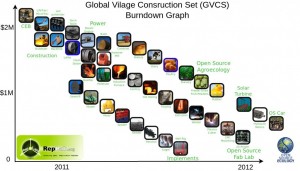
Open Source Ecology

Building tools for replicable, open source, post-scarcity resilient communities

We are farmer scientists – working to develop a world class research center for decentralization technologies using open source permaculture and technology to work together for providing basic needs and self replicating the entire operation at the cost of scrap metal. We seek societal transformation through interconnected self-sufficient villages and homes. This is a stepping stone to transcending survival and evolving to freedom. Factor e Farm is the land-based facility where we put this theory, Open Source Ecology, into practice.

See below as a scalable PowerPoint 97-2003

The Master Plan

Tip of the Hatto Brandin Watson via email.

See Also:

Graphic: Open Everything

2009 Briefing: Open Everything at UNICEF in NYC

2007 Open Everything: We Won, Let’s Self-Govern

Review: The World Is Open–How Web Technology Is Revolutionizing Education

Journal: Gallup Poll on US Public Concerns

03 Economy, 09 Justice, 11 Society, Civil Society, Corruption, Cultural Intelligence

September 10, 2010

Nine Years After 9/11, Few See Terrorism as Top U.S. Problem

One percent see it as the top problem today, down from 46% in 2001

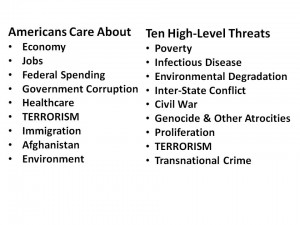
PRINCETON, NJ — Nine years after the terrorist attacks of Sept. 11, 2001, 1% of Americans mention terrorism as the most important problem facing the country, down from 46% just after the attacks.

. . . . . . .

Still, Americans rated economic issues such as the economy, jobs, and federal spending, as well as corruption in government and healthcare, even higher. They rated terrorism as more important than immigration, Afghanistan, and the environment.

US versus Global Cares
See Also:

Journal: Unemployment Up AND Gap in Skills

03 Economy, 04 Education

Skilled worker positions go unfilled, despite high unemployment

Employers cannot find job candidates with the most sought-after ability

By John Schmid of the Journal Sentinel

Sept. 11, 2010 7:06 p.m

EXTRACT 1:  According to Manpower Inc., the global job-placement company, the nation has a gaping disconnect between openings and qualified candidates – a gap contributing to around 3 million unfilled U.S. jobs – which in turn hampers growth.

EXTRACT 2: Talent shortages span a broad scale, from engineers who can contribute to global development teams to electricians, mechanics and other specialized machine-shop skills that have seen waves of retirees exit the workforce in recent years without a commensurate wave of apprenticeships to replace them.

EXTRACT 3: “Notwithstanding all our best efforts in attempting to fix the system with recent improvements in workforce development, the pipeline is broken,” Sullivan said. “The fact that virtually all (kindergarten through 12th grade) education in southeastern Wisconsin is based solely on a college prep curriculum, with no exposure to industrial arts, means we are not feeding the market with the right skill sets.”

EXTRACT 4:  Resigned they might not find the exact candidates they need, even from abroad, employers will begin to abandon the notion of the ideal candidate. Instead, they will seek the most “teachable fit.”  This is a new breed of job candidate – folks who lack some qualifications “but whose capability gaps can be filled in a timely and cost-effective way.” Employers who are willing to set up in-house training academies increasingly will look outside their traditional industries.

SEE LIST OF TEN TOP JOBS LACKING FILLS

CounterPunch on Defense & Economy

03 Economy

What Did the Pentagon Do With That Extra Trillion Dollars?

The Surge in Defense Spending

By WINSLOW T. WHEELER

EXTRACT:  Finally, that $102 billion efficiency drive being pursued by Secretary Gates is over five years. The current Pentagon budget plan is to spend $3.245 Trillion over that period. In other words, the much touted Gates plan would shift from overhead to hardware just 3 percent of the planned spending.

READ ARTICLE ONLINE

+ + + + + + +

The Angelides Commission Squints Back at the Bank Bailout and the Fall of Lehman

Does Our Economy Really Have to Run on Fraud?

By MICHAEL HUDSON

EXTRACT: Given today’s florid emotionalism when it comes to discussing Wall Street finances, it hardly is surprising that the Angelides hearings do not dare venture into such territory as to ask whether the bottom 90 per cent of the U.S. economy might need to be bailed out with debt relief just as Wall Street’s elites were.

READ ARTICLE ONLINE