Berto Jongman: Top 10 Whistle Blowers

09 Justice, 11 Society, Civil Society, Ethics, Government, IO Deeds of Peace, Military, Officers Call
Berto Jongman

Top 10 Most Influential Whistleblowers

The subject of insiders — or “whistleblowers” — is somewhat tricky; anyone on the inside is often presumed to be compromised by their former allegiance. Nonetheless, the nature of government work is rooted in compartmentalization. So, perhaps the best indication as to whether whistleblowers have something valid to say is the level of persecution they have endured.

The following whistleblowers have endured a varying degree of pushback from the system, but are still around to reveal key points of information that make us all question what we are being told by our government and the corporate media.

List Only, In Order Presented:

01 Jesslyn Radack, Department of Justice
02 Thomas Drake, National Security Agency
03 William Binney, National Security Agency
04 Matt Klein, AT&T for the National Security Agency
05 Sibel Edmonds, Federal Bureau of Investigation
06 Susan Linauer, Central Intelligence Agency and Department of Justice
07 Anthony Shaffer, Department of Defense
08 Joe Banister, Internal Revenue Service
09 Bradley Manning, Departments of Defense and State
10 Julian Assange, WikiLeaks

Read snapshots and watch individual videos.

Berto Jongman: Genocide’s Definition Revisited – More About Cultural Extinction than Mass Violence

06 Genocide, 11 Society, Cultural Intelligence
Berto Jongman

Genocide's Definition Revisited

Alexander J. Motyl

World Affairs, 19 October 2012

If you think you know what Raphael Lemkin, the originator of the term genocide, thought about genocide, think again. A dissertation-in-progress on Lemkin and the history of the United Nations Genocide Convention by Douglas Irvin-Erickson, a doctoral student in global affairs at Rutgers University-Newark, is likely to change how we think and talk about genocide.

As Irvin-Erickson writes in an article (“The Romantic Signature of Raphael Lemkin”) scheduled to appear in the Journal of Genocide Research:

Lemkin used the work of an art historian to define nations as “families of minds”…. Lemkin intended the word genocide to signify the cultural destruction of peoples, which could occur without a perpetrator employing violence at all. In his 1944 Axis Rule in Occupied Europe, Lemkin wrote that genocide was “a coordinated plan of different actions aiming at the destruction of essential foundations of the life of national groups, with the aim of annihilating the groups themselves.” A colonial practice, genocide had two phases: “One, the destruction of the national pattern of the oppressed group; the other, the imposition of the national pattern of the oppressor.”

Genocide, in other words, is not, in Lemkin’s understanding, about mass killing per se, but about the destruction of nations qua nations. Mass killing is, thus, a means to the end of genocide, and not its goal.

Lemkin adopted his definition of a nation as a family of minds in the context of his writing on the French genocide against Algeria, where he believed that the French colonial power was breaking the “bodily and mental integrity” of the Algerian people.… The goal of the genocide, Lemkin wrote, was to integrate Algerians into the French Republic and prevent Algeria from emerging from colonial rule.

Read full article.

Owl: World Bank Leading Eugenics Actor? + Eugenics RECAP

06 Family, 07 Health, 11 Society
Who? Who?

The article provides no substantive information on World Bank vaccination programs including undeclared sterilization protocols, but past reports have found that various parties have in fact executed such programs.

Leading World Bank Demographer: Vaccination Campaigns Part Of Population Reduction Policy

Jurriaan Maessen

ExplosiveReports.Com

October 4, 2012

On October 2nd a retired demographer at the World Bank admitted that vaccination campaigns are an integral part of the World Bank’s population policies. John F. May, the Bank’s leading demographer from 1992 to 2012, told the French web journal Sens Public (and in turn transcribed by the think-tank May works for) that vaccination campaigns, especially in so-called “high-fertility countries”, are means to achieve population reduction in those countries. May:

“The means used to implement population policies are “policy levers” or targeted actions such as vaccination campaigns or family planning to change certain key variables.”

Continue reading “Owl: World Bank Leading Eugenics Actor? + Eugenics RECAP”

Berto Jongman: New World Order (Banks) Facing Challenge from New New World Order (BRICS+)

01 Brazil, 02 China, 03 Economy, 03 India, 06 Russia, 08 Wild Cards, 11 Society, Commerce, Commercial Intelligence, Ethics, Government, Law Enforcement
Berto Jongman

Being read in Europe.

Swiss Study Shows 147 Technocratic “Super Entities” Rule the World

Susanne Posel
Infowars.com
October 10, 2012

Click on Image to Enlarge

The Swiss Federal Institute (SFI) in Zurich released a study entitled “The Network of Global Corporate Control” that proves a small consortiums of corporations – mainly banks – run the world. A mere 147 corporations which form a “super entity” have control 40% of the world’s wealth; which is the real economy. These mega-corporations are at the center of the global economy. The banks found to be most influential include:

• Barclays
• Goldman Sachs
• JPMorgan Chase & Co
• Vanguard Group
• UBS
• Deutsche Bank
• Bank of New York Melon Corp
• Morgan Stanley
• Bank of America Corp
• Société Générale

However as the connections to the controlling groups are networked throughout the world, they become the catalyst for global financial collapse.

Continue reading “Berto Jongman: New World Order (Banks) Facing Challenge from New New World Order (BRICS+)”

Berto Jongman: Food Security Index & Map 2013

01 Agriculture, 03 Economy, 05 Energy, 06 Family, 07 Health, 09 Justice, 10 Security, 11 Society, 12 Water, Earth Intelligence
Berto Jongman

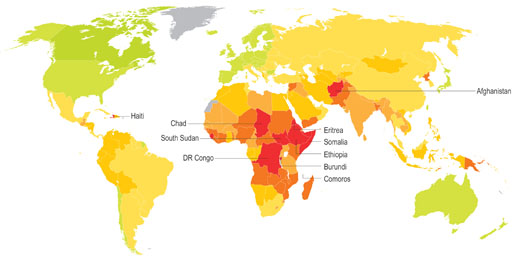
Food security in 75% of African countries at high or extreme risk – Maplecroft global index

‘Arab Awakening' countries at increased risk from 2013 food price shocks

10/10/2012

Despite strong economic growth, food security remains an issue of primary importance for Africa, according to a new study by risk analysis company Maplecroft, which classifies 75% of the continent’s countries at ‘high’ or ‘extreme risk.’

Click on Image to Enlarge

In the light of recent food price spikes, the findings are especially significant for areas of sub-Saharan Africa where poverty, armed conflict, civil unrest, drought, displacement and poor governance can combine to create conditions where a food crisis may take hold.

Africa accounts for 39 of the 59 most at risk countries in Maplecroft’s Food Security Risk Index and hosts nine of the eleven countries in the ‘extreme risk’ category. These include: Somalia and DR Congo (ranked joint 1st in the index), Burundi (4), Chad (5), Ethiopia (6), Eritrea (7), South Sudan (9), Comoros (10) and Sierra Leone (11). The countries of Haiti (3) and Afghanistan (8) complete the category.

Read full article.

Tom Atlee: Public Wisdom Practical Links

11 Society, Advanced Cyber/IO, Civil Society, Cultural Intelligence, Ethics, Government, Links (Global Security)
Tom Atlee

21st Century Town Meetings

Appreciative Inquiry

Argument Mapping

Asset-Based Community Development (ABCD)

bCisiveOnline

Canada Maclean experiment

charrette

choice-creating

citizen consensus councils (CCCs)

citizen deliberative councils (CDCs)

citizen councilor forums

citizen panels [By Popular Demand]

citizen reflective councils


Amazon Page

Citizens’ Assembly

citizens juries

civic journalism

Community-Based Watershed Management Councils

community quality of life indicators

Commons Cafés

Community Forums Network

Community vision programs

Consensus Conferences aka Danish Technical Panels

Consensus Councils

Continue reading “Tom Atlee: Public Wisdom Practical Links”

noble gold