Journal: Dennis Kucinich Introduces Monetary Reform

03 Economy, 07 Other Atrocities, 11 Society, Budgets & Funding, Civil Society, Collective Intelligence, Commerce, Commercial Intelligence, Corporations, Counter-Oppression/Counter-Dictatorship Practices, Cultural Intelligence, Government, InfoOps (IO), Methods & Process, Money, Banks & Concentrated Wealth, Power Behind-the-Scenes/Special Interests, Strategy
Dennis Kucinich

Dear Friends of the American Monetary Institute,

IMPORTANT MONETARY NEWS ALERT:   MAJOR, HISTORIC PROGRESS BEING MADE

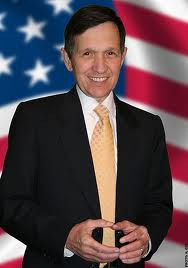
On Friday December 17th Congressman Dennis Kucinich (D,Ohio, 10th District) took a crucial and heroic step to resolve our growing financial crisis and achieve a just and sustainable money system for our nation by introducing the National Emergency Employment Defense Act of 2010, abbreviated NEED. The bill number is  HR6550.

While the bill focuses on our unemployment crisis, the remedy proposed contains all the essential monetary measures being proposed by the American Monetary Institute in the American Monetary Act. These are what decades of research and centuries of experience have shown to be necessary to end the economic crisis in a just and sustainable way, and place the U.S. money system under our constitutional checks and balances. Yes it can be done!

We expect this bill will also be re-introduced next year in the 112th Congress. By putting it in now Congressman Kucinich accomplishes these important things:

* First, the seriousness of intent is underscored;

* Second, it gives our nation the opportunity to view, discuss and understand the necessary provisions, giving the chance to make improvements for re-introduction;

* Third it serves as a beacon to our beleaguered people, cutting through the error, vested interest and disinformation that has blocked monetary reform understanding and action in the past.

The American Monetary Institute has activated its blog to discuss and review any questions about this act. Just click on the blog link at our homepage.

To participate in this process, please sign up at the bottom of our home page at . Then, after reading the proposed legislation feel free to make comments or put questions on the blog, including thoughtful suggestions on how it might be improved.

You can read a copy of the legislation here.

Warm regards to all,
Stephen Zarlenga
AMI

See Also:

Dennis Kucinich on the Proposed Monetary Reform

New Economy Network

Dennis Kucinich, Vice President for the Commonwealth–and Some Details

Journal: Denial of Service Attacks on Humanitarian Sites

07 Other Atrocities, 10 Security, 11 Society, Computer/online security, Gift Intelligence, IO Multinational, Non-Governmental
Berto Jongman Recommends...

DDoS Attacks Continue to Plague Human Rights Sites

By: Chloe Albanesius

PC Magazine, 12.22.2010

WikiLeaks and Operation Payback have put distributed denial of service (DDoS) attacks in the news recently, but independent media and human rights Web sites have been battling these attacks on a consistent basis with no easy solution in sight, according to a Wednesday study.

While major sites can fend off a DDoS or recover quickly, smaller sites can be crippled by these attacks, which often hit in conjunction with other attacks like filtering, intrusions, and defacements, according to the Berkman Center for Internet & Society.

“DDoS is an increasingly common Internet phenomenon capable of silencing Internet speech, usually for a brief interval but occasionally for longer,” the report said. “Our report offers advice to independent media and human rights sites likely to be targeted by DDoS but comes to the uncomfortable conclusion that there is no easy solution to these attacks for many of these sites, particularly for attacks that exhaust network bandwidth.”

The report's authors suggest that DDoS attacks will become more common amidst news about similar WikiLeaks and Operation Payback attacks. Even before that, however, DDoS attacks on independent media and human rights sites were quite common during the last year, happening even outside of major events like elections, protests, and military operations.

These sites are being hit with two types of DDoS: application and network. Application attacks exhaust local server resources and can usually be rectified with the help of a skilled system admin. Network attacks, however, exhaust network bandwidth and can usually only be fixed with the (costly) help of a hosting provider.

Read rest of article….

Journal: Israel Persists on Polard–an Information Operations (IO) Case Study

07 Other Atrocities, 08 Wild Cards, 09 Justice, 10 Security, 11 Society, Corruption, Cultural Intelligence, Government, IO Sense-Making, Military, Officers Call
Marcus Aurelius Recommends

In Wash Post article on CIA's Wikileaks TF, passed u/s/c, the following quote closes the piece, “the former high-ranking CIA officer said. “Nobody could carry out enough paper to do what WikiLeaks has done.””  Not sure that's true.  Open source reporting not long after his trial indicated that Pollard hand carried tremendous volumes of paper documents out of his office to the Israelis; if memory serves, it amounted to hundreds of cubic feet.  Volume was so great that the Israelis set up a safesite equipped with a copying machine of significant capability so that they could quickly copy Pollard's offerings and let him carry them back to the office.

New York Times December 22, 2010 Pg. 6

Israel Plans Public Appeal To Ask U.S. To Free A Spy

By Isabel Kershner

JERUSALEM — Prime Minister Benjamin Netanyahu of Israel will officially and publicly appeal to President Obama in the coming days for the release of Jonathan Jay Pollard, the American serving a life term in a North Carolina prison for spying for Israel, Mr. Netanyahu’s office announced Tuesday.

Read rest of article that makes clear Israel believes it can win on this perfidious demand.

Phi Beta Iota: The facts are clear.  Pollard approached other governments before he approached Israel.  His elevation into a national hero to be brought home to accolades is perfectly consistent with what every Jewish male cutting a swath through Christian girls accepts as his mantra: “Chiksas don't count.”  Evidently the crew and families of the USS Liberty don't count either.  We strongly support the US Intelligence Community's view that Pollard is a traitor and should die in prison.  We also strongly support the need to for a comprehensive review of how every US taxpayer dollar is spent in the Middle East, with the objective of ending military support to dictators and financial support to Israel.  Creating a regional water and educational trust makes more sense to us.  At the same time, the fact is that at least three quarters of what we have classified should not be classified, and we are out of touch with unclassified reality across all ten high-level threats.  We need to heal ourselves before we attempt to heal others, Pollard is an excellent case study of how out of touch both Israel and the White House are with reality.

Undersea Cables: The Achilles Heel of our Economies

03 Economy, 07 Other Atrocities, 11 Society, Computer/online security

Franz-Stefan Gady

Franz-Stefan Gady

Foreign policy analyst, EastWest Institute

Huffington Post, Posted: December 21, 2010 02:20 PM

In December 2008 within milliseconds, Egypt lost 70 percent of its connection to the outside Internet. In far away India, 50 to 60 percent of online connectivity similarly was lost. In Pakistan, 12 million people were knocked offline suddenly, and in Saudi Arabia, 4.7 million were unable to connect to the Internet. The economic costs of this 24-hour outage: approximately 64 million dollars.

The recent revelations by WikiLeaks of U.S. national security interests in critical infrastructure vulnerabilities mention the often neglected underpinning of the current connectivity revolution sweeping the planet–undersea cables. In December 2008, four undersea cables were cut simultaneously, affecting Internet users all over the world. While cable cuts happen from time to time nothing, the scope of the cuts illustrate the exposure of our economies to disruption once we lose connectivity.

Read full article….

Phi Beta Iota: In 1990 Peter Black published a “top ten” hit list for cyber-space in WIRED Magazine, and the conventionals went nuts.  Shortly thereafter Winn Schwartau testified to Congress on the possibilities of an electronic Pearl Harbor, and Robert Steele added to the conventional hysteria by pointing out that absent “action this day,” there would indeed be a day off reckoning in the future.  Now here's the key bit (not byte):  Information Operations (IO) is mostly about information access, assurance, and analysis. It's about ensuring that the OODA (Observe, Orient, Decide Act) Loop for all deciders, all action officers, all front-line mission specialists, is as good as it can get.  It's about culture, education, leadership, mentoring. A huge part of that lies in addressing human errors & omissions, fully 50% of the data or capability loss; and in the design of the over-all global, national, state, and local information architectures.  Redundancy, for example–but we still have companies putting BOTH cables in the same ditch where they can be cut by ONE swipe of a backhoe….  The underwater cables (not just in the ocean but in inland waters as well) have been pointed out as the Achilles heel since at least 1990, 20 years ago.  One wonders what it will take …..

See Also:

Journal: Weaponizing Web 2.0

Journal: Information Security Seven Guiding Principles

1994 Sounding the Alarm on Cyber-Security

Review: INFORMATION WARFARE–Chaos on the Electronic Superhighway

Review: Terminal Compromise

Journal: Company Officers in Afghanistan

08 Wild Cards, 11 Society, Military
Marcus Aurelius Recommends

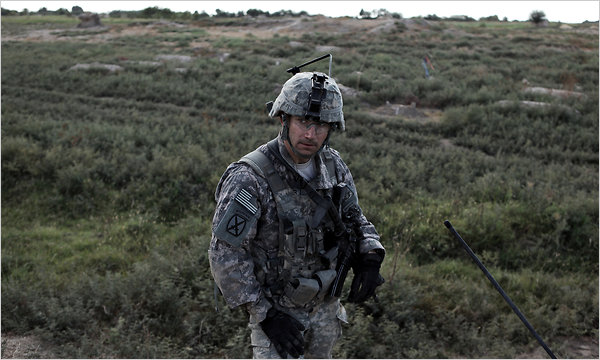
The American public is getting a very high return on its investment in our current crop of junior officers.  The are bright, industrious, and typically working significantly above their experience and training.  And, day after day, they deliver for us.  Iraq and Afghanistan are junior leaders' wars.  And OUR junior leaders — officer AND non-commissioned officer — are serving us very well.

Phi Beta Iota: Viet-Nam deja vu, El Salvador deja vu, MASINT deja vu– in 1988-1989 the Marine Corps' highest priority for MASINT was the detection of mines based on explosives not the container, at a safe distance.  $80 billion a year and the IC still cannot find anomalous objects buried in the ground.  As MG Robert Scales points out, 4% of the force is taking 80% of the casualties, and we are spending less than 1% of the Pentagon's total budget on protecting them.

New York Times
December 21, 2010
Pg. 1

A Year At War: In Command

Life And Death Decisions Weigh On Junior Officers

By James Dao

Articles in this series are chronicling the yearlong deployment of the First Battalion, 87th Infantry Regiment, based in Kunduz Province, Afghanistan. The series follows the battalion’s part in the surge in northern Afghanistan and the impact of war on individual soldiers and their families back home.

QURGHAN TAPA, Afghanistan — The hill wasn’t much to behold, just a treeless mound of dirt barely 80 feet high. But for Taliban fighters, it was a favorite spot for launching rockets into Imam Sahib city. Ideal, American commanders figured, for the insurgents to disrupt the coming parliamentary elections.

Read entire article (every word recommended)….

Reference: Private Military Corporations–A Non-State Actor-Nuclear Terror Nexus?

03 Economy, 07 Other Atrocities, 09 Justice, 10 Security, 11 Society, Commerce, Corruption, Military, Officers Call, Peace Intelligence
Full Paper Online
Private Military Corporations: A Non-State Actor-Nuclear Terror Nexus?

Robert L. Brown
Temple University

August 16, 2010

Abstract:

The risk of nuclear terrorism is hyped by some as possible and high consequence (Allison 2006) while others dismiss the strategy as too difficult and too risky for terrorist organizations (Jenkins 2008). However, analysts have no data from which to directly analyze the probability of terrorist acquisition and use. One methodological solution is to extend the range analysis to include analogous cases: private military corporations (PMCs) are one class of non-state actors (NSAs) who may possess the capacity and autonomy to pose a risk of nuclear terrorism for their state masters. I find that the while the technical and military capabilities of PMCs may be greater than those of terrorist organizations with respect to nuclear weapon construction or delivery, they are still be insufficient (and PMCs must also somehow acquire fissile materials). Also, PMCs benefit from agency slack, as demonstrated by Blackwater’s performance in Iraq, but this autonomy does not appear sufficient to carry out an illicit nuclear plot. Therefore, PMCs may be more capable than most terrorist organizations if they sought to acquire nuclear weapons but they are still unlikely to succeed.

Keywords: Nuclear Weapons, Terrorism, Private Military Corporations, Blackwater, Xe

Working Paper Series
Brown, Robert L., Private Military Corporations: A Non-State Actor-Nuclear Terror Nexus? (August 16, 2010). Available at SSRN: http://ssrn.com/abstract=1659785

See Also:

David Isenberg, Jack Bauer Beats Blackwater, Huffington Post 20 december 2010

Journal: Near-Term Demise of Private Military Contractors

Journal: Corporate Hijacking of Cyber-Space

03 Economy, 07 Other Atrocities, 11 Society, Civil Society, Collective Intelligence, Commerce, Commercial Intelligence, Earth Intelligence, InfoOps (IO), Methods & Process, Mobile, Money, Banks & Concentrated Wealth, Policy, Politics of Science & Science of Politics, Power Behind-the-Scenes/Special Interests, Privacy, Reform, Standards, Strategy, Technologies
Marcus Aurelius Recommends

The Wall Street Journal

The FCC's Threat to Internet Freedom

‘Net neutrality' sounds nice, but the Web is working fine now. The new rules will inhibit investment, deter innovation and create a billable-hours bonanza for lawyers.

Tomorrow morning the Federal Communications Commission (FCC) will mark the winter solstice by taking an unprecedented step to expand government's reach into the Internet by attempting to regulate its inner workings. In doing so, the agency will circumvent Congress and disregard a recent court ruling.

How did the FCC get here?

Read entire article….

Phi Beta Iota: The public is now much more aware that neither of the two political parties can be trusted, and that trust for any given government element, policy, or point of view is contingent on a much deeper examination of bias and motive than many would wish.  There are two sides to this issue, irrespective of the competency and good faith of government: on the one side are the corporations, including Google and Verizon, that wish to hijack cyber-space and claim that they own it.  This will allow them to charge premium prices for access to high-speed services.  On the other are those whose taxes paid for the creation of the Internet in the first place, the US taxpayer–they see the vital importance of open spectrum, open source software, and open source intelligence as the tri-fecta of cyber-freedom.  At OSS '92 John Perry Barlow said that the Internet interprets censorship as an outage, and routes around it.  Our view is that the corporations will succeed in hijacking cyberspace in the near term, but in the mid-term and beyond OpenBTS and other bottom-up public innovation solutions will restore the noosphere to its rightful owners, the human minds that comprise the World Brain.

noble gold