The European and Asian powers have had it with being lectured by the
U.S.—and President Obama’s letter seeking to defuse the tension ahead of Thursday’s summit is likely to make things worse, says Zachary Karabell.
With the leaders of the world gathering for two days of economic points
and counterpoints under the aegis of the G-20, Seoul has become the scene of a showdown between a testy set of European and Asian powers and a rather flummoxed and flat-footed America represented by President Obama in
all his post-Nov. 2 glory and malaise.
Graphic Source
The agenda of the meeting has long been telegraphed by multiple mini-summits over the past few months, but with the announcement by the U.S. Federal Reserve this week of $600 billion in further “quantitative easing” (read: printing more money), the tenor has shifted. Two years after the uncorking of the global financial crisis, the United States faces a cohort of other wealthy nations that have had it with being told what to do by Americans, regardless of the merits. They are in a mood to lecture and berate, and recent statements by Obama and Treasury Secretary Tim Geithner, and Fed chief Ben Bernanke’s actions, have given them ample fodder.
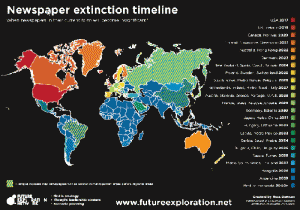
Part of the point I wanted to make was that this date is different for every country. As such I have created a Newspaper Extinction Timeline that maps out the wide diversity in how quickly we can expect newspapers to remain significant around the world. First out is USA in 2017, followed by UK and Iceland in 2019 and Canada and Norway in 2020. In many countries newspapers will survive the year 2040.
Phi Beta Iota: Certainly worth reflecting on, this misses two big realities. First, newspapers could still convert themselves into honest citizen intelligence networks and focus on sense-making. Second, five billion poor people are not yet digital and while the dumb cell phone has a bright future, the smart phones and pads do not, in part because of raw earth shortfalls, in part because of embedded toxicity of materials, and in part because even with call centers, there is a very big space that “smart analog” newspapers could fill. The latter is particularly true if one factors in the fact that five billion poor people need alternatives to rote education including primers that can be passed around and do not need power sources.
Pacific Institute's Community Strategies for Sustainability and Justice (CSSJ) Program has produced Gearing Up for Action: A Curriculum Guide for Freight Transport Justice (pdf), an important advocacy tool to build the power and capacity of communities to participate in decision making around freight transport issues. The guide contains popular-education-style activities that CSSJ developed and piloted in partnership with community groups and coalitions including the West Oakland Environmental Indicators Project and the “Ditching Dirty Diesel” Collaborative.This user-friendly curriculum guide is designed to help communities grappling with freight transport issues share their experiences, explore the root causes of freight transport impacts, identify those responsible for dealing with these causes, and develop a plan for advocacy to advance their solutions.
How crowdsourcing will change the way the world works.
As the amount of digital work increases and the amount of physical work
decreases, our notions of employment and work change profoundly. Digital work doesn't require roads and factories; it requires a laptop and an Internet connection–equipment that people have access to in their homes. The need for offices, supervisors and rigid employment arrangements
diminishes.
As technology improves, companies should theoretically be able to access in real-time the perfect person for a given job–the one who will do the job the best, enjoy it the most or do it the fastest. All these factors combine in a way that will change the landscape of work. Here's what I think that will look like:
–Within a decade résumés will become less important as we continue to adopt newer, multifaceted ways to measure the quality of a candidate's work. Current hiring processes often involve online research about candidates on sites like LinkedIn and Facebook. Articles, portfolios, presentations and papers by potential job candidates are increasingly
found online. Companies like oDesk and Elance rate workers based on past work rather than on what college they attended.
Phi Beta Iota: This is of course precisely what OSS.Net, Inc. has been doing since 1993, in sharp contrast to the beltway bandit “butts in seats” high overhead approach. HOWEVER, the world will be divided into three workforces:
A. Digital work done from anywhere by high end digital workers.
B. Analog work done from anywhere by low end physical workers with a simple cell phone–e.g. eyes on observations.
C. Analog work done at a fixed place because the tools or the raw materials or other factors demand a fixed location.
The five billion at the bottom of the pyramid are at C and need to be moved toward B in order to create infinite wealth. That is the insight that governments and corporations refuse to grasp, despite the fact that the annual income of the five trillion is FOUR TIMES the annual income of the one billion rich.
In 2009, the United States government spent some $650 billion on its military. This is more than the next 46 highest-spending countries combined. Much of this treasure ended up in the hands of profit-driven weapons manufacturers. In the following short film, Cultures of Resistance takes a brief look at the current state of what President Eisenhower famously called the “military industrial complex.” With the U.S. waging two wars overseas at the same time that millions of people are out of work at home, those pushing to reel in government spending and balance the budget would be wise to look carefully at bloated and unchecked military spending.
WASHINGTON — With critical decisions ahead on the war in Afghanistan, President Obama is about to receive an unusual opportunity to reshape the Pentagon’s leadership, naming a new defense secretary as well as several top generals and admirals in the next several months.
It is a rare confluence of tenure calendars and personal calculations, coming midway through Mr. Obama’s first term and on the heels of an election that challenged his domestic policies. His choices could have lasting consequences for his national security agenda, perhaps strengthening his hand over a military with which he has often clashed, and are likely to have an effect beyond the next election, whether he wins or loses.
That is all the more reason that Mr. Obama’s choices are certain to face scrutiny in a narrowly divided Senate, whose Republican leadership has declared itself intent on defeating him.
Defense Secretary Robert M. Gates has said he plans to retire next year, while the terms of four members of the Joint Chiefs of Staff are scheduled to end: Adm. Mike Mullen, the chairman; Gen. James E. Cartwright, the vice chairman; Gen. George W. Casey Jr., the Army chief; and Adm. Gary Roughead, the chief of naval operations.
Phi Beta Iota: The current and prospective leaders being discussed and considered are all inter-changeable. They share the same paradigmatic views, the same commitment to the military-industrial-congressional complex (MICC), and therefore, to suggest that changing out the guard is in any way an option, is to demonstrate profound naivete or a gift for deception. President Obama is truly at a historic fork in the road: he can go on with business as usual, bailing out Wall Street and carrying on with a global military cmapaign that is both ineffective and unaffordable–or he can reach deep down and come up with one startling insight and two serious options.
Startling insight: integrity matters. Doing the right thing is more important than continuing to do the wrong thing righter.
Option A: Make Electoral Reform (1 Page, 9 Points) the issue. That will burn down the two-party tyranny and restore the Republic WHILE EARNING HIM A SECOND TERM.
Option B: Hold an Open Space Technology event on the future of the USA in all its forms, in the Washington Convention Center, a no-notice open public event, with Harrison Owen as the facilitator.
Sadly, we are quite certain neither the startling insight nor either of the two options will be considered. The Titanic is sinking and the President is being asked to re-arrange the name cards…..thus does the Republic flail in the tar pit of history.
We predict, with a depth of despair, that Obama will choose to go along and eventually be as wealthy as Bill Bradley and Al Gore. He is one phone call away from greatness, and won't do it. He lives, we die.