Journal: Deep Insights into Failure of US Intelligence

10 Security, Government, Methods & Process

Marcus Aurelius

Dot, Dot, Dot . . .

March 10, 2010

In his new book The Watchers, (Penguin Press, 2010), Shane Harris chronicles what he calls “the rise of America's surveillance state,” a process he's been following since he was a reporter and technology editor at Government Executive from 2001 to 2005.

It's a story with all the elements of a spy thriller: political intrigue, shadowy federal organizations and a compelling cast of characters desperately seeking to prevent the next Sept. 11. At the center is the enigmatic John Poindexter, former national security adviser and architect of the ill-fated Total Information Awareness data collection and analysis effort.

. . . . . . .

What I discovered was that it really was the Beirut attack that shocked the intelligence system in a very similar way to 9/11. You have the Marines in Beirut, ostensibly on this international peacekeeping mission. They're hunkered down at the airport. For various political reasons, they're not allowed to go out very much in public. They are sort of sitting ducks. What happens is in the aftermath of the bombing, the intelligence community finds out there were all these warnings that something bad was about to happen to the Marines at the airport. So you had, in the spring of 1983, more than 100 individual warnings about car bombings fielded by the intelligence community.

Full Interview Online

The Marines were blind, deaf and dumb sitting at the base. And the golden nugget of it all is that NSA intercepted, in the days before the attack, this phone conversation going from a minister in Iran to presumably one of these organizing terrorist groups–directing this group to go and take this spectacular action against the Marines. You add all these up and it looks a lot like 9/11. There's all this information sitting there and it's like, how come nobody's putting it together? And Poindexter is the guy who looks at this and says, “This shouldn't happen and we can take steps to make sure it doesn't happen. There has to be a way to logically approach this problem, systematize the whole process and connect those dots.”

Phi Beta Iota: The US Intelligence Community is badly managed, grotesquely over-funded, and incapable of changing its culture for the simple reason that instead of finding and empowering leaders with new ideas and open minds, we continue to give more money to old leaders, like pouring gasoline on a fire.  We still cannot process 90% of what we collect; we still cannot speak foreign languages; and we still do not play well with others.  The IC is managed by people who know nothing of intelligence–they are essentially staffers who went through the motions of moving money around–and their only real accomplishment is that they have not burned any bridges.  Unfortunately, they have been so busy not burning bridges they have not built anything worthwhile.  The IC is a shell game–move money, move the harem around, repeat the same testimony over and over to Congress again–ultimately the IC is a $75 billion a year tragic farce.

See Also:

Review (Guest): THE WATCHERS–The Rise of America’s Surveillance State

2000 ON INTELLIGENCE: Spies and Secrecy in an Open World

2010: Human Intelligence (HUMINT) Trilogy Updated

Search: The Future of OSINT [is M4IS2-Multinational]
2009 DoD OSINT Leadership and Staff Briefings

Book: INTELLIGENCE FOR EARTH–Final

Journal: Hurray for Iceland, Shun the Corrupt

Collaboration Zones, Communities of Practice, Ethics, Key Players, Policies, Threats
Chuck Spinney

This is a dynamite op-ed written jointly by my good friend Marshall Auerback and Rob Parenteau.

Chuck

Coming to a Country Near You

Let a Dozen Latvias Bloom?

By MARSHALL AUERBACK and ROB PARENTEAU

The article's bottom line conclusion:

It is now time for the rest of us to follow the Lilliputians of Iceland:  to take the rentier juggernaut down before it completes the task. Time to pry the vampire squid off our faces so we can see the light of day again and allow some semblance of humanity to flourish again.  Hopefully, Iceland represents the future, not Latvia.

Full Story Online

Phi Beta Iota: Iceland has led the way.  It is time to start closing down the International Monetary Fund, the World Bank, and the outrageous misbehavior of Goldman Sachs and the other banks.  Nations need to start nationalizing ill-gotten gains, refusing to pay predatory loan interest, and beginning to think for themselves.  We certainly encourage judicial activism in confiscating foreign-owned land and structures and in blocking both the privatization of water and other commonwealth resources, while also blocking predatory and often hazardous or poisonous importations.    Top-down government has been corrupted and does not work.  The only means to achieve resilience is bottom-up “home rule.”  We salute Iceland for its intelligence and its integiryt.

Journal: Attacks Against the US Government

09 Justice, 11 Society, Collective Intelligence, Cultural Intelligence, Government, Peace Intelligence, Reform
Marcus Aurelius

Timeline: Government Under Attack

By Dawn Lim and Ross Gianfortune dlim@govexec.com March 5, 2010

Thursday evening's shootout between Pentagon police officers and a gunman apparently motivated by anti-government sentiment was the latest in a spate of attacks on federal employees and facilities and serves as a stark reminder that public servants too often find themselves unexpectedly in harm's way. The following timeline reviews major attacks during the past two decades.

Feb. 18, 2010. A small jet is flown into a building housing a federal tax office in Austin, Texas, injuring 13 and killing two. The pilot, Joseph Andrew Stack, was angry with the Internal Revenue Service.

Nov. 5, 2009. An Army psychiatrist goes on a rampage at Fort Hood, Texas, killing 13 people and wounding dozens. The alleged gunman, Maj. Nidal Malik Hasan, was a Muslim who had been in contact with a radical Imam and was about to be deployed overseas.

June 1, 2009. A gunman opens fire on a U.S. military recruiting office in Little Rock, Ark., killing one soldier and wounding another. The suspect, a Muslim convert, opposed the wars in Iraq and Afghanistan, but was not affiliated with a larger terrorist network.

Full Story Online

Phi Beta Iota: The full list is both very incomplete, and hugely misrepresentative.   The list does not include the hanging of census workers, the increased calls for Tyrannicide, the many under-reported bombs and threats across the country, and the growing underground economy that is turning its back on a government many now consider to be an unaffordable burden.   The list also fails to address the nuances between state-sponsored attacks, state-allowed attacks, Islam-oriented attackes, and domestic insurgency such as documented in Harvest Of Rage–Why Oklahoma City Is Only The Beginning and Rage of the Random Actor.  The list also avoids addressing the behavior of the US Government acting “in our name” but far removed from our values as a Republic Of, By, and For We the People, a story told in many books, such as Blood Money–Wasted Billions, Lost Lives, and Corporate Greed in Iraq on top ofSAVAGE CAPITALISM AND THE MYTH OF DEMOCRACY–Latin America in the Third Millennium and Open Veins of Latin America–Five Centuries of the Pillage of a Continent;  and in journal articles such as Why they hate us (II): How many Muslims has the U.S. killed in the past 30 years?.

Continue reading “Journal: Attacks Against the US Government”

Journal: United Nations and Information-Sharing

Communities of Practice, Earth Intelligence, InfoOps (IO), Key Players, Methods & Process, Peace Intelligence, Policies, Technologies, Threats

UPDATED 2014-01-29 to add the following new links:

2012 Robert Steele: Practical Reflections on UN Intelligence + UN RECAP

References: NATO Transformation Process Documents — and Gaps + Peace from Above RECAP

Search: phd topics on the role of intelligence in peace support operation + Peacekeeping RECAP

United Nations @ Phi Beta Iota

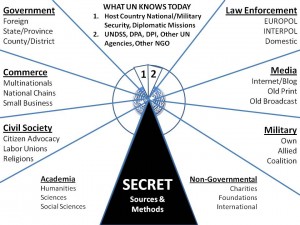
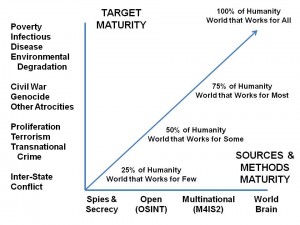
Phi Beta Iota: We are detecting a fascinating evolutionary process within the United Nations “system” which is not a system at all, more like an archipelago with a different cat in charge of each island.  Information-sharing is coming into vogue, but more importantly, the United Nations, perhaps stimulated by the report of the United Nations High-Level Panel on Threats, Challenges, and Change, A more secure world: our shared responsibility, appears to finally be realizing that all threats are connected and that poverty is the foundation for all of the other threats thriving–one cannot defeat transnational crime (threat #10) without first addressing poverty (threat #1).

Security Council Calls for Strengthened International, Regional Cooperation to Counter Transnational Organized Crime, in Presidential Statement

With the top United Nations anti-drug official urging concerted global action to “break the vicious circle between insecurity and underdevelopment” being increasingly fuelled by criminal networks, drug smugglers and human traffickers, the Security Council today called on the world body’s Member States to increase international and regional cooperation to tackle transnational organized crime.

The Council invited Secretary-General Ban Ki-moon, who opened today’s meeting, to consider transnational threats as a factor in conflict prevention strategies, conflict analysis, integrated missions’ assessment and planning and to consider including in his reports, as appropriate, analysis on the role played by those threats in situations on the Council’s agenda.  [Phi Beta Iota: Emphasis Added.]

UN Intelligence = World that Works for All

Global gangs exploit blind spots for trafficking: U.N.

UNITED NATIONS (Reuters) – International criminal gangs and traffickers are exploiting large geographic blind spots where radar, satellite or other surveillance is minimal or nonexistent, the U.N. crime and drugs czar said on Wednesday.

Antonio Maria Costa, head of the Vienna-based U.N. Office on Drugs and Crime (UNODC), told members of the 15-nation U.N. Security Council that countries must improve their systems of sharing intelligence to reduce these surveillance gaps.

“We need a change in attitude,” Costa told the council. “It is time to regard information sharing as a way of strengthening sovereignty, not surrendering it.”

Continue reading “Journal: United Nations and Information-Sharing”

Journal: Reasons Big Banks Are Bad for Democracy

03 Economy
Chuck Spinney

Why Exactly Are Big Banks Bad?

By Simon Johnson, Baseline Scenario, 4 March 2010

Just over 100 years ago, as the nineteenth century drew to a close, big business in America was synonymous with productivity, quality, and success.  “Economies of scale” meant that big railroads and big oil companies could move cargo and supply energy cheaper than their smaller competitors and, consequently, became even larger.

But there also proved to be a dark side to size and in the first decade of the 20th century mainstream opinion turned sharply against big business for three reasons.  [Click on headline for complete original post.]

Phi Beta Iota: The earlier literature represented by Small is Beautiful and Human Scale has now been dramatically reinforced by literatures on civilization building, collective intelligence, common wealth, and so on (other lists).  They all boil down to keeping power at the lowest level possible.  Aggregated power is bad for democracy–this applies to big government just as it does to big banks, and it applies especially to the ludicrous notions of world government (as opposed to a world brain, where every node is unique and independent).

Journal: Three United Nations (UN) Memes Emergent

01 Agriculture, 04 Education, 07 Health, 12 Water, Collective Intelligence, Cultural Intelligence, Earth Intelligence, Non-Governmental, Peace Intelligence

Meme 1:  Separate Agency Budget Intelligence (SABI). The  United Nations Educational, Scientific and Cultural Organization (UNESCO)  may be within a year of a huge management advance, understanding, with decision-support, the relative return on investment (ROI) of its investments in relation to the ten high-level threats, many of which it is uniquely positioned to address.  Understanding that clean water and sanitation is the most important medical advancement since 1840, UNESCO is poised to call into question its excessive investments in vaccinations that yield little return and often create broader health issues, as opposed to focusing on micro-education (see meme 3) and micro-financiing of clean water initiatives.

Meme 2: integrated missions’ assessment and planning. This is the United Nations (UN) equivalent of Whole of Government planning, programming. and budgeting.  While non-existent within most governments, the UN appears to be realizing that with its back to the fall and the fate of over 175 “failed states” on the table, it might be time to add intelligence (decision-support)  to how it does business.  This means understanding that all threats and all policies have to be evaluated together and in relation (the Eastern way), and that all budgets and behaviors must be planned–harmonized–so as to achieve integrated outcomes, not outcomes in isolation that undermine “rest of system” stability.

Meme 3:  micro-education. This is a brand new meme but it defines practices that already exist and could be brought together.  With the vast majority of subsistence farmers still using ancient methods such as furrow irrigation, and many not recognizing the value of rain harvesting, there is a route opening for UNESCO by which it can leverage Alvin Toffler's insight and substitute information for capital, labor, time, and space.  Put bluntly, some micro-education is vastly more important than a complete (albeit mediocre) elementary education.  Micro-education on water and health appears to be the center of gravity for jump-starting the entrepreneurial possibilities among the extreme poor.  What no one has done is create a stacked list of “Essential Elements of Information” (EEI) that should be taught to the poor in priority order as part of “any and all” encounters.

Journal: “Dumb” Government versus Smart Humans

03 Environmental Degradation, 05 Energy, Commercial Intelligence, Earth Intelligence
Full Story Online

Op-Ed Columnist

Dreaming the Possible Dream

By THOMAS L. FRIEDMAN

March 6, 2010

EXTRACT (1 of 2 Innovations): If you combine CO2 with seawater, or any kind of briny water, you produce CaCO3, calcium carbonate. That is not only the stuff of corals. It is also the same white, pasty goop that appears on your shower head from hard (calcium-rich) water. At its demonstration plant near Santa Cruz, Calif., Calera has developed a process that takes CO2 emissions from a coal- or gas-fired power plant and sprays seawater into it and naturally converts most of the CO2 into calcium carbonate, which is then spray-dried into cement or shaped into little pellets that can be used as concrete aggregates for building walls or highways — instead of letting the CO2 emissions go into the atmosphere and produce climate change.

If this can scale, it would eliminate the need for expensive carbon-sequestration facilities planned to be built alongside coal-fired power plants — and it might actually make the heretofore specious notion of “clean coal” a possibility.

Continue reading “Journal: “Dumb” Government versus Smart Humans”

noble gold