Eltel Networks Smart Meters A Good Example for Middle East Countries to Follow
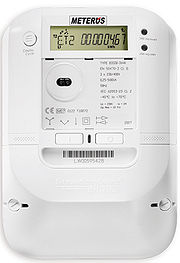
For those who are not aware of this technology, a smart grid delivers electricity from suppliers to consumers using two-way digital technology to control appliances at consumers’ homes to save energy, reduce cost and increase reliability and transparency.
NEW METER
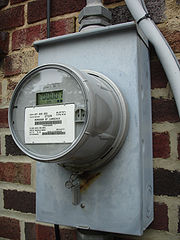
It includes an intelligent monitoring system that keeps track of all electricity flowing through the system. A smart meter enables accurate electronic measuring of energy being used, and are much more accurate than standard meters which simply estimate the amount of energy being used. They enable the calculation of flexible energy tariffs that measure consumption over set time periods.
They also enable the capability of selling unused energy back to the supplier, i.e. the utility company, and will enable better usage of renewable energy technologies, such as solar panels and wind turbines.
Phi Beta Iota: It will probably take another twenty years, but “smart” grids are coming along. The real break-through will be when “true costs” of every product and service are clearly visible at the press of a button on one's cell phonoe. Open Spectrum is also inevitable, along with Open Money. See the Graphic: Open Everything.
A new US assessment of Venezuela's oil reserves could give the country double the supplies of Saudi Arabia.
Scientists working for the US Geological Survey say Venezuela's Orinoco belt region holds twice as much petroleum as previously thought.
The geologists estimate the area could yield more than 500bn barrels of crude oil.
Phi Beta Iota: This is consistent with both the Brazilian discoveries and the rare nature of the Amazon region. All signs point to a re-emergence of the United Nations of South America (UNASUR) as a major political, socio-eceonomic, ideo-cultural, and techno-demographic “bloc” in the next quarter century. If they create their own Multinational Engagement network for regional information-sharing and sense-making, with a model that can be ported to South Africa for extension into that continent, and to the Indonesia-Malaysia axis with Singapore as a central hub for Chinese diaspora influence, the balance of power in the world will change dramatically. The “closed model” of top down command and control has faded, the “open model” of networks is emergent. Latin American populism is a force that cannot be repressed, it can only be respected.
Now that the mega banks have been bailed out, there is growing pressure in the US and the EU to cut back on state deficits. In the US, which is now under the constraints of of it highest burden private debt burden in recorded economic debt burden (i.e., level of debt related to size of GDP), a reduction in government spending runs a clear risk of a debt deflation — where the economy shrinks because consumers and businesses cut back of spending to reduce their debts. In theory, if the government retrenched and triggered a debt deflation, the US government could reverse course and return to a policy of fiscal stimulus, in part because it has a sovereign economy with its own currency.
The situation is very different in the EU, were the burdens of private debt are lower but burdens of public debt are higher. Moreover, as my friend Marshall Auerback argues below, the economic situation is fundamentally different for each nation in the European Union, because the common currency, together with the accompanying centralized bureaucracy, which is necessary to manage that currency, constrains the ability of individual state governments, like that of Spain, to respond to their own peculiar conditions.
I find Auerback's analysis to be deeply troubling, because it makes sense. I have viewed the EU from the other end of the telescope since 2005, and my greatest impression has been one of its economic benefits — I have seen at the local level in rich and poor countries alike how a rising tide was lifting all boats. To be sure there were inefficiencies and waste, like excessive and shoddy construction in Spain and unfinished projects in Greece, and chaos in Italy, but all in all, what has impressed me the most was level of positive atmosphere in all the EU countries I have visited and lived in. When the EU is growing, the system of open borders; free movement of labour and capital, and a common currency works like oil in an economic engine; rich countries, like the Netherlands, can transfer funds to poorer countries, like Greece. Smaller economies can run big deficits without worrying about the value of their currency.
But, if Auerback is right, when overall growth slows or reverses, the EU engine gets sand in its gears, and as its internal friction increases, it slows down even more. Moreover, the EU's complex centrally controlled nature naturally makes the engine less adaptable to changing conditions. If he is right, this could spell real trouble.
Phi Beta Iota: The world and its populations are trapped right between an Industrial Era “too big to fail” set of governments and corporations and central banks, and a fragmenting complexity and speed of decomposition local landscape that begs for adaptive localized decision-making. We are in an interruggum between the collapse of the old systems of governance and the emergence of new bottom-up networks that would include Open Money and dismiss the fraudulent scarcity and hoarding characteristic of traditional money.
Muscling Latin America: The Pentagon has a new Monroe Doctrine (The Nation)
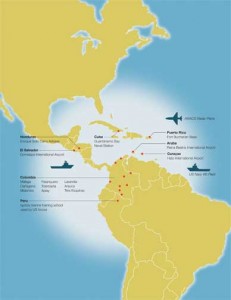
In September Ecuador's president, Rafael Correa, delivered on an electoral promise and refused to renew Washington's decade-old, rent-free lease on an air base outside the Pacific coast town of Manta, which for the past ten years has served as the Pentagon's main South American outpost. The eviction was a serious effort to fulfill the call of Ecuador's new Constitution to promote “universal disarmament” and oppose the “imposition” of military bases of “some states in the territory of others.” It was also one of the most important victories for the global demilitarization movement, loosely organized around the International Network for the Abolition of Foreign Military Bases, since protests forced the US Navy to withdraw from Vieques, Puerto Rico, in 2003. Correa, though, couldn't resist an easy joke. “We'll renew the lease,” he quipped, “if the US lets us set up a base in Miami.”
Funny. Then Washington answered with a show of force: take away one, we'll grab seven. In late October the United States and Colombia signed an agreement granting the Pentagon use of seven military bases, along with an unlimited number of as yet unspecified “facilities and locations.”
Connect these dots: In Nigeria this week, Muslim youths set fire to a church, killing more than two dozen Christian worshippers. In Egypt, Coptic Christians have been suffering increased persecution including, this month, a drive-by shooting outside a church in which seven people were murdered. In Pakistan, Christian churches were bombed over Christmas. In Turkey, authorities have been closing Christian churches, monasteries and schools. Recently, churches in Malaysia have been attacked, too, provoked by this grievance: Christians inside the churches were referring to God as “Allah.” How dare infidels use the same name for the Almighty as do Muslims!
Cars are evil, right? But what if they ran on hydrogen, did 300 miles per gallon, were leased rather than owned, and were produced under an open source business model…
Riversimple’s network electric car is a hydrogen fuel cell powered car, with unique technologies that enable it to run on a 6kW fuel cell, with a fuel consumption equivalent to 300 miles per gallon and greenhouse gas emissions at 30g per km, well-to-wheel – less than a third of that from the most efficient petrol-engine cars currently available.
It also has the potential to be 10 times cleaner still if the hydrogen is produced from renewable energy.
Phi Beta Iota: “Open Everything” is not just a meme, it is the gameplan for the simple reason that open everything abolishes scarcity and makes it possible to create a prosperous world at peace. Intelligence-driven peace and prosperity. What a concept.
This is both a very intelligent search and a very funny search. CIA and the rest of the IC do not have a “method” because they do not do “learning” in the classical sense. It is virtually all “on the job” training and the culture across the board is one of hubris as in “we know best, if you have time for training–which we consider a vacation–then you must not be essential or having anything urgent to do.”
The National Intelligence University has taken a few baby steps, perhaps moving the US Intelligence Community from the first grade to the fourth grade, absolutely no further. The legal, security, management, budget, and cultural mind-sets are simply too daunting.
The ONE THING that could be taught early, and is not, because all of the management levels crush it along with creativity and freedom of expression, is INTEGRITY. The truth at any cost reduces all others costs. Most managers in most of the secret agencies believe they are the sole arbiters of the truth, the truth must by definition be secret, and anyone who disagrees with them is a traitor, stupid, or a loose-cannon.
Chuck Spinney is still the best “real” engineer in this town–almost everyone else is staggering after fifty years of government-specification cost-plus engineering. Also, as Chuck explores in the piece on Complexity to Avoid Accountability is Expensive we in the “requirements” business are as much to blame–Service connivance with complexity has killed acquisition from both a financial inputs and a war-fighting relevance outcome point of view. The Services have forgotten the basics of requirements definition and multi-mission interoperability and supportability.
The Marine Corps Intelligence Center (MCIC) was created by General Al Gray, USMC (Ret), then Commandant of the Marine Corps, for three reasons:
1. Intelligence support to constabulary and expeditionary operations from the three major services was abysmal to non-existent.
2. Intelligence support to the Service level planners and programmers striving to interact with other Services, the Unified Commands, and the Joint Staff was non-existent–this was the case with respect to policy, acquisition, and operations. The cluster-feel over Haiti and the total inadequacy of our 24-48 hour response tells us nothing has changed, in part because we still cannot do a “come as you are” joint inter-agency anything.