Robert Capps: System D – Informal Economy Ignores Government

03 Economy, 09 Justice, 10 Security, Advanced Cyber/IO, Articles & Chapters, Civil Society, Commerce, Commercial Intelligence, Cultural Intelligence, Government, Law Enforcement, Methods & Process, microfinancing
Robert Capps

Why Black Market Entrepreneurs Matter to the World Economy

Robert Capps

WIRED, 16 December 2011

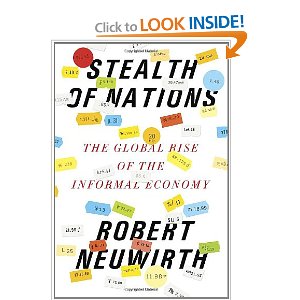
Not many people think of shantytowns, illegal street vendors, and unlicensed roadside hawkers as major economic players. But according to journalist Robert Neuwirth, that’s exactly what they’ve become. In his new book, Stealth of Nations: The Global Rise of the Informal Economy, Neuwirth points out that small, illegal, off-the-books businesses collectively account for trillions of dollars in commerce and employ fully half the world’s workers.
Amazon Page

Further, he says, these enterprises are critical sources of entrepreneurialism, innovation, and self-reliance. And the globe’s gray and black markets have grown during the international recession, adding jobs, increasing sales, and improving the lives of hundreds of millions. It’s time, Neuwirth says, for the developed world to wake up to what those who are working in the shadows of globalization have to offer. We asked him how these tiny enterprises got to be such big business.

Wired: You refer to the untaxed, unlicensed, and unregulated economies of the world as System D. What does that mean?

Robert Neuwirth:There’s a French word for someone who’s self-reliant or ingenious: débrouillard. This got sort of mutated in the postcolonial areas of Africa and the Caribbean to refer to the street economy, which is called l’économie de la débrouillardise—the self-reliance economy, or the DIY economy, if you will. I decided to use this term myself—shortening it to System D—because it’s a less pejorative way of referring to what has traditionally been called the informal economy or black market or even underground economy. I’m basically using the term to refer to all the economic activity that flies under the radar of government. So, unregistered, unregulated, untaxed, but not outright criminal—I don’t include gun-running, drugs, human trafficking, or things like that.

Click on Image to Enlarge

Wired: Certainly the people who make their living from illegal street stalls don’t see themselves as criminals.

Neuwirth: Not at all. They see themselves as supporting their family, hiring people, and putting their relatives through school—all without any help from the government or aid networks.

Wired: The sheer scale of System D is mind-blowing.

Neuwirth: Yeah. If you think of System D as having a collective GDP, it would be on the order of $10 trillion a year. That’s a very rough calculation, which is almost certainly on the low side. If System D were a country, it would have the second-largest economy on earth, after the United States.

Read a SUPERB interview.

Tip of the Hat to Berto Jongman.

Phi Beta Iota:  System D is completely separate from straight forward black crime (organized crime) or white crime (Goldman Sachs et al).  What this really means is that governments have lost all legitimacy and two thirds of the global economy now considers governments to be at best a meddling (and costly) nuisance and at worst the enemy to be defeated by any means necessary.   Governments brought this on themselves.

See Also:

Critical Choices. The United Nations, Networks, and the Future of Global Governance

Global Public Policy: Governing Without Government?

High Noon: 20 Global Problems, 20 Years to Solve Them

Illicit: How Smugglers, Traffickers, and Copycats are Hijacking the Global Economy

Intelligence for Earth: Clarity, Diversity, Integrity, & Sustainability

The Open-Source Everything Manifesto: Transparency, Truth, and Trust

Chuck Spinny: Log of War

03 Economy, 08 Wild Cards, 10 Security, DoD, Government, Military
Chuck Spinney

While the US is distracted at home by warmongering politicians competing for the Republican nomination and Israeli-neocon warmongering for launching a new war against Iran, a crisis may be metastasizing in cancer that is Afghanistan.

Below is a report in the Pakistani newspaper Dawn that describes the logistics bottleneck in the port of Karachi caused by Pakistan's closure of the Nato's crucial southern supply route.

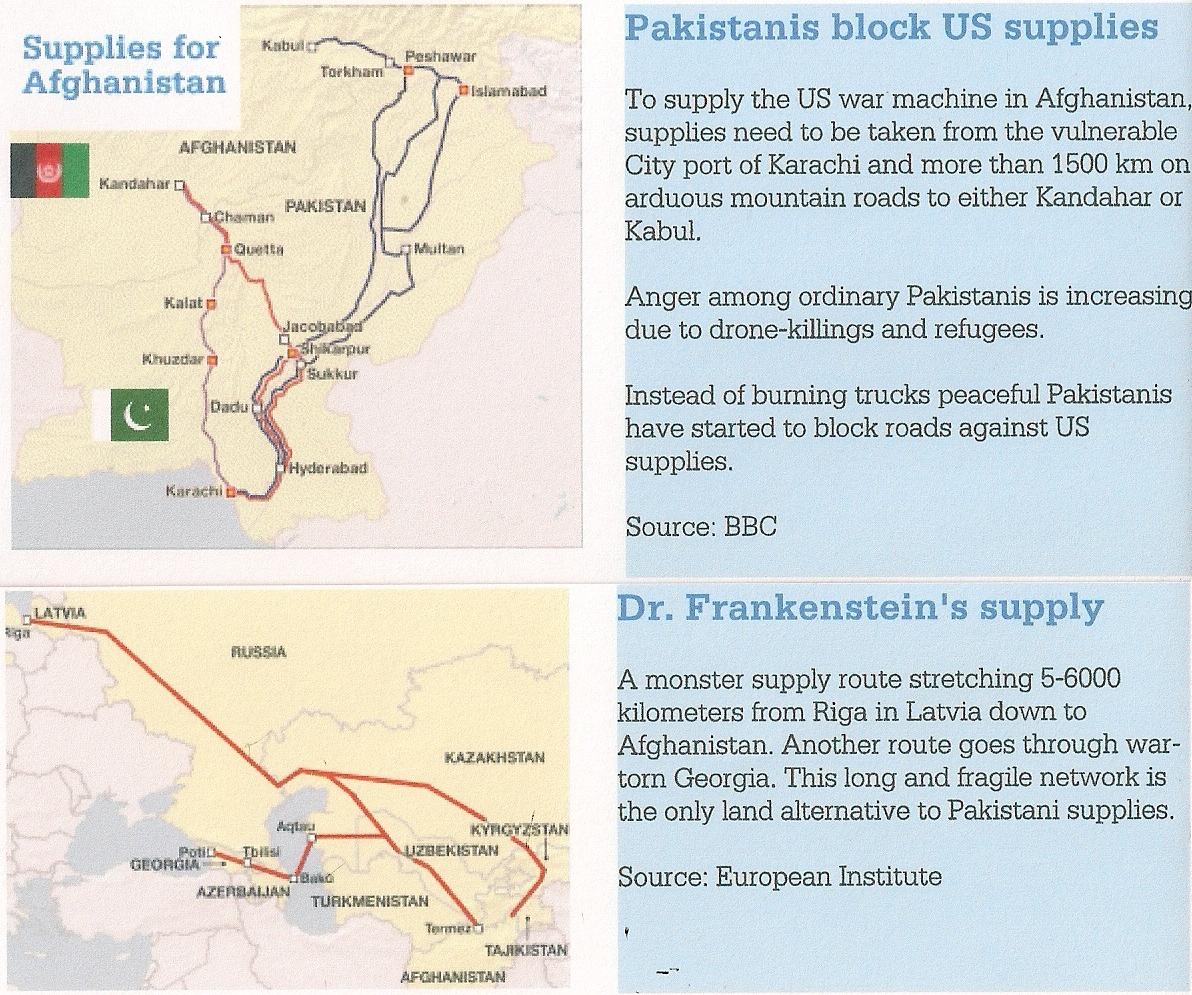
There are three logistics routes to sending supplies into Afghanistan: one by air and two by land.  Air is too expensive and of limited carrying capacity. The least costly route is the long vulnerable highway net thru Pakistan — this is the southern route (top map) that has been shut down as described below.  The northern route (lower map) is much longer going from either the Baltic or the Black Seas and is dependent on the good will of Russia, Kazakhstan, and Uzbekistan. According to the AP, The northern route at $104 million per month in total cost is at least six times as expensive as the southern route.  

The AP report contained no information on the cost per ton, but that factor is likely to be much higher that six-to-one, because prior to the closure (as of last June), about 50% of Nato's total supply requirement was was flowing through the southern route, with the other 50% being divided between the norther route and the air route.]

Thousands of Nato trucks in Pakistan backlog

Dawn [Pk], 26 Jan 2012

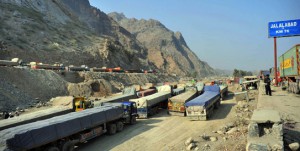
KARACHI: Two months into Pakistan’s blockade on Nato supplies crossing into Afghanistan, thousands of trucks are crowding the port in Karachi where drivers, fed up with waiting, are starting to desert.

Read rest of article.

Chuck Spinney's Graphics from BBC & European Institute:

Click on Image to Enlarge

Venessa Miemis: Decision Tree for Vision Manifestation

Blog Wisdom, Cultural Intelligence, IO Impotency
Venessa Miemis

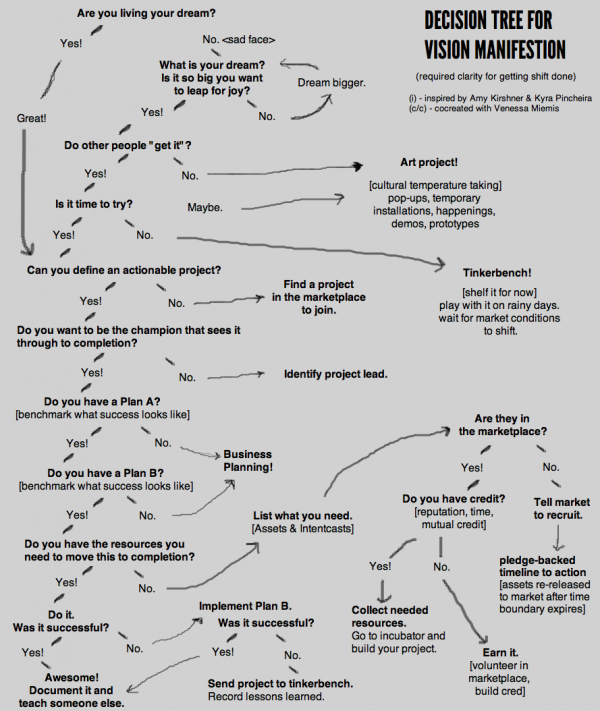
[Image]: Decision Tree for Vision Manifestion

I just got back from a great trip to Burlington, VT, where I touched base with Amy Kirschner of the Vermont Sustainable Exchange. She and cocreator Kyra Pinchiera have been working on creating an inquiry process to assist people in making ideas happen.

Many of us have grand visions of the future, but to be able to tranform those into a “minimum viable product” – something tangible and actionable – can be a bit of an art.

She showed me her sketches for taking idea to action, and i made them into a little graphic. Enjoy!

Phi Beta Iota:  Where this disappoints is in turning to art in the early stage when the marketplace does not “get it.”  Some kind of mass educational shock appears called for–Shock Education.  Revolutions start with violent shocks–no one has achieved a non-violent shock that leads to a non-violent revolution Of, By, and For We the People, that we know of.

Click on Image to Enlarge


David Isenberg: Steve Coll Reviews Three Books on Secret American Security State

04 Education, 07 Other Atrocities, 09 Justice, 10 Security, 11 Society, Book Lists, Corruption, Government, Intelligence (government), IO Impotency, Officers Call
David Isenberg

Our Secret American Security State

The New York Review of Books, February 9, 2012

Steve Coll

Top Secret America: The Rise of the New American Security State
by Dana Priest and William M. Arkin
Little, Brown, 296 pp., $27.99

Intelligence and US Foreign Policy: Iraq, 9/11, and Misguided Reform
by Paul R. Pillar
Columbia University Press, 413 pp., $29.50

Counterstrike: The Untold Story of America’s Secret Campaign Against Al Qaeda
by Eric Schmitt and Thom Shanker
Times Books, 324 pp., $27.00

What is the American intelligence bureaucracy good for? The question is difficult to ask in a serious way in Washington because it risks raising the hackles of career intelligence professionals and their political sponsors at a time when spy agencies remain under pressure to combat resilient if diminished international terrorist groups and to monitor and check Iran’s nuclear program, among other challenges. Yet a serious, transparent review of the intelligence system’s strengths and limitations is overdue.

The past decade has witnessed one of the most egregious misuses of intelligence in American history—the Bush administration’s distortion of information about Saddam Hussein’s terrorist ties and unconventional weapons, in order to justify the invasion of Iraq. It has also seen a surge of paramilitary activity and covert action that has included the operation of secret prisons, the use of torture, and targeted killing. The Obama administration ended officially sanctioned torture, but it has refused to allow official inquiries into how it occurred, and the administration has increased the number of covert, unacknowledged targeted killings through the use of armed, unmanned aerial drones in Afghanistan, Pakistan, Yemen, and elsewhere.

In all, a president who might have challenged the American intelligence bureaucracy and given it a new direction has instead maintained and even expanded what he inherited. Nor has Congress reviewed the hasty organizational reforms it enacted after September 11 or reckoned in depth with the problems exposed by the Iraq disaster. The vital questions that seemed to be begged after the Bush era—about the intelligence system’s scope, effectiveness, costs, outsourcing, legal justifications, and vulnerability to politicization—have remained largely unaddressed.

. . . . . . .

After September 11, newspaper Op-Ed pages were full of recommendations for radical departures in American intelligence, changes that might place new emphasis on lean and adaptable operations. There was much talk of a long-term development of “human sources of information”; of the need for risk-taking and the bold penetration of what are known in the intelligence agencies as “denied areas,” such as Iran and North Korea. Some of that ambition has been fulfilled; it is difficult to measure how much, since so much of the detail of post–September 11 covert action and intelligence collection remains secret.

. . . . . .

What is plain, nonetheless, is that the larger story of the American intelligence system is one of continuity. The bureaucracy has defended itself from outside investigation and oversight and has followed many of the trajectories set during the Eisenhower years. The relative strengths of tactical American intelligence tradecraft today include innovative technology, vacuum cleaner–like collection of electronic data worldwide, computer algorithms that sort valuable information from noise, and the bludgeoning effects on adversaries of huge if wasteful spending. These methods look very similar to those of the anti-Soviet intelligence system. The bureaucracy’s weaknesses—inefficiency, ignorance of local cultures, revolving doors, self-perpetuation, vulnerability to political pressure, and an overall lack of accountability—are deeply familiar, too.

Read full article with registration.

Phi Beta Iota:  The New York Review of Books is retarded.  Search for the article to read the full piece without their demand for registration.  We note with interest that most of these themes were clearly addressed by Robert Steele in ON INTELLIGENCE: Spies and Secrecy in an Open World (AFCEA, 2000), but “blacked out” by the sycophantic media including Steve Coll and David Ignatius.  It is a rare day when a mainstream media person gets this real–Mr. Coll now administers the New America Foundation, a front for the Obama Administration that receives taxpayer funding it has not earned.   This sudden “conversion” by Mr. Coll may be a preamble to a very large but still insufficient and ineffective cut of secret intelligence just prior to the election.  Neither Mr. Coll nor the Obama Administration are interested in intelligence with integrity–only profiteering from the commonwealth while flim-flaming the public with theatrics.

See Also:

Journal: Politics & Intelligence–Partners Only When Integrity is Central to Both

Journal: Reflections on Integrity UPDATED + Integrity RECAP

Penguin: Gabriel Kolko on CIA’s Contradictions / Cassandras

10 Security, Blog Wisdom, Corruption, Cultural Intelligence, Government, IO Impotency, Officers Call
Who, Me?

GABRIEL KOLKO is the leading historian of modern warfare. He is the author of the classic Century of War: Politics, Conflicts and Society Since 1914 and Another Century of War?. He has also written the best history of the Vietnam War, Anatomy of a War: Vietnam, the US and the Modern Historical Experience.

Paid to be Ignored

The CIA’s Cassandras

GABRIEL KOLKO

Counterpunch, 20-21 January 2012

At no time has the U.S. based its foreign policies on facts — as opposed to its conceptions reliant on sheer wishes, interests, or pretensions, (its ambitions are often a mixture of all of these). Nor has it had fears that are warranted by reality. It has needs, whether economic or geopolitical. It has, however, often had the correct intelligence and the facts before it to warrant entirely different policies on its part.  At the same time as it gets into tenuous military situations, situations it is often destined to lose and pay a great deal for while in the process of doing so, it employs people to produce rational analyses—which it then ignores.  Why?

Read full article.

Phi Beta Iota:  This is one of the longest, most cogent pieces we have seen on the internal and external contradictions inherent in the CIA archipelago of contrasting functions, values, and marginal outputs.  It is totally consistent with the many books reviewed here on intelligence.

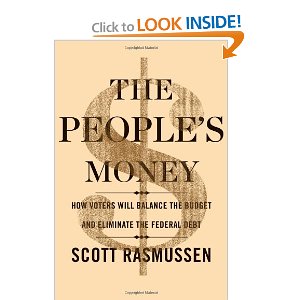
Worth a Look: The People’s Money – How Voters Will Balance the Budget and Eliminate the Federal Debt

Book Lists, Policies, Worth A Look
Amazon Page

PART ONE: The Political Class
1.  What the Political Class Thinks Voters Think
2.  How the Political Class Deceives

PART TWO: How Voters Would Spend the People's Money
3.  How Voters Would Fix Defense
4.  How Voters Would Fix Social Security
5.  How Voters would Fix Medicate and Health Care
6.  How Voters Would Fix the Tax System
7.  How Voters Want to Be Generous

PART THREE:  How Voters Would Save the People's Money
8.  Ending Corporate Welfare
9.  Giving the People a Return on Investments
10.  Tightening the Belt of the Beltway
11.  Adding it All Up

CONCLUSION: The End of the Political Class

Phi Beta Iota:  This book will be released on 31 January 2012.  It has been ordered and a full review will be provided right away.  This may be one of the most exciting books to be released in 2012, and one of the most relevant, for it is certain to break the back of the political class with transparency and truth.  The fact is that the two-party tyranny is corrupt and Congress in criminally neglectful of the public trust.

Jon Lebkowsky: Clay Shirky on SOPA as Keeping Us Passive Not Producing and Not Sharing

07 Other Atrocities, Advanced Cyber/IO, Blog Wisdom, Commerce, Corruption, Counter-Oppression/Counter-Dictatorship Practices, Government, Movies
Jon Lebkowsky

Clay Shirky has the best overview I’ve seen/heard/read of PIPA and SOPA and the context from whence they emerged; the bottom line: the legilsation’s about wanting us to be passive consumers, not producing and not sharing.

Phi Beta Iota:  To this we would add it is also about a criminally negligent and corrupt Congress exercising its power against the public interest (treason), and a criminally negligent and corrupt combination of Hollywood and Internet Service Providers seeking to legitimize vigilante arbitrary untempered attacks on anyone anywhere without due process.

noble gold