Mini-Me: End of the Delusional UAV Era

05 Iran, 08 Wild Cards, Corruption, DoD, InfoOps (IO), Intelligence (government), IO Deeds of War, Methods & Process, Military, Technologies
Who? Mini-Me?

The Unmanned Aerial Vehicle (UAV) rose to prominence in an era of uncontested budget growth (including a borrowed trillion dollars a year) and uncontested airspace.  That era is now over.

There will still be a place for mico-UAVs, especially in direct support of small unit operations, but neither the US military nor the US secret intelligence world consider infantry solutions to be “expensive enough” to be worth doing well.

For those who lack the sophistication to hack control over a UAV and force its undamaged landing, Electromagnetic Pulse rays remain the generic counter-measure that will proliferate rapidly.

NIGHTWATCH:

Point and Shoot...

Pakistan: Any unmanned aerial vehicles, including US UAVs, entering Pakistani air space will be treated as hostile and shot down per a new defense policy, a senior Pakistani official said on 10 December.

Comment: Pakistani forces lack the capabilities to execute the directive as announced, but the loss of one or two drones would be enough to curtail the program because of the expense from multiple aircraft losses. The program is not sustainable in contested airspace. This declaration has been coming for a very long time.

Algeria-US-France: For the record. US and French unmanned aerial vehicles (UAV) will not be allowed to fly over Algeria's southern airspace to counter weapons smuggling from Libya, according to El Khabar newspaper. Algeria will increase its reconnaissance of UAV air surveillance operations.

Comment: The Iranians will be quick to disseminate any insights they developed in downing a US reconnaissance drone. Algeria might not yet have Iran's insights but it is showing that it is open to Iranian help.

NIGHTWATCH KGS Home

See Also:

DefDog: Iran Hijacks US Drone Shows Film + RECAP

Dolphin: Their Drones, Our Drones, and EMP Rays

2011 Robert Steele: Global Trends 2030 – Gaps + RECAP

Corruption, Cultural Intelligence, Director of National Intelligence et al (IC), Earth Intelligence, Government, IO Impotency, Methods & Process, Officers Call
Robert David STEELE Vivas

UPDATE 11 December 2012:  The report is now out.  The below commentary was posted 12 December 2011, one year prior to the final report.  Global Trends 2030: Full Copy (166 Pages) Here, Review by Robert Steele — Report Lauds Fracking as Energy Solution, Disappoints on Multiple Fronts

Although Global Trends 2030 will not be released by the US secret intelligence community until after the November 2012 election, minutes of the 22-24 May 2011 meeting are available and provide a useful panorama of what the group is and is not considering.

Original Source (PDF 14 Pages)

Back-Up Source (PDF 14 Pages)

A few observations:

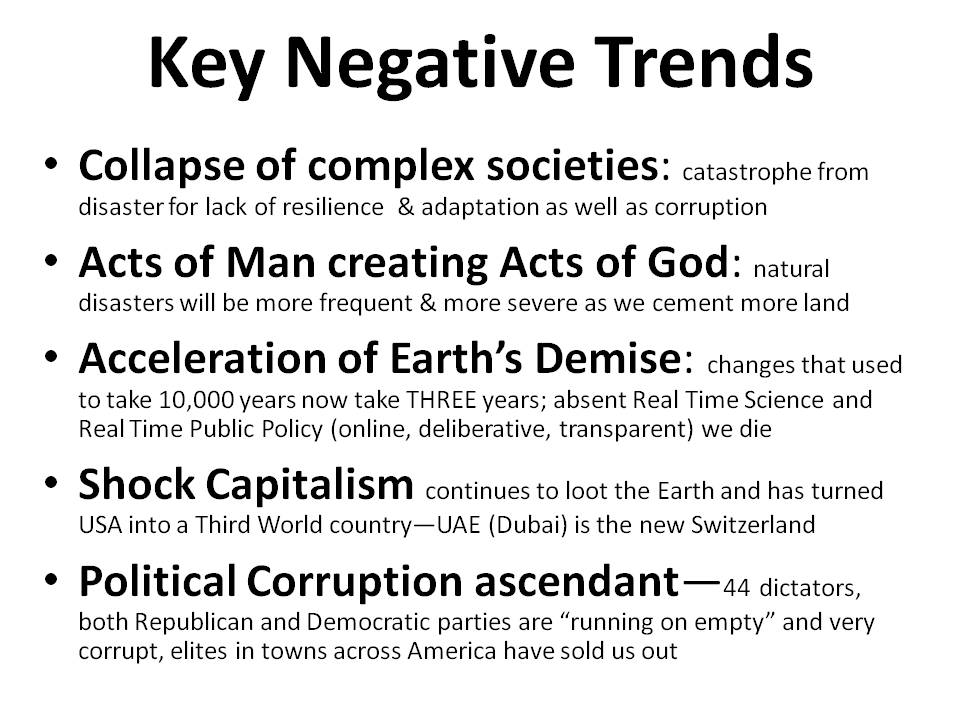
1.  They still do not have  a Strategic Analytic Model, nor do they understand in any systematic manner the preconditions and precipitants of revolution, or the cultural fundamentals.

Click on Image to Enlarge

2.  They are so beholden to status quo science they actually consider the exploitation of shale gas and oil to be a serious positive–lacking a strategic analytic model, it does not occur to them to examine the true cost of such initiatives, e.g. water, environmental degradation, etcetera.  They do not “get” the fragmentation of knowledge as being among the chief obstacles to creating strategic intelligence.

3.  They are oblivious to the “eight tribes* while creeping up on government-business collaboration (and clearly also oblivious to the fact that this is actually plutocracy and corporate capture, not collaboration).

* Academia, Civil Society [inclusive of labor and religion], Commerce, Government [all levels], Law Enforcement, Media, Military, Non-Governmental / Non-Profit.

Continue reading “2011 Robert Steele: Global Trends 2030 – Gaps + RECAP”

Chuck Spinney: Bombing Iran . . . Soon

04 Inter-State Conflict, 05 Iran, 08 Wild Cards, 10 Security, 11 Society, Corruption, DoD, Government, IO Deeds of War, Military
Chuck Spinney

Shaping the Popular Psyche in America's Post-Information Era:  Why the US & Israel May Agree to Bombing Iran

by FRANKLIN C. SPINNEY

Counterpunch, December 12, 2011

The arguments for attacking Iran are crazy, like those for attacking Iraq in response to 9-11. But that does not mean such an attack by the American and/or the Israelis will not occur.

Indeed, I think the political pressure for such an attack is increasing.  My reasons for saying this are as follows:

On 11 October, Patrick Seale wrote a very important essay, Will Israel Bomb Iran.  Seale described secret internal deliberations in the Israeli government over the twin questions of (1) how short a time window existed for Israel to launch a sneak attack on Iran and (2) how to suck in the United States into supporting such an attack, even if an Israeli attack was launched without US approval or if the US was kept in ignorance beforehand?  Seale, who is extremely well connected and very knowledgeable on the Middle Eastern affairs, also reported the Americans knew of the Israeli discussions, and the idea of Israeli decision makers thinking their window of opportunity was closing was causing alarm in Washington.

Continue reading “Chuck Spinney: Bombing Iran . . . Soon”

Steven Aftergood: CIA Classifies Open Source Works

04 Education, 07 Other Atrocities, Corruption, Cultural Intelligence, Director of National Intelligence et al (IC), Government, Intelligence (government), IO Impotency, Methods & Process, Officers Call
Steven Aftergood

Charter of Open Source Org is Classified, CIA Says

Open Source Works, which is the CIA’s in-house open source analysis component, is devoted to intelligence analysis of unclassified, open source information.  Oddly, however, the directive that established Open Source Works is classified, as is the charter of the organization.  In fact, CIA says the very existence of any such records is a classified fact.

“The CIA can neither confirm nor deny the existence or nonexistence of records responsive to your request,” wrote Susan Viscuso, CIA Information and Privacy Coordinator, in a November 29 response to a Freedom of Information Act request from Jeffrey Richelson of the National Security Archive for the Open Source Works directive and charter.

“The fact of the existence or nonexistence of requested records is currently and properly classified and is intelligence sources and methods information that is protected from disclosure,” Dr. Viscuso wrote.

This is a surprising development since Open Source Works — by definition — does not engage in clandestine collection of intelligence.  Rather, it performs analysis based on unclassified, open source materials.

Thus, according to a November 2010 CIA report, Open Source Works “was charged by the [CIA] Director for Intelligence with drawing on language-trained analysts to mine open-source information for new or alternative insights on intelligence issues. Open Source Works’ products, based only on open source information, do not represent the coordinated views of the Central Intelligence Agency.”

As such, there is no basis for treating Open Source Works as a covert, unacknowledged intelligence organization.  It isn’t one.

Continue reading “Steven Aftergood: CIA Classifies Open Source Works”

Chuck Spinney: Break-Up of Iraq, History of Oil Invasions

02 Diplomacy, 04 Inter-State Conflict, 05 Civil War, 05 Iran, 07 Other Atrocities, 08 Wild Cards, 09 Justice, 10 Security, 11 Society, Blog Wisdom, Counter-Oppression/Counter-Dictatorship Practices, Cultural Intelligence, IO Deeds of War
Chuck Spinney

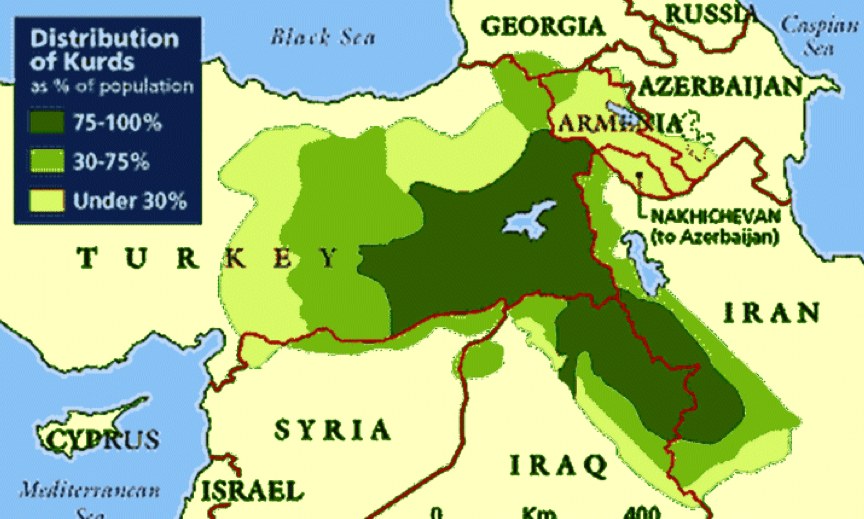
The below report by Patrick Cockburn, one of the best reporters now covering the Middle East, describes the growing tensions in Iraq over the question of sharing its oil wealth among its constituent regions.  Although his report is important in its own right, its contents become even more ominous when they viewed in a larger historical context:

The long view of history is likely to record the greatest ‘sins' of Iraq, Iran, and Libya prompting interventions by the West have been related to the control of oil — not nuclear weapons; not any communist leanings during the Cold War; not support of worldwide terrorism.

Each country committed the unforgivable sin of being governed at one time by nationalistic leaders who believed the oil under each country belonged to that country and should be controlled by the government of that country — therefore, these leaders had to be removed:

  • Iran – Mohammed Mosaddegh, a popularly elected Prime Minister of Iran and social reformer, removed by a CIA/MI6 coup in August 1953.
  • Iraq – Saddam Hussein, a murderous neo-Stalinist dictator and social reformer (e.g., major achievements in women's rights and education), removed by military force in 2003.
  • Libya – Muammar Qaddafy, a quirky tribal dictator and social reformer (e.g., major achievements in women's rights and education) removed by military force in 2011.
Click on Image to Enlarge

One short-term common denominator in these imposed regime changes was that the nationalist leader was replaced by a more compliant government that agreed to an opening of that country's oil fields to exploitation by privately owned western oil companies.

While history does not repeat itself, memories of the past condition events in the future.  Over the longer term, perceived wrongs are not forgotten, and such interventions can provoke blowbacks, which in turn provoke counteractions that enmesh the intervener in a welter of increasingly complicated conflicts.  In the case of Iran, for example, the 1953 coup eventually backfired in 1979, when  Reza Shah Pahlavi was overthrown by the Islamic revolution led by the Ayatollah Khomeini.  Khomeini then established a regime retook control of Iran's oil fields, among other things.  But the Iranian game is not over, and the historical pattern of move and countermove is in play, with the nationalist (Islamic) regime of Iran again in the West's crosshairs, allegedly because of its nuclear ambitions and support of international terror.  Nevertheless, the glittering temptations of re-privatizing Persian oilfields are lurking in the background, attracting the private oil capitalists of the West like flies to honey.

Finish long comment from Spinney, plus reference, plus See Also.

Continue reading “Chuck Spinney: Break-Up of Iraq, History of Oil Invasions”

Lynn Wheeler: Why Financial Systems Demand False Complexity and Ignorance…Corruption is Merely a Bonus

03 Economy, 07 Other Atrocities, 10 Transnational Crime, 11 Society, Blog Wisdom, Commerce, Commercial Intelligence, Misinformation & Propaganda, Money, Banks & Concentrated Wealth, Power Behind-the-Scenes/Special Interests
Lynn Wheeler

Financial Cryptography

Where the crypto rubber meets the Road of Finance…

December 11, 2011

Why (my, all) financial systems fail — information complexity

I spent over a decade building the snappiest financial system around. In that time I pursued one goal of efficiency: reduction of complexity. This wasn't only goodness in an angelic sense, it was a pragmatic goal to reduce my own costs in building systems.

The result was pretty spectacular: we were settling trades in seconds and doing so with every leg firmly fastened to the ground. That is, the whole thing was running with direct concrete ties to assets.

But, the big players weren't interested. Indeed they were more than uninterested, they were highly interested in making sure this would never ever happen. Time after time, the message was delivered: Never. Other companies received the same message, so after a few years, I started to take it seriously.

At the time I hypothesised that the reason for this was insider fraud, or at least profits capture. The complexities were endemic and there were very few people who could see the whole picture. So, I theorised that those who could understand the complexities were cashing in on their advantage; from the inside. And some very few who cashed in were also driving the information agenda, as their success made them both wealthy and influential:  more complexity.

Of course such a hypothesis is unlikely to find proof. By its very nature, how do you prove such a tendency towards chaos? Here comes an alternate perspective from ZeroHedge, citing two papers (1, 2):

And the punchline: “Liquidity requires symmetric information, which is easiest to achieve when everyone is ignorant. This determines the design of many securities, including the design of debt and securitization.” Reread the last statement as it explains perhaps better than anything, the true functioning of modern capital markets and why they are terminally broken: in order to preserve the system, the banking cartel need to make everything of virtually infinite complexity so that no one has a clear understanding of what is going on!

Read full posting.

Phi Beta Iota:  In brief, finance is fraud.  As William Greider documents in his book, The Soul of Capitalism, financial instruments (incomprehensible to their own vendors) appreciated seventeen times while real assets appreciated five times.  Twelve is the fraud-complexity-corruption delta.

See Also:

Mini-Me: European-US Banking–Tangled Web — Tell Me Again, Why Shouldn’t We Default and Let the Banks Fry? + Financial Terrorism RECAP

noble gold