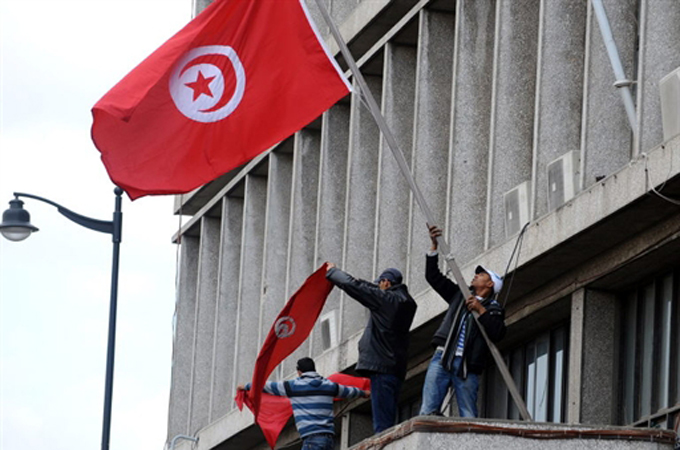
Historic events in the Arab world gripped the world's attention in January. In Tunisia weeks of escalating riots and demonstrations over dire economic conditions, corruption and government repression culminated in the ouster of President Zine al-Abidine Ben Ali on 14 January. He was replaced by an interim government which announced the country's first free elections since independence.
The direction of Tunisia's transition, and its significance for the region, are not yet clear. But, assuming a successful transition, this could mark the first genuine popular revolt leading to a democratic government in the Arab world.
Inspired by the Tunisian uprising yet fuelled by their own long-standing grievances, hundreds of thousands took to the streets across Egypt towards the end of the month, protesting against authoritarian rule and poor living standards, and calling for President Hosni Mubarak to step down. Over 135 people were killed and more than 2,000 injured during the initial police response. The army was deployed at the end of the month to curb increasing chaos and looting, but vowed not to use force against the protesters.
US admiration for its soldiers may be deep and widespread, but interest in what they are doing is shallow and fleeting
article
by Gary Younge
Published on Monday, January 31, 2011 by The Guardian
Most of the stories told about Benjamin Moore, 23, at his funeral started in a bar and ended in a laugh. Invited to testify about his life from the pews, friend, relative, colleague and neighbour alike described a boisterous, gregarious, energetic young man they'd known in the small New Jersey town of Bordentown since he was born. “I'll love him 'til I go,” his granny said. “If I could go today and bring him back, I would.”
Grown men choked on their memories, under the gaze of swollen, reddened eyes, as they remembered a “snot-nosed kid” and a fidget who'd become a volunteer firefighter before enlisting in the military. Shortly before Benjamin left for Afghanistan, he sent a message to his cousin that began: “I'm about to go into another country where they hate me for everything I stand for.” Now he was back in a flag-draped box, killed by roadside bomb with two other soldiers in Ghazni province.
There is need for bright news on the democracy front — and, luckily, there is some. (I'm also working to create some in the background, but I've got nothing to announce yet. Cross your fingers.) So I thought I'd share a bit of it the good stuff I've seen.
The first article is an announcement that the Vermont legislature is planning to become the first state to ban corporate personhood statewide. This is a move in the right direction to balance social power — a topic specifically addressed by the most popular article on the Co-Intelligence Institute website, “Democracy: A Social Power Analysis“, written by my father, John Atlee. (Perhaps you'll get a sense of how my upbringing influenced my choice of career when you read it.)
The second article below is an interview with Frances Moore Lappé, one of my early mentors (see “Living Democracy“) exploring themes in her new book GET A GRIP 2. She invites us to both work wholeheartedly on the issues that concern us AND to work on changing the systems (such as money's influence in politics) that create the problems we are trying to solve.
My good friend Jim Fallows, national correspondent for the The Atlantic, asked me to be part of a team to publish guest blogs while he is using the ‘down time' to finish a book. I am assigned, with three other people, for this week. Attached is my first entry, which I am also distributing as a blaster.
During his brilliantly run campaign of 2008, Barack Obama electrified the world with vague promises of change in foreign policy as well as domestic policy. (My take on his campaign strategy can be found here.) Two and a half years later, those promises are ashes. Nowhere is that clearer in foreign policy than in the Arab world.
In contrast to the euphoria surrounding the fall of the Berlin Wall, the Arab Revolt of 2011 leaves one with a disquieting sense that we may be standing on the wrong side of history. People power and the promise of democracy worked spectacularly well for the United States when the tyrants in Eastern Europe collapsed twenty years ago, but I think it may be working against us in the Arab world of 2011.
Phi Beta Iota: Brother Chuck is at least half right. The Davies J-Curve shows how people revolt not when they are oppressed, but when they have enjoyed or tangibly seen within reach the state of non-oppression. What we have here is a convergence. Yes, the US is on the wrong side of history–it gave up its strategic integrity immediately after WWII when it joined the UK in reneging on all promises to the Arabs and then supporting a series of brutal dictators. Yes, Obama's broken promises had an effect, but not the effect Brother Chuck suggests: instead of raising hopes, Obama's promises, quickly broken, sidelined the US. It took the US off the table. All that was left was the example of the former Soviet Union states, what Vaclav Havel calls “the power of the powerless.” That memory lay dormant while the Internet and cellular telephones and social networks (including especially Facebook) created a new sense of social power independent of the state. The PRECIPITANT for Egypt was the fall of the despotic Tunisian government in less than a week IN COMBINATION WITH the visible collapse of the US and global economies and the food scarcities visible across the region. Paradigms of failure have been with us for some time, but the word ENOUGH!, first articulated in Egypt, will now be heard–and acted upon–around the world. Saudi Arabia is ripe. That's a good thing.
The real terror eating away at the Arab world is socio-economic marginalisation.
Larbi Sadiki 14 Jan 2011 Al-Jazeera
From Tunisia and Algeria in the Maghreb to Jordan and Egypt in the Arab east, the real terror that eats at self-worth, sabotages community and communal rites of passage, including marriage, is the terror of socio-economic marginalisation.
The armies of ‘khobzistes' (the unemployed of the Maghreb) – now marching for bread in the streets and slums of Algiers and Kasserine and who tomorrow may be in Amman, Rabat, San'aa, Ramallah, Cairo and southern Beirut – are not fighting the terror of unemployment with ideology. They do not need one. Unemployment is their ideology. The periphery is their geography. And for now, spontaneous peaceful protest and self-harm is their weaponry. They are ‘les misérables' of the modern world.
As the #jan25 revolution continues in Egypt, many people are finding that some of the oldest tricks in the book are working to get them connected, which authorities have tried to stop from happening with enforced curfews and cuts to Internet service.
IDG News Service – “When countries block, we evolve,” an activist with the group We Rebuild wrote in a Twitter message Friday.
That's just what many Egyptians have been doing this week, as groups like We Rebuild scramble to keep the country connected to the outside world, turning to landline telephones, fax machines and even ham radio to keep information flowing in and out of the country.