John Bogle: ENOUGH – Speculation Bad Investment Good

03 Economy, 07 Other Atrocities, 09 Justice, 10 Transnational Crime, Civil Society, Commerce, Commercial Intelligence, Corporations, Corruption, Government, Money, Banks & Concentrated Wealth, Power Behind-the-Scenes/Special Interests

MARK JEWELL

Associated Press, 22 December 2011

EXTRACTS:

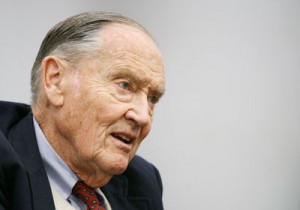
Bogle says he's paying close attention to tax policies he considers unfair, including one that's favorable to the fund industry and investors with taxable accounts. The top rate for dividends and long-term capital gains is historically low at 15 percent, as a result of the extension of Bush era tax cuts that Congress and President Barack Obama agreed to a year ago. In contrast, top earners pay 35 percent on regular income. He doesn't like that disparity.

. . . . . . .

As for capital gains, there ought to be some distinction between capital made by people who start businesses, and contribute value to society, and capital made by gamblers on Wall Street, some of whom win. Earned capital income should carry the regular dividend rate, but capital income gains by trading, and particularly short-term trading, should pay a higher tax, even than the present ordinary income rate.

. . . . . . .

Q: What's your take on the Occupy movement?

A: I'm happy to say that my current income puts me in the 99 percent group. So maybe I'm not so happy, I don't know.

This movement has brought to the surface some very serious problems in our country about disparities in opportunity and income. So many young people are having a terrible time getting a job.

Young people have great idealism, and the Occupy movement has been a bit unrealistic at times. So what? I can't imagine a worse America if our younger generation didn't have great idealism. I salute them for their enthusiasm, and their mission.

The negative side is that they just pushed too hard for too long. It's very difficult for any movement without any seeming leadership — other than a good idea — to have any sense of taste or judgment. Who's to say, ‘This is going too far'? In some places, it's just gone on too long, and it's been too disruptive. So I think it's good that we've been cleaning up the plazas where the Occupy movement set up.

Read full interview.

See Also (Steele Reviews in Each Case):

John Bogle, The Battle for the Soul of Capitalism

William Greider, The Soul of Capitalism: Opening Paths to a Moral Economy

Matt Taibbi, Griftopia: A Story of Bankers, Politicians, and the Most Audacious Power Grab in American History


Michael Ostrolenk: Should Corporations Have People Rights?

03 Economy, 07 Other Atrocities, 09 Justice, 10 Transnational Crime, 11 Society, Civil Society, Commerce, Commercial Intelligence, Corruption, Counter-Oppression/Counter-Dictatorship Practices, Government, IO Deeds of War, Law Enforcement
Michael Ostrolenk

Corporations are artificial creations of the state and receive special protections from the state. Thus, claims attorney and author Jeff Clements, corporations should not have the same Constitutional rights as individuals even though some argue that they are simply organized associations of individuals.

In this interview with Michael Ostrolenk, Mr. Clements outlines his belief that many of the abuses of crony capitalism are allowed by corporations exploiting these illegitimate “rights.”

He also exposes how tobacco industry attorney turned Supreme Court Justice, Lewis Powell, helped to spearhead the creation of a constitutional right to corporate “speech” which was recently strengthened by theCitizens United decision.  Read more about this issue (and buy his new book Corporations Are Not People) at Mr. Clement’s website.

Listen to Interview

Mini-Me: WWIII, from Gold Circles, A Whiff of…? + RECAP

07 Other Atrocities, 10 Transnational Crime, Analysis, Commerce, Commercial Intelligence, Corruption, Cultural Intelligence, Government, Key Players, Money, Banks & Concentrated Wealth, Officers Call, Policies, Power Behind-the-Scenes/Special Interests
Who? Mini-Me?

Sometimes lunatics see stuff the rest of us miss. The trick is knowing when to listen and which pieces to pull out for closer examination.  This is from Benjamin Fulford, reprinted in full at Spiritual Truth Blog, and circulating in Gold Warrior / Gold Lily / Black Eagle Trust circles.  Phi Beta Iota comments and more links below the full piece.

– – – – – – –

North Korean dictator Kim Jong Il was murdered Saturday as part of a major power struggle in East Asia, according to Asian secret society sources and Japanese military intelligence.

The murder of Kim was followed by a series of arrests of senior police officials in Japan linked to North Korea as well as the ouster of six CIA agents, the Japanese sources say.

The death has left Yasuhiro Nakasone, the top North Korean and Rothschild agent in Japan, without a power base, Japanese underworld sources say. In North Korea, meanwhile, there is now a succession battle taking place between the Rothschild faction, who want to place their trained stooge Kim Jong Un in power and set up a Rothschild central bank versus a military clique that wants independence from Rothschild control, Rothschild and Japanese underworld sources say. The action is Asia is linked to a worldwide takedown of the satanic cabal that has been trying to create a global dictatorship.

Continue reading “Mini-Me: WWIII, from Gold Circles, A Whiff of…? + RECAP”

Chuck Spinney: German Economic Imperialism Killing Europe?

01 Brazil, 02 China, 03 Economy, 03 India, 04 Inter-State Conflict, 05 Civil War, 06 Russia, 07 Other Atrocities, 08 Wild Cards, 10 Transnational Crime, Analysis, Civil Society, Commerce, Corruption, Government, Law Enforcement, Money, Banks & Concentrated Wealth, Policy, Power Behind-the-Scenes/Special Interests, White Papers
Chuck Spinney

Will Germany Kill the Goose that Laid the Golden Egg?

Since the middle of the 19th Century, the central questions in European politics have been been have been the closely connected questions of nationalism and the rise of German power.  As my good friend and eminent historian Gabriel Kolko shows in the brilliant essay attached below, the post war solutions of NATO and the European Union, together with the exigencies of the Cold War, put these questions on hold, but their fundamentals remained, sleeping beneath the surface, and today, the conflicting questions of nationalism and German power are again coming to the fore to create ominous problems for Europe and the world.
There can be no question that, until 2007 or so, the European Union — particularly the opening of borders, the free flow of labour and capital, the disappearance of tariffs, and diminution of non-tariff trade restrictions, etc. combined to make life better for the mass of average Europeans.  Standards of living rose steeply and social services improved in parallel.  This was particularly evident in the poorer EU countries on the southern rim.  I saw and experienced this astounding improvement in the quality of life on a very personal level, living on a sailboat in southern Europe since the summer of 2005.  I will never forget the comment made to me by an Italian psychologist in Calabria in 2006, which is the heart of the provincial south of Italy, “It is a great time to be a European.” To be sure, he was an educated member of the upper middle class, and not representative of the average Calabrian, but it struck me that this Calabrian saw himself as a European.  It was not very long ago, that such a person would only loosely consider himself to be an Italian, not to mention a European.

Lynn Wheeler: Why Financial Systems Demand False Complexity and Ignorance…Corruption is Merely a Bonus

03 Economy, 07 Other Atrocities, 10 Transnational Crime, 11 Society, Blog Wisdom, Commerce, Commercial Intelligence, Misinformation & Propaganda, Money, Banks & Concentrated Wealth, Power Behind-the-Scenes/Special Interests
Lynn Wheeler

Financial Cryptography

Where the crypto rubber meets the Road of Finance…

December 11, 2011

Why (my, all) financial systems fail — information complexity

I spent over a decade building the snappiest financial system around. In that time I pursued one goal of efficiency: reduction of complexity. This wasn't only goodness in an angelic sense, it was a pragmatic goal to reduce my own costs in building systems.

The result was pretty spectacular: we were settling trades in seconds and doing so with every leg firmly fastened to the ground. That is, the whole thing was running with direct concrete ties to assets.

But, the big players weren't interested. Indeed they were more than uninterested, they were highly interested in making sure this would never ever happen. Time after time, the message was delivered: Never. Other companies received the same message, so after a few years, I started to take it seriously.

At the time I hypothesised that the reason for this was insider fraud, or at least profits capture. The complexities were endemic and there were very few people who could see the whole picture. So, I theorised that those who could understand the complexities were cashing in on their advantage; from the inside. And some very few who cashed in were also driving the information agenda, as their success made them both wealthy and influential:  more complexity.

Of course such a hypothesis is unlikely to find proof. By its very nature, how do you prove such a tendency towards chaos? Here comes an alternate perspective from ZeroHedge, citing two papers (1, 2):

And the punchline: “Liquidity requires symmetric information, which is easiest to achieve when everyone is ignorant. This determines the design of many securities, including the design of debt and securitization.” Reread the last statement as it explains perhaps better than anything, the true functioning of modern capital markets and why they are terminally broken: in order to preserve the system, the banking cartel need to make everything of virtually infinite complexity so that no one has a clear understanding of what is going on!

Read full posting.

Phi Beta Iota:  In brief, finance is fraud.  As William Greider documents in his book, The Soul of Capitalism, financial instruments (incomprehensible to their own vendors) appreciated seventeen times while real assets appreciated five times.  Twelve is the fraud-complexity-corruption delta.

See Also:

Mini-Me: European-US Banking–Tangled Web — Tell Me Again, Why Shouldn’t We Default and Let the Banks Fry? + Financial Terrorism RECAP

Mini-Me: European-US Banking–Tangled Web — Tell Me Again, Why Shouldn’t We Default and Let the Banks Fry? + Financial Terrorism RECAP

03 Economy, 07 Other Atrocities, 10 Transnational Crime, 11 Society, Budgets & Funding, Commerce, Commercial Intelligence, Corruption, Government, Money, Banks & Concentrated Wealth, Power Behind-the-Scenes/Special Interests
Who? Mini-Me?

The question has to be asked: “Why shouldn't we default and let the banks fry?”

What possible benefit it there to the people of a nation whose previous leaders “sold out” the entire country on the basis of lies from the banks, notably Goldman Sachs?

Why not default and focus on full employment and resilience at home?  Why rescue German banks?

If a new financial system is emerging, anchored by the BRICS [Brazil, Russia, India, China, South Africa], why not focus on being attractive that that new ethical financial system instead of giving up what is left in the way of seed corn to the old predatory unethical system?

Banks Sit in a Tangled Web

Many European Lenders Have Sold Sovereign-Default Protection to One Another

EXTRACT:

Of the total protection that European banks have written on government bonds in Europe's five most-stressed countries, nearly one-third originated from German banks.

See Also:

Continue reading “Mini-Me: European-US Banking–Tangled Web — Tell Me Again, Why Shouldn't We Default and Let the Banks Fry? + Financial Terrorism RECAP”

noble gold