Please don't underestimate how powerful this sentence is.
When you say this to a colleague, a new hire, a student or a freelancer, you've established a powerful norm, one that they will be hesitant to challenge.
This might be exactly what you were hoping for, but if your goal is to encourage innovation, you blew it.
Phi Beta Iota: In strategic and force structure studies (neither strategic nor studies) the code is “protect the shooters” when they really mean protect shooter command billets, never mind the shooters themselves or the desperate need for a 10% move from shooters to thinkers.
Summary: The author discusses the intellectual but not the ethical underpinings of the failure of US foreign policy and national security since the first Clinton Administration. He touches on alternative policies such as isolationalism, offshore balancing, selective engagement, global dominance, and then settles on offshore balancing as the way to go: pulling back the Army and Marines from overseas, sharply reducing their budgets, and restoring budget to the Air Force and the Navy.
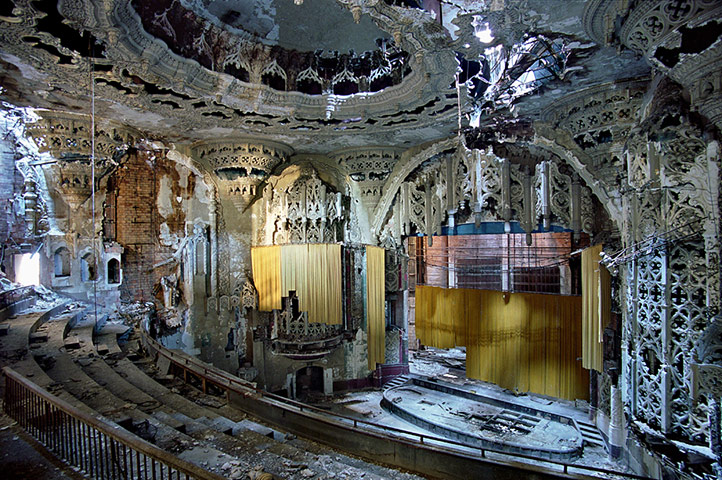
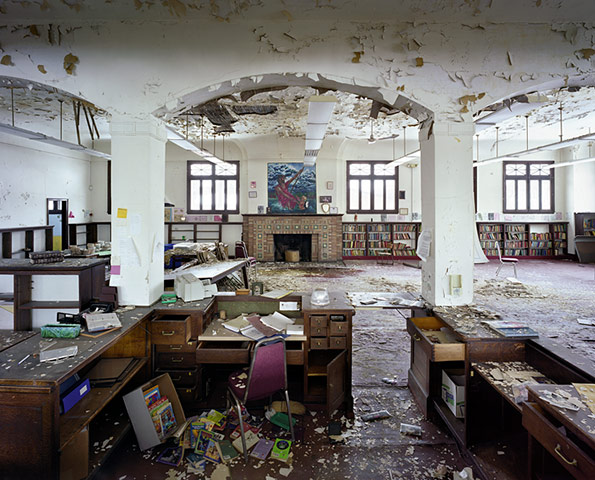
In downtown Detroit, the streets are lined with abandoned hotels and swimming pools, ruined movie houses and schools, all evidence of the motor city's painful decline. The photographs of Yves Marchand and Romain Meffre capture what remains of a once-great city – and hint at the wider story of post-industrial America
. . . . . . .
Click to Enlarge
Cumulatively, the photographs are a powerful and disturbing testament to the glory and the destructive cost of American capitalism: the centre of a once-thriving metropolis in the most powerful nation on earth has become a ghost town of decaying buildings and streets. There is a formal beauty here too, though, reminiscent of Robert Polidori's images of post-hurricane Katrina New Orleans. “It seems like Detroit has just been left to die,” says Marchand, “Many times we would enter huge art deco buildings with once-beautiful chandeliers, ornate columns and extraordinary frescoes, and everything was crumbling and covered in dust, and the sense that you had entered a lost world was almost overwhelming. In a very real way, Detroit is a lost world – or at least a lost city where the magnificence of its past is everywhere evident.”
. . . . . . .
Click to Enlarge
The Ruins of Detroit tells the city's story so far in one starkly beautiful photograph after another, all of which add up to nothing less than an end-of-empire narrative. Or as Sugrue puts it: “The abandoned factories, the eerily vacant schools, the rotting houses, and gutted skyscrapers that Yves Marchand and Romain Meffre chronicle are the artefacts of Detroit's astonishing rise as a global capital of capitalism and its even more extraordinary descent into ruin, a place where the boundaries between the American dream and the American nightmare, between prosperity and poverty, between the permanent and the ephemeral are powerfully and painfully visible. No place epitomises the creative and destructive forces of modernity more than Detroit, past and present.”
Phi Beta Iota: When did it go out of style for warriors to speak the truth and only the truth? Lies kill our own and dishonor our Republic. It is time for integrity to come back into being. Advanced Cyber/Information Operations (IO) are about truth & trust. No amount of courage at the tactical level can overcome a dishonest, unaffordable, intellectually-bankrupt strategy.
American forces invaded Afghanistan more than nine years ago, and we still don't know whom we're fighting. It's hard to know who did the better job of playing us for fools a few weeks ago – the Afghan who passed himself off as the “moderate” Taliban leader, who was rewarded with American cash for his performance, or Hamid Karzai.
. . . . . . .
With the lion's share of Iraq‘s southern oil fields in Chinese hands and the Kurdish nationalists determined to control the country's largest oil reserves, more fighting in Iraq is inevitable. This sort of thing would almost be funny, in an insane sort of way, if such military leadership did not result in the pointless loss of American lives, undermine American strategic interests and erode the security and prosperity of the American people – the things the nation's four-stars are sworn to defend.
. . . . . . .
When the budget ax falls, many inconvenient facts will come to light, unmasking the great deception that America confronted a serious military threat in the aftermath of Sept. 11, a deception promoted and fostered by politicians and ambitious generals who sought to gain from it. It will horrify and discourage Americans to learn we've bankrupted ourselves in a fight that always was analogous to clubbing baby seals. From 2001 onward, we never confronted armies, air forces or capable air defenses. Bottom line: There was no existential military threat to the United States or its NATO allies emanating from Afghanistan or the Middle East. There is none today.
For the time being, no one will say these things. It's easier to go, in Winston Churchill's words, “from failure to failure without loss of enthusiasm” and nurture the money flow to Washington.
Retired Col. Douglas Macgregor, a decorated combat veteran, is executive vice president of Burke-Macgregor Group. His newest book, Warrior's Rage, was published by Naval Institute Press. See also his earlier books, Breaking the Phalanx and Transformation Under Fire.
By Simon Johnson (bio), Baseline Scenario, 30 December 2010
Our leading bankers looted the state, plunged the world into deep recession, and cost us 8 million jobs. And now many of them stand by with sharpened knives and enhanced bonuses – also most willing to suggest how the salaries and jobs of others can be further cut. Think about the morality of that one.
Will no one think hard about what this means for our budget and our political system until it is too late?
In fact, the more we learn about what the plotters were up to, as well as the efforts to stop them, the more troubling the DNI’s ignorance becomes.
Three facts, in particular, have emerged that make this lapse inexcusable.
First, the State Department says the plotters had the U.S. embassy in London in their sites. On Monday, a Foggy Bottom spokesman confirmed that the embassy was on the plotters’ “targeting list.”
Second, according to the Guardian (UK), the alleged would-be terrorists were arrested “after several months of surveillance and monitoring by police and MI5 officers.”
Third, the UK press has reported that the plotters were, at the very least, inspired by the notorious al Qaeda cleric Anwar al Awlaki. … Awlaki is currently one of the most wanted terrorists in the world.
Phi Beta Iota: The DNI has been sand-bagged by three people and himself. Neither John Brennan (kitchen DNI at the White House), Leon Panetta (cheerleader for the CIA), or Michael E. Leiter (lawyer fronting the National Counterterrorism Center) appear to have any direct interest in seeing Jim Clapper succeed. Unfortunately, Jim Clapper has also sand-bagged himself by accepting “business as usual” and contenting himself with improvements on the margins–doing the wrong things righter. There is not a single piece of the US secret world that is working the way it should, in part because the entire mess lacks the legitimacy derived from relevance, and in part because the one thing Jim Clapper could have done on his own authority–the creation of an Open Source Center and an embedded Multinational Decision Support Centre–he has not done. Since the obvious needs to be spelled out, here are the two reasons why the OSC/MDSC are essential: 1) to begin providing the 96% of the decision-support not now provided to everyone including the President but explicitly not provided by classified to anyone below the President including policy, acquisition, and operations action officers; and b) to create the baseline for evaluating the Return on Investment (RoI) for the mis-begotten pieces of the secret world that are not, by any stretch of the imagination, worth the $90 billion a year they are costing us now. If there were one person among the seniors actually capable of making a difference, it should have been Jim Clapper. Happy New Year…
Decision-support (intelligence) is the ultimate objective of information processes. One must carefully distinguish between data which is raw text, signal, or image; information which is collated data of generic interest; and intelligence which is information tailored to support a specific decision…
As noted in an earlier Journal entry (Assessment of the Position of Director of National Intelligence December 27 2010), the Director of National Intelligence (DNI) is an unclaimed orphan among the senior U.S. intelligence managers while the Office of DNI (ODNI) is an unwelcome member of the so-called Intelligence Community (IC). The current DNI, General James Clapper (USAF ret.) is a good man in a bad job. He conspicuously does not have the ear of his most important constituent, the President of the U.S. (POTUS) or the support of the President’s most important intelligence advisor John Brennan. So how can the DNI carve out a niche for himself and his office that will enable him to build a Washington D.C. based constituency that may even include the POTUS ?
Even a cursory examination of the principal agencies of the IC, will reveal that none of them are producing strategic intelligence. CIA maintains that its intelligence analysts (most less than five years in service) are too pressed by the need to develop current intelligence to engage in the in depth analysis and research required to produce strategic intelligence. State INR the only other intelligence center really capable of producing strategic intelligence tells much the same story. The once widely influential National Intelligence Estimates (NIEs), primary vehicles for strategic intelligence, are no longer highly regarded guides to policy formulation.
Yet according to one of the most important thinkers on intelligence analysis, Sherman Kent, strategic intelligence provides, “the knowledge which our highly placed civilians and military men must have to guard the national welfare” (emphasis added). Put another way, strategic intelligence can be described as accurate and comprehensive information that is needed by decision makers to formulate policies or take actions to protect our national interests.