Robert Steele: Clandestine Operations 101 + Personal Comment

Advanced Cyber/IO, Ethics, Government, Intelligence (government)
Robert David STEELE Vivas

Clandestine Operations 101

Here's how to create a clandestine service that is not the laughing stock of the planet:

00  Stop confusing secure field operations with any need for access to official secrets.  The primary reason CIA is such a mess is the ascendance of security ignorance and myopia combined with sedentary overly fearful managers unable to do anything from outside an official cover safety net.

01  Recruit mid-career US citizens who have unwittingly created their own cover and access.  Do not assign them anything requiring more than 10% of their time.

02  Recruit mid-career non-US citizens, same as above, they never visit HQS or touch secrets not collected by themselves.

03  Get back in the business of Principal Agents (PA) from all countries, same selection concept as above (mid-career, have the cover and access desired).

04  Start doing multinational regional clandestine stations, using indigenous case officers (the Australians and Cambodians seem to have this down pat) while providing close-in technical, money, and leads from the constellation.

05  Be more aggressive (with appropriate caution) in doing what one of my mentors termed “it's just business.”  One time offers based on outcomes, no polygraphs, no approvals from HQS people  out of touch with reality, etcetera.

ON A PERSONAL NOTE

It has come to my attention that someone describing themselves as one of my classmates has said that I nearly killed people in El Salvador, had an accident, and was effectively non-operational from 1982 on.  Since half my class quit within five years, by my calculation there should be no more than one or two of my graduating class (I skipped interims and jumped one class, I remember no one from my EOD class.

Below are the facts, without any grudges.  What I learned from my experiences within CIA remains priceless and has informed my persistent efforts to reform US intelligence.

Continue reading “Robert Steele: Clandestine Operations 101 + Personal Comment”

Patrick Meier: Advice to Future PhDs from 2 Unusual Graduating PhDs – Blog Twitter Hybrid Teach-Consult Dissertation Focus

Advanced Cyber/IO, Blog Wisdom, Collective Intelligence, Communities of Practice, Cultural Intelligence, Ethics, Intelligence (government), Methods & Process, Officers Call
Patrick Meier

Advice to Future PhDs from 2 Unusual Graduating PhDs

Next week I will be attending my official graduation from The Fletcher School to receive my PhD diploma. It is—in a word—surreal. I've been working on my PhD for almost as long as I've known my good friend and colleague Chris Albon, which is to say, a long time. Chris is also a newly minted political science PhD and recently joined the FrontlineSMS team as the director of their Governance Project. Needless to say, our paths have crossed on many occasions over the years and we've had many long conversations about the scholar-practitioner path that we've taken. With graduation just a few days away, we thought we'd write-up this joint post to share our pearls of wisdom with future PhDs.

First: blog, blog, blog! The blog is the new CV. If you don't exist dynamically online, then you're not indexable on the web. And if you're not indexable, then you're not searchable or discoverable. You don't exist! Blog-ergo-sum, simple as that. Chris and I have been blogging for years and this has enabled us to further our knowledge and credibility, not to mention our of network of contacts. The blog allows you to build your own independent brand, not your advisor’s and not your program’s. This is critical. We've received consulting gigs and keynote invitations based on blog posts that we've published over the years. Do not underestimate the power of blogging for your professional (and yes, academic) career. In many ways, blogging is about getting credit for your ideas and to signal to others what you know and what your interests are.

Second: get on Twitter! Malcolm Gladwell is wrong: social media can build strong-tie bonds. Heck, social media is how I originally met Chris. If the blog is the new CV, then consider your Twitter account the new business card. Use Twitter to meet everyone, everywhere. Let people know you'll be in London for a conference and don't underestimate the synergies and serendipity that is the twittersphere. Chris currently follows around 1,200 people on Twitter, and he estimates that over the years he has met around half of them in person. That is a lot of contacts and, frankly, potential employers. Moreover, like blogging, tweeting enables you to connect to others and stay abreast of interesting new developments. Once upon a time, people used to email you interesting articles, conferences, etc. I personally got on Twitter several years ago when I realized that said emails were no longer making it to my inbox. This information was now being shared via Twitter instead. Like the blog, Twitter allows you to create and manage your own personal brand.

Continue reading “Patrick Meier: Advice to Future PhDs from 2 Unusual Graduating PhDs – Blog Twitter Hybrid Teach-Consult Dissertation Focus”

Reference: Defense and Energy Deficit Reduction: $688 Billion

03 Economy, 04 Inter-State Conflict, 05 Energy, 07 Other Atrocities, 08 Proliferation, 09 Justice, 10 Security, 11 Society, Budgets & Funding, Commercial Intelligence, Corruption, General Accountability Office, Government, Military, Office of Management and Budget, Officers Call

POGO Source Page, May 8, 2012

national security spending

Wasteful Spending in the Department of Defense Budget
Wasteful Spending on Nuclear Weapons Programs
Service Contracts
Conclusion
Endnotes

Americans are tightening their belts, and it’s time for the U.S. government to do the same. In light of the Budget Control Act of 2011 and the subsequent failure of the “Super Committee,” Congress is still desperately seeking ways to reduce spending. To this end, the Project On Government Oversight and Taxpayers for Common Sense have closely examined the proposed national security budget[1] and found plenty of wasteful spending. Adjusted for inflation, U.S. national security spending is higher than at any point during the Cold War and accounts for more than half of all discretionary spending.[2] However, the U.S. faces no existential threats as it did then, and U.S. defense needs are changing as the military draws down its presence in Iraq and Afghanistan.

Still, military spending at the Department of Defense (DoD) has increased by an astounding 95 percent from FY 2001 to the FY 2013 estimate, adjusted for inflation.[3] Nuclear weapons spending at the Department of Energy (DOE) is projected to grow by billions of dollars over the next decade.[4] And the federal government’s reliance on contractors, most of whom work on national security-related work and cost on average nearly twice as much as the federal workers who do the same job, is also driving budgets through the roof.[5] It’s clear that any serious proposal to shrink the U.S. deficit must include cuts to the national security budget.

The following list updates our recommendations from 2011[6] and details nearly $700 billion in savings over the next ten years, including cuts to wasteful weapons systems as well as limits on out-of-control contract spending. We found programs for which there are cheaper yet equally effective alternatives, and programs that can be cancelled or delayed without putting America’s security at risk.

The Project On Government Oversight is a nonpartisan independent watchdog that champions good government reforms. POGO’s investigations into corruption, misconduct, and conflicts of interest achieve a more effective, accountable, open, and ethical federal government.

Taxpayers for Common Sense is a nonpartisan budget watchdog serving as an independent voice for American taxpayers. Its mission is to achieve a government that spends taxpayer dollars responsibly and operates within its means. TCS works with individuals, policymakers, and the media to increase transparency, expose and eliminate wasteful and corrupt subsidies, earmarks, and corporate welfare, and hold decision makers accountable.

Wasteful Spending in the Department of Defense Budget

Continue reading “Reference: Defense and Energy Deficit Reduction: $688 Billion”

Marcus Aurelius: The Pentagon’s New Defense Clandestine Service

Intelligence (government), Military
Marcus Aurelius

The Pentagon's New Defense Clandestine Service

American Thinker, 27 April 2012

Earlier this week, the Associated Press reported a new intelligence initiative coming out of the Pentagon. We are constantly reminded that intelligence agencies have difficulty sharing their work, yet the Pentagon has decided to create another intelligence agency — the Defense Clandestine Service. Many professionals believe that this initiative is doomed to fail.

Since the technological revolution, intelligence-collection among human activity has swiftly deteriorated. Technology has superseded human intelligence (HUMINT) collection efforts with tools such as Signals Intelligence, Measures and Signatures Intelligence, and Open Source. Today, HUMINT has become an endangered species. The good news behind the newly formed Defense Clandestine Service demonstrates that America's HUMINT is like the bald eagle — it may be endangered, but it is making a comeback.

America's clandestine activities and HUMINT operations have been crippled by years of internal feuding dating back as far as the Carter administration. Creating additional organizations will not fix the problem; rather, pre-existing organizational resolve is needed. As one operative who spoke on condition of anonymity stated, “[y]ou don't just go out and buy a new car because you need an oil change and some new tires.” When it comes to intelligence, specifically HUMINT, we don't have the money to purchase an entirely new luxury, so we need to fix the one we have.

“HUMINT is assuredly broken. A series of incapable DCI's and self-promoting Deputy Directors for Operations (now called National Clandestine Service) have converted what was once a stellar service into a cadre of messenger boys begging for scraps from foreign liaisons. This problem began long ago with Admiral Stansfield Turner[.]” -Robert David Steele

Continue reading “Marcus Aurelius: The Pentagon's New Defense Clandestine Service”

Paul Craig Roberts: Disinformation (Lies) From Left to Right — Why the Military-Industrial Complex Consistently Assassinates or Impeaches Presidents Who Cross Them….

03 Economy, 04 Inter-State Conflict, 07 Other Atrocities, 10 Security, 11 Society, Commerce, Corruption, Counter-Oppression/Counter-Dictatorship Practices, Cultural Intelligence, Government, IO Deeds of War, Military, Officers Call
Paul Craig Roberts

Disinformation On Every Front

Some readers have come to the erroneous conclusion that the Matrix consists of Republican Party disinformation as if there is no disinformation from the left. Others think that propaganda is the business of Obama and the Democrats. In fact, propaganda from the right, the left and the middle are all part of the disinformation fed to americans.

If I may give some examples: The other day Chuck Colson, one of the Nixon officials imprisoned for Watergate crimes, died. This gave NPR the opportunity to relive the Nixon horror.

What precisely was the Nixon horror? Essentially, there was no such thing. Watergate was about President Nixon lying about when he learned about the Watergate burglary.
When Nixon learned about the burglary, he did not act on it prior to his reelection, because he reasoned, rightly, that the Washington Post would blame him for the burglary, although he had nothing to do with it, in the hopes of preventing his reelection.

By going along with a cover-up, Nixon enabled the Washington Post to make an issue of the precise date on which Nixon learned of the burglary. White House tapes indicated that Nixon had learned of the burglary before he said he learned of it. So Nixon had permitted a cover-up and had to go, but what was the real reason?

What was the Watergate burglary? We don’t really know. A group of men including former CIA operatives were hired by the Committee to Re-elect the President to break into a Democratic campaign office in the Watergate complex. We don’t know the purpose of the burglary. Some claim it was to wire-tap the telephones in the belief that the Democratic Party was getting re-election money from communists in Cuba or elsewhere. Others claim that the burglars were looking for a list of call girls, that compromised a White House official, as his fiancee was allegedly one of the call girls.

Looking back from our time during which Bush and Obama have deep-sixed the US Constitution, violated numerous US and international laws, and behaved as if they were caesars unconstrained by any law or any morality, Nixon’s “crimes” appear so trivial as to be unremarkable. Yet, Nixon was driven from office and is regarded as a criminal.

What was Watergate really about?

Continue reading “Paul Craig Roberts: Disinformation (Lies) From Left to Right — Why the Military-Industrial Complex Consistently Assassinates or Impeaches Presidents Who Cross Them….”

Bojan Radej: Data Journalism Handbook & Graphic Map

Advanced Cyber/IO, Civil Society, Collective Intelligence, Counter-Oppression/Counter-Dictatorship Practices, Ethics, Media, Methods & Process
Bojan Radej

The Data Journalism Handbook is Out

6 months ago at Mozilla Festival 2011, the Data Journalism Handbook was born. Thanks for your interest in the book – I have great pleasure in announcing that the Handbook is now live!

The Handbook features contributions from over 70 leading practitioners of data journalism from every corner of the globe, from Japan to Finland, Nigeria to the US and from leading news outlets such the New York Times, Zeit Online, the BBC and the Guardian. The Handbook is an open educational resource, under a creative commons licence (CC-BY-SA) so please share it with your friends and remix it. We hope that it will encourage many budding data journalists to look at data as a source and give them courage to tackle it, as well as showcasing some great examples of journalism using data as inspiration for future stories.

You can find the handbook at: http://datajournalismhandbook.org/ 

Also available for pre-order is the e- and print version from O'Reilly Media – http://oreil.ly/ddj-e-print – so if you are interested in a version to read offline, take a look!

We will soon have the facility to submit feedback via the website if you spot any errors or have any improvements for the next version,


Lucy Chambers

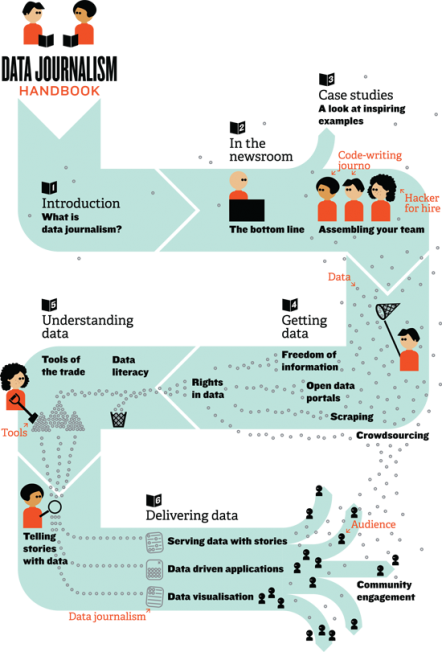
Infographic impresario Lulu Pinney created this superb poster, which gives an overview of the contents of the Data Journalism Handbook.

Click on Image to Enlarge
noble gold