When Nokia announced yesterday that it was reabsorbing the Symbian operating system it had spun out as an open source effort 18 months ago, I thought, “Why bother? I thought MeeGo was your mobile OS future anyhow?” — especially given the lack of attention to the last major release of Symbian (Symbian 3) in September.
Phi Beta Iota: Both Microsoft and Nokia are at a fork in the road. The above review, vastly more critical than the fluff found elsewhere, is bleeding edge truth. Absent new management and a compelling vision–ideally one that united both companies to favor a very simple low cost cellular “key” combined with a vast global grid meshing humans with call centers and back office cloud processing, both companies appear destined for further decline.
PCMag.com met with RockMelt's founders Eric Vishria and Tim Howes last week for an early look at the new browser software. Entering a competitor into a full field that includes Internet Explorer, Firefox, Chrome, Safari, and Opera, not to mention an even more direct socially enhanced-browser competitor, Flock, may seem questionable, but Visheria and Howes made a fairly compelling case for it. Their point was that the current all-purpose browsers don't reflect most people's actual usage patterns.
Reinventing the Browser
“At RockMelt we are reinventing the browser for the way people use the Web today,” said Howes. “We think this has changed dramatically from the way people used it just a few short years ago. But all the browsers available today, although they've gotten a lot faster, are still just about navigating web pages. We built features into the browser to address people's three top browsing behaviors: interacting with friends, consume news and information, and searching.”
This is just too cool. The smart guys always went into artillery, where you had to be able to count not just spell. As upset as one might be with all the high end waste, fraud, and abuse within our military-industrial-congressional complex (MICC), this short film is a celebration in combat effectiveness. Go Army! [The Marines still do not have Naval Gunfire Support, the Navy decided a couple of decades ago it really doesn't give a shit about supporting Marines, and multiple Commandants of the Marine Corps have let them get away with it.]
“Net neutrality” and “freedom to connect” might be loaded or vague terminologies; the label “Open Internet” is clearer, more effective, no way misleading. A group of Internet experts and pioneers submitted a paper to the FCC that defines the Open Internet and explains how it differs from networks that are dedicated to specialized services, and why that distinction is imortant. It’s a general purpose network for all, and can’t be appreciated (or properly regulated) unless this point and its implications are well understood. I signed on (late) to the paper, which is freely available at Scribd, and which is worth reading and disseminating even among people who don’t completely get it. I think the meaning and relevance of the distinction will sink in, even with those who don’t have deep knowledge of the Internet and, more generally, computer networking. The key point is that “the Internet should be delineated from specialized services specifically based on whether network providers treat the transmission of packets in special ways according to the applications those packets support. Transmitting packets without regard for application, in a best efforts manner, is at the very core of how the Internet provides a general purpose platform that is open and conducive to innovation by all end users.”
Press release:
Numerous Internet and technology leaders issued a joint statement last night encouraging the FCC to expand its recent analysis of open Internet policy in a newly fruitful direction.
In the statement, they commend the agency’s recent request for input on “Two Underdeveloped Issues in the Open Internet Proceeding” for its making possible greater recognition of the nature and benefits of the open Internet — in particular, as compared to “specialized services.” In response to the FCC’s request, their submission illustrates how this distinction dispels misconceptions and helps bring about more constructive insight and understanding in the “net neutrality” policy debate.
Longtime network and computer architecture expert David Reed comments in a special blog posting: “It is historic and critical [to] finally recognize the existence of ‘the Open Internet’ as a living entity that is distinct from all of the services and the Bureaus, all of the underlying technologies, and all of the services into which the FCC historically has partitioned little fiefdoms of control.”
Another signer, John Furrier of SiliconANGLE, has publicized the statement, stating “the future Internet needs to remain open in order to preserve entrepreneurship and innovation.”
The statement’s signers are listed below. Please reply to me, Seth Johnson (seth.p.johnson@gmail.com), to request contact information for those available for comment.
The Federal Reserve will pump $600 billion more into the US economy and keep interest rates at historical low levels. The short-term impact of the Fed’s move, known as quantitative easing, has been a jump in stock prices across the globe. Many nations, however, have accused the United States of waging a currency war by devaluing the dollar. We speak to former Wall Street economist and University of Missouri professor Michael Hudson. “The object of warfare is to take over a country’s land, raw materials and assets, and grab them,” Hudson says. “In the past, that used to be done militarily by invading them. But today you can do it financially simply by creating credit, which is what the Federal Reserve has done.” [includes rush transcript]
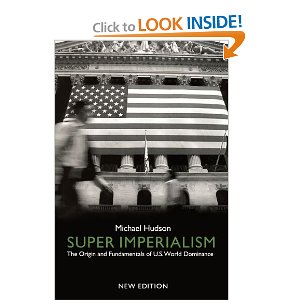
Amazon Page -- New Edition (2003)
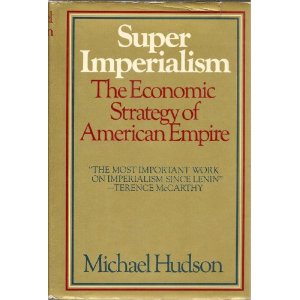
QUOTE from the Introduction: “The last time there were a series of devaluations like this it led to WW II.”
QUOTE from the TV Interview: “A legalized way for Wall Street to loot other Central Banks.”
QUOTE from the TV Interview: “In Europe it is illegal for the Central Bank to finance government debt.”
Phi Beta Iota: This interview, viewed in its entirety, destroys the myth of Barack Obama and clarifies with stunning detail the degree to which the Obama Administration is blocking all forms of relief for the public at the state level at the same time that he is assuring that the Chinese yuan will become the global reserve currency. We anticipate all sales of anything to US currency to be blocked by other countries, and we hope that US Governors will start nullifying federal interference with justice at the state level.
In my last Counterpunch essay, “How Obama's Initial Personnel Decisions Hardwired the Wipeout” I organized my argument around verbiage describing how Obama “fatal move” to the middle,” leaving the misleading impression that his connection to the middle occurred after the election. This was sloppy wording and in retrospect it is clear to me that impression did not even reflect what I was trying to say. “Irrevocable” would have been a better modifier than “fatal.” And the word “move” was more related to the perceptions of the people whose enthusiasm he unleashed during the campaign, not Obama's political proclivities.
Obama has always been a center-right politician tightly connected to ruling oligarchs in the US. I have been concerned about this connection with the oligarchy since December 2007, when I became aware of the people who were advising him on defense, foreign policy, and treasury matters. I publicly expressed concerns about his defense advisors in July 2008 and all of them on 5 November 2008, (see last paragraph here) the day after he was elected. “Hardwiring the Wipeout” was basically a first-cut bookend to the 5 November piece (what I called the outer layer of the onion).
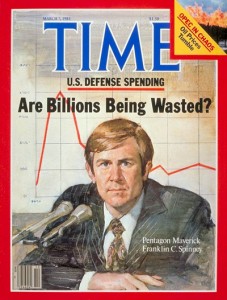
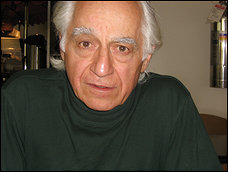
Lest you think I am quibbling about what the meaning of “is” is, for the record, I agree with the critical comments (attached below) from my good friend Pierre Sprey, who has taken the trouble to give an incisive correction to my sloppy wording, and which he has graciously agreed to let me forward. Think of this as a roadmap for probing into the second and more rancid layer of the onion.
——————————- [Sprey's Comment]————————
Pierre Sprey
Chuck,
Superb analysis of why the voters tossed out Bush and his cohorts, how Obama generated such strong support and, two years later, why many of those supporters felt betrayed enough to stay home or to vote Republican. The article is most certainly needed and timely to fend off the tsunami of obfuscation that both the Republican and Democratic pundits are about to unleash.
On the other hand, I view your chronology of Obama's (and the Democratic Party's) “move to the middle” a bit differently–and our differences have serious implications for judging Obama's character, his decision-making and the futility of expecting change in anything but his rhetoric:
1. I see no evidence that there's been any change or “move” in substantive actions and stated policies going from Senator Obama to Candidate Obama to President Obama. Needless to say, over this entire time most of his policy “positions” were (and are) rhetoric cleverly crafted to avoid any specific position at all.
2. Given that early financial backers of Obama in Chicago politics were the Crown family (General Dynamics and super-Zionists) and the Pritzker family (credit business, Goldman Sachs allies and super-Zionists), I'd say it's likely that Obama's commitment to the MICC, to Wall Street and to Israel predated his run for the Senate.