TED Video on “Recovering Plunderer” and “Greenest CEO” Ray Anderson & I = P x A / T2

03 Environmental Degradation, 05 Energy, 07 Health, 12 Water, Commerce, Corporations, Earth Intelligence, Peace Intelligence, TED Videos, Videos/Movies/Documentaries

The Magnitude of the Entrepreneurial Mission
Ray Anderson and the Business Logic of Sustainability

Thirty-six years ago, Ray Anderson bootstrapped a carpet company called Interface. He maneuvered it though the challenging years, and by the 1990s he was a major player, which also meant he was a preeminent contributor to the take/make/waste production system of the carpet industry. “We were digging up the earth and converting it to pollution,” he says.

Anderson devoted his company to “Mission Zero,” a vow that within five years it would “only take from the earth that which can be replenished by the earth, take not one fresh drop of oil in an oil-intensive industry, and do no harm.” The results: Greenhouse emissions declined 82 percent, fossil fuel use dropped 60 percent, water use declined 77 percent, while sales increased 66 percent and profits doubled. Interface realized $400 million in “avoided costs” in pursuit of zero emissions, which paid for the entire transformation.

Anderson's green business model is classic: Costs come down as innovation–inspired with missionary zeal–goes up, products become better, talent is attracted to your company for its moral and emotional enterprise, and the marketplace perceives the good that you do as reflective of the goods that you make. Most important, Anderson's real-life model presents an irrefutable challenge. As he says, “If something exists, it must be possible.”

I = P x A x T1 is Paul & Anne Erhlich's  Environmental Impact Equation where Impact = Population multiplied by Affluence multiplied by Technology. The revised equation is I = P x A / T2.

Thanks to Entrepreneur.com for listing various TED videos

Comment: If you are a CEO, contact Ray Anderson for more information, advice, wisdom, etc.

Event: 5 Nov 2010, New York City, Columbia Univ, Mobile Money II

01 Poverty, 03 Economy, Academia, Civil Society, Commerce, Mobile, Technologies

Mobile Money II

Columbia Institute for Tele-Information

Columbia Business School

Uris Hall TBD

In April 2010 CITI held its first conference on “Mobile Money”, focusing on the macroeconomic aspects.  Since then, developments have accelerated.  Around the world, the rapid spread of mobile phones is being followed by their use as a tool for financial transactions.  The cell phone serves as a bank account, debit card, and money creator. Developing countries lack effective financial infrastructure.  The positive economic impact of the mobile telecommunications infrastructure has been demonstrated, as has been the ability of microfinance to stimulate economic activity.  Now a hybrid of the technologies has begun to emerge, enabling a mobile financial system.  A notable example is Kenya where the M-PESA system (‘m-money’ in Swahili) has transferred in its short history over $5.4 billion by 12 million customers. This conference addresses some of the following issues:

  • What are the economics of mobile money?
  • What policy issues does it raise?
  • Is m-money a threat to the traditional banking system?
  • How might it be regulated?
  • Security issues
  • Consumer protection perspectives
  • Investor perspectives
  • Indicators for demand
  • M-money and m-health
  • What are consumer and privacy protection issues?
  • Who will control the system—banks or telecom operators?
  • What are the emerging trends?
 Continue reading "Event: 5 Nov 2010, New York City, Columbia Univ, Mobile Money II"

Journal: UK Defence Bottoms Up, US DoD Next…

10 Security, 11 Society, Budgets & Funding, Military, Officers Call, Peace Intelligence
Joe Cirincione

Joe Cirincione

President of Ploughshares Fund

Posted: October 20, 2010 02:13 PM

British Budget Collapse Foreshadows Cuts to Come in U.S. Defense Budget

Great Britain's cuts, particularly to its nuclear forces, are the canary in the defense budget mine. Just as massive deficits forced the conservative UK government to cut deep into its military programs, the United States will soon have to choose: update its force structure or cling to obsolete Cold War posture?
– – – – – –

U.S. Secretary of Defense Robert Gates is going through his own budget pain, now choosing which weapons to cut in an effort to save some $100 billion over the next five years. The Pentagon budget has doubled since 2001, rising an average of seven percent a year. This budget growth is expected to slow to only 1 percent in the near future, and even that may be unsupportable. Something's got to give. To preserve vital conventional military forces, the service chiefs will likely have to cut into the $54 billion spent each year on nuclear weapons-related programs.

Read full article…

Phi Beta Iota: DoD needs to fall back to $500 billion a year, and wean itself of contractors at the same time that it creates a long-haul Air Force, a 450-ship Navy, and a military-based multinational Peace Corps.

2010: Human Intelligence (HUMINT) Trilogy Updated

2010: OPINION–America’s Cyber Scam

2009 Perhaps We Should Have Shouted: A Twenty-Year Restrospective

2008 U.S. Naval Power in the 21st Century

2008 Rebalancing the Instruments of National Power–Army Strategy Conference of 2008 Notes, Summary, & Article

2001 Threats, Strategy, and Force Structure: An Alternative Paradigm for National Security

2000 Presidential Leadership and National Security Policy Making

1998 JFQ The Asymmetric Threat: Listening to the Debate

1997 Strategic Intelligence in the USA: Myth or Reality?

1997 USIP Conference on Virtual Diplomacy Virtual Intelligence: Conflict Avoidance and Resolution through Information Peacekeeping

1995 Re-Inventing Intelligence The Vision and the Strategy

1995 GIQ 13/2 Creating a Smart Nation: Strategy, Policy, Intelligence, and Information

1993 On Defense & Intelligence–The Grand Vision

1991 MCG Intelligence Support for Expeditionary Planners

Reference: How to Think Like Steve Jobs…Explore!

Articles & Chapters, Cultural Intelligence, info-graphics/data-visualization, Methods & Process
DefDog Recommends...

Very interesting……Jobs sees the same things as other leaders, but he perceives them differently.

The key to thinking differently is perceiving things differently. To perceive things differently, you must be exposed to divergent ideas, places and people. This forces your brain to make connections it otherwise might miss. Steve Jobs has done this his entire life. He dropped out of college so he could “drop in” to classes that really interested him, such as calligraphy, whose lessons would come back to him years later when he designed the Mac, the first personal computer with beautiful fonts. Jobs wanted the Apple II to be the first personal computer people used in their homes, so he sought inspiration for it in the kitchen appliance aisle at Macy's. And when he hired musicians, artists, poets and historians on the original Macintosh team, he was again exposing himself to new experiences and novel ways of looking at problems.

Leadership

How To Think Like Steve Jobs

Carmine Gallo, 10.19.10, 04:30 PM EDT

You have to bombard your brain with new and novel experiences.

imageThomas Friedman, the New York Times columnist, recently wrote that America's core competency is its ability to attract, develop and unleash creative talent. He suggested that what America needs if it is to emerge from the Great Recession even stronger than before is more Jobs–Steve Jobs. That sounds good on paper, but how does Steve Jobs do it? How did Apple‘s chief executive pioneer the personal computer, revive the Apple brand in 1997 when it was close to bankruptcy and grow Apple into the most valuable tech company in the world? That's the question I took on in writing my new book, The Innovation Secrets of Steve Jobs.

Read Rest of Story Online….

Reference: Reader-to-Leader Framework–Motivating Technology-Mediated Social Participation

Collective Intelligence, Collective Intelligence, Communities of Practice, Cultural Intelligence, info-graphics/data-visualization, InfoOps (IO), IO Mapping, IO Multinational, Methods & Process, Mobile, Open Government, Standards, Strategy, Tools

The Reader-to-Leader Framework: Motivating Technology-Mediated Social Participation

Jennifer Preece, University of Maryland1
Ben Shneiderman, University of Maryland2

Abstract

Billions of people participate in online social activities. Most users participate as readers of discussion boards, searchers of blog posts, or viewers of photos. A fraction of users become contributors of user-generated content by writing consumer product reviews, uploading travel photos, or expressing political opinions. Some users move beyond such individual efforts to become collaborators, forming tightly connected groups with lively discussions whose outcome might be a Wikipedia article or a carefully edited YouTube video. A small fraction of users becomes leaders, who participate in governance by setting and upholding policies, repairing vandalized materials, or mentoring novices. We analyze these activities and offer the Reader-to-Leader Framework with the goal of helping researchers, designers, and managers understand what motivates technology-mediated social participation. This will enable them to improve interface design and social support for their companies, government agencies, and non-governmental organizations. These improvements could reduce the number of failed projects, while accelerating the application of social media for national priorities such as healthcare, energy sustainability, emergency response, economic development, education, and more.

Recommended Citation

Preece, Jennifer and Shneiderman, Ben (2009) “The Reader-to-Leader Framework: Motivating Technology-Mediated Social Participation,” AIS Transactions on Human-Computer Interaction (1) 1, pp. 13-32
Available at: http://aisel.aisnet.org/thci/vol1/iss1/5

Visit Home to Download Free

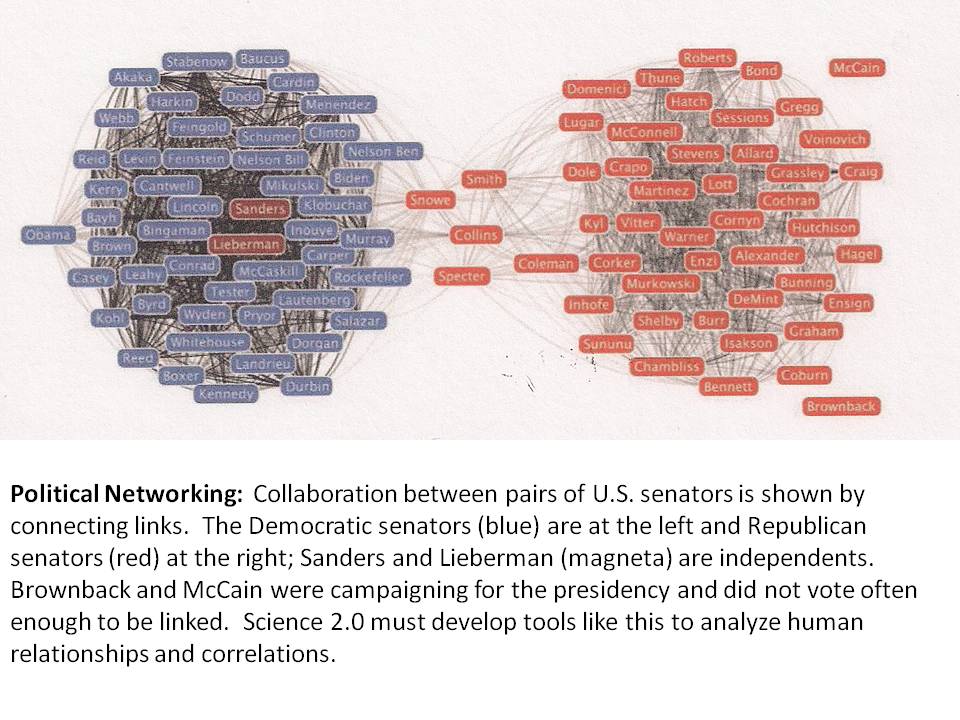
Reference: Science 2.0 by Ben Shneiderman

Articles & Chapters, Collective Intelligence, Communities of Practice, Cultural Intelligence, info-graphics/data-visualization, IO Mapping, IO Multinational, Mobile, Open Government, Strategy, Tools

Click on Image to Enlarge

Read Source Article, Science 2.0 (2008-07-03)

Phi Beta Iota: Eugene Garfield gave us citation analysis via the Institute for Scientific Information, and Dick Klavans and company have given us the (fragmented) web of knowledge.  Top commercial intelligence practitioners have long known that published experts can lead to unpublished experts without which ground truth cannot be determined.  If citations are the “things” that can be measured, “relationships” or “transactions” are the intangibles between the spaces, the Ying of the Yang.  This article is important in part because it coincides with MajGen Robert Scales, USA (Ret) view that WWI was about chemistry, WWII was about physics, WWIII was about information, and WWIV is about human factors.

See Also:

Reference: 27 Sep MajGen Robert Scales, USA (Ret), PhD

Search: The Future of OSINT [is M4IS2-Multinational]

2010: Human Intelligence (HUMINT) Trilogy Updated

2010 INTELLIGENCE FOR EARTH: Clarity, Diversity, Integrity, & Sustainability

Graphic (12): Gun Control Perspectives

10 Security, 11 Society, Civil Society, Collective Intelligence, Cultural Intelligence, History, Mobile, Open Government, Peace Intelligence, Standards, Strategy, Tools
Marcus Aurelius Recommends

Following is self explanatory. About all I can add is:

– “The West wasn't won with a registered gun.”
– As Charlton Heston said, “… from my cold, dead hand …”
– “Better to be judged by twelve than carried by six.”
– “Don't dry fire in a gunfight.”
– “I am the NRA — and I vote!”

Click on Image to Upload

Eleven Other Images Below the Line

Continue reading “Graphic (12): Gun Control Perspectives”

noble gold