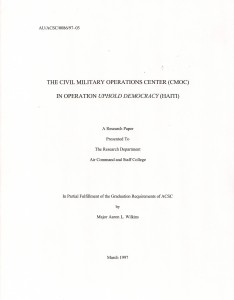
The full title is “The Civil Military Operations Center (CMOC) in Operation Uphold Democracy (Haiti). Although dated March 1997, this is a very fine contribution that maintains its relevance, not least because of its descriptions of both the functions and the effect of the functions in dealing with NGOs (like herding turkeys).
Nine of the ten largest hotels in the world are in Las Vegas. Four of them share one intersection: Las Vegas Boulevard (The Strip) and Tropicana Avenue. Together, these four corners comprise 12,953 rooms, most of which enjoy high occupancy year-round and are often full. Figure 25,000 people huddled on four corners.
The imagery is also appealing to terrorists: Occupying one corner is New York, New York, with a “skyline” that features the Empire State Building, the Chrysler Building, and the Statue of Liberty.
This thought: It is no longer necessary for al-Qaeda terrorists to hijack two Beechcraft C99 planes out of Vegas, as easy as this would be. Instead, why not drive (three-and-a-half hours from Vegas) to Grand Canyon West Airport with a few vans filled with ammonium nitrate (fertilizer) and diesel fuel? Armed with a few baseball bats, one could take command of the airstrip in less than a minute. Then wait for the Beechcrafts to arrive. Loaded with ammonium nitrate (or a low grade chemical or biological agent), these vector weapons could then be dispatched back at Las Vegas, a mere 15 minutes away at full throttle, or Hoover Dam, half the distance.
Phi Beta Iota: This posting was brought to our attention by a patriotic citizen who finds a great deal of common sense on this web site, and none at all within the so-called Department of Homeland Security (DHS). We recollect the period 1990-1994 when Peter Black, Winn Schwartau, and Robert Steele, among others, tried to warn Congress and the Executive about the cyber-threat, to include substantive correspondence to the top National Information Infrastructure security officer, Marty Harris, sounding the alarm. We vividly recollect testifying on behalf of Hackers and trying to tell the Secret Service it should hire them, not torment them. Now we have a government spending hundreds of billions of dollars in the wrong way, and failing to LISTEN to common sense solutions from its citizens.
East View Cartographic has been and remains our preferred provider of emergency geospatial services, but we like what we see here at MapAction, which appears to be popular in meeting United Nation (UN) needs, so we show them today as Worth a Look.
Sample Entry:
MapAction has published the first edition of its Field Guide to Humanitarian Mapping. The guide, which is downloadable free, will help aid organisations to use geospatial tools and methods in their work in emergencies. There are tutorials for Google Earth and open-source GIS software. Click here to access the guide.
The guide was written to meet the need for practical, step-by-step advice for aid workers who wish to use free and open-source resources to produce maps both at field and headquarters levels. The first edition contains an introduction to the topic of GIS, followed by chapters focused on the use of two recommended free software tools: Google Earth, and MapWindow. However much of the guidance is also relevant for users of other software. In addition there is a chapter on using GPS to collect data during humanitarian emergencies.
The principal author of the guide, MapAction team member Naomi Morris, commented: “We will be trialing the first edition during a three-month mission to Papua New Guinea in which we will show local organisations how to use these methods for disaster risk reduction mapping. More widely, we will welcome input from all our humanitarian organisations and a second edition of the guide will be issued later this year.”
The guide is available free as a PDF download (118 A5-sized pages) from our Resources page or by clicking here. In case of difficulty contactinfo@mapaction.orgThis e-mail address is being protected from spambots. You need JavaScript enabled to view itand a copy can be emailed. We also welcome user feedback and suggestions for content to be included in the next edition.
Production of the guide was funded by the Dulverton Trust.
Computational Mathematics is the heart of both Google, and Wolfram Alpha. We understand that there are competing initiatives in China that have impressed Jim Fallows, now stationed there for Atlantic Monthly and in Russia. We imagine that both India and Iran have their own approaches underway as well, all emphasizing mathematics applied to bits and bytes.
This endeavor is funded by Stephen Wolfram, who made his fortune creating mathematical models and tools that are from a different planet. His book, A New Kind of Science, is a collector's item and could one day be considered the first step toward true cyber-biological integration.
Today WolframAlpha is highlighting updates and new capabilities in the following arenas:
sensible memo from BTC: Aviation Security After Detroit
INDUSTRY ANALYSIS: Aviation System Security
Business Travel Coalition December 27, 2009
By Kevin Mitchell
The Christmas attempt by a Nigerian man with PETN (one of the most powerful explosives known) affixed to his body to cause harm to an internationally-originated Delta Air Lines flight on approach to Detroit shone a bright light on much that is wrong with the U.S. approach to aviation system security. It is welcome news that President Obama has ordered an airline industry security review so long as it is strategic in nature.
. . . . . . .
The immediate post 9/11 security priority for the U.S. was to prevent a commercial airline from ever again being used as a weapon-of-mass-destruction. Airport screening was strengthened substantially, the Air Marshall program was expanded, cabin and cockpit crews were trained in advanced anti-terrorism techniques, many pilots were armed, F-14s were placed on alert, and most importantly, cockpit doors were reinforced and passengers were forever transformed from passive participants in a time of threat to able defenders. All of this was accomplished within a relatively short period of time after the U.S. was attacked on 9/11.
From that point forward the highest and best use of each incremental security dollar spent should have been on intelligence gathering, risk-management analysis and sharing, and on fundamental police work such that terrorists would never reach an airport, much less board an airplane. What does the immediate investigation into the near-calamity on Christmas reveal?
• The father of the accused terrorist, Umar Farouk Abdulmutallab, informed U.S. officials months ago that he was concerned about his son’s extreme religious views. Not a friend, not a teacher, but his very own father issued the warning!
• The accused Nigerian is in the Terrorist Identities Datamart Environment database (550K names) maintained by the U.S. National Counterterrorism Center. While not on the selectee list (14K names) or no-fly list (4K names), should not some of our scarce security dollars have been used to ensure that he was placed on the selectee list, questioned and subjected to extra searching prior to being allowed to board the Detroit-bound flight from Amsterdam?
U.S. Homeland Security Secretary Janet Napolitano appeared today on ABC’s This Week show and unabashedly steered clear of government accountability arguing that the U.S. did not have enough information to keep the accused man from boarding the flight or to add him to the selectee or no-fly list. However, his very father warned us! Moreover, the UK’s Daily Mail reports that Umar Farouk Abdulmutallab was banned from Britain; his last visa request refused! That the suspect did not but should have received additional questioning and physical screening is where the U.S. government’s focus should be, versus on the in-flight security illusion of restricted passenger movement, if it is intended to be more that temporary.
The below article written by my two good friends Winslow Wheeler and Pierre Sprey is one of the very best case studies describing how the incredible corruption of critical thinking that prevails in the day to day life of the Military – Industrial – Congressional Complex (MICC) produces techno trash.
With programs like the F-35 populating the Pentagon's modernization plan, there can be no question of why the defense budget is now at a post World War II high, yet is powering the Defense Department into a Death Spiral, where forces continue to shrink (the AF is now contemplating yet another reduction of its fighter structure by 2 more tactical fighter wings), weapons continue to get older, and there is continual pressure to cut readiness, even though we are fighting two wars. Add in the fact that the Pentagon's planning and budgeting system can not pass a simple audit that identifies and verifies the links between money appropriated by Congress to the money expended by the Pentagon, which is required by the Chief Financial Officers Act of 1990, not to mention the Accountability and Appropriations Clauses of the same Constitution every member of the federal government has sworn to protect and uphold … and you have a prescription for ever increasing disasters at ever higher costs.
Setting aside the not-so-proud history of the P-38, the Lightning II moniker is a poor fit for the F-35. Despite the F-35's whopping (and still growing) $122 million per copy price tag, the Air Force and other advocates pretend it is the low-priced, affordable spread in fighter-bombers. Though horrendously overburdened with every high tech weight and drag inducing goodie the aviation bureaucracy in the Pentagon can cram in, the Lightning II is hardly a pioneer, being little more than a pastiche of pre-existing air-to-air and air-to-ground technology – albeit with vastly more complexified computer programs. The P-38 Lightning of the twenty-first century it is surely not, especially for those who hold the P-38 in undeserved high regard.
In the interests of giving credit where credit is due, a more historically fitting moniker for the F-35 would be “Aardvark II.” Aardvark — literally ground pig in Afrikaans — was the nickname pilots (and ultimately the Air Force) gave to the F-111–and for good reasons. The F-111 was the tri-Service, tri-mission fighter-bomber of the 60s, and also a legendary disaster. The F-35 is rapidly earning its place as the Aardvark's true heir.
There are astonishing parallels between the two programs.
Click A Tale of Two Pigs to read entire story. other references below the fold.