Worth a look.
eBook of Secret Power

The truth at any cost lowers all other costs — curated by former US spy Robert David Steele.
Worth a look.

Discussed this the other day with a couple of like minded folks, one noted that his Apple devices are synched when he walks into the house, his son's is synched with all his school work when he enters a classroom. There is little use of Word or like minded products, the school uses YouTube, Twitter, etc.
With the advent of iPad into the business market (the Air Force just
jettisoned its paper flight manuals for pilots and replaced them with
iPads)…..
Blue screen of death fades into the sunset. Enjoy.
Microsoft Office, Enjoy Your Retirement
This nearly 30-year-old product should be headed for the sunset villa in this age of smartphones, cloud computing, and Facebook.
By Eric Lundquist  InformationWeek
December 05, 2011 08:30 AM
Please join me for the retirement party for the productivity software suite.
Our good friend word/spreadsheet/presentation has been an exemplary employee, even as he gained a few pounds as contact management, calendaring, and all sorts of other bits and pieces of the office routine were piled on. And while we can have fun arguing about which was the first such software product (Framework in 1984, Lotus Symphony at about the same time), we can all agree that Microsoft Office started occupying the corner office in 1989. So thank you very much for your service. Here's your gold watch. Now go play some golf.
It's hard to believe that a nearly 30-year-old product is still synonymous with office productivity during a period that has included the rise of the Internet, smartphones, cloud computing, and Facebook. So with the retirement party over, what's the shape of the new office suite?
Phi Beta Iota: Microsoft is now officially brain-dead. The departure of Ray Ozzie was its final heart attack. OpenBTS, Twitter, Hypothes.is, and Wiki-think Wiki-work are all moving in interesting directions. Microsoft was an industrial-era “stand-alone” approach to human productivity, and it retarded the world for decades because of its hostility to third-party vendors and its constant mutation of Application Program Interfaces (API) as predatory toll-booths.
See Also:
2012 Reflexivity = Integrity: Toward Earth/Life 4.0
2010 M4IS2 Briefing for South America — 2010 M4IS2 Presentacion por Sur America (ANEPE Chile)
2008: World Brain as EarthGame (Full Text Online for Google Translate)
Open Source Agency: Executive Access Point
Reference: Advanced Cyber-IO (First Cut)
Reference: The Web as Epoch B Leadership
Review: The World Is Open–How Web Technology Is Revolutionizing Education
Robert Steele: Microsoft Operation Cloudburst
Worth a Look: 1989 All-Source Fusion Analytic Workstation–The Four Requirements Documents
This is fascinating at multiple levels. Neither Google nor Facebook have been effective at helping humans “make sense,” now it appears that Twitter–perhaps combined with Hypothes.is–just might be a hair away from creating the skeleton of the World Brain.
Twitter Just Fired A Cannonball At Facebook And Google+
Matt Rosoff
Business Insider, 8 December 2011
Twitter is revamping the service with personal Twitter profile pages, a new timeline that includes rich media and other related informationembedded into tweets, and easier search for information based on @ symbols (usernames) and hash tags.
Talking at Twitter's unfinished new headquarters building in San Francisco, founder Jack Dorsey and CEO Dick Costolo explained that the changes are meant to make Twitter more accessible to everybody.
Their three goals:
The trick is doing this without adding too much complexity. As Dorsey put it, “simplification is the key here.”

Gringos? We don't need no stinkin' gringos…
A Union is Born: Latin America in Revolution
The Community of Latin American and Caribbean States (CELAC)
by Eva Golinger
Global Research, December 8, 2011
While much of the world is in crisis and protests are erupting throughout Europe and the United States, Latin American and Caribbean nations are building consensus, advancing social justice and increasing positive cooperation in the region. Social, political and economic transformations have been taking place through democratic processes in countries such as Venezuela, Bolivia, Ecuador, Nicaragua, Uruguay, Argentina and Brazil throughout the past decade, leading to a massive reduction in poverty and income disparity in the region, and a substantial increase in social services, quality of life and direct participation in political process.
 One of the major initiatives of progressive Latin American governments this century has been the creation of new regional organizations that promote integration, cooperation and solidarity amongst neighboring nations. Cuba and Venezuela began this process in 2004 with the founding of the Bolivarian Alliance for the Peoples of Our America (ALBA), that now includes Bolivia, Ecuador, Nicaragua, Dominica, St. Vincent’s and the Grenadines and Antigua and Barbuda. ALBA was initially launched in response to the US government’s failed attempt to impose its Free Trade Agreement of the Americas (FTAA) throughout the region.
Today ALBA is a thriving multilateral organization with member nations that share similar political visions for their countries and for the region, and includes numerous cooperation agreements in economic, social and cultural areas. The fundamental basis of trade amongst ALBA nations is solidarity and mutual benefit. There is no competition, exploitation or attempt to dominate amongst ALBA states. ALBA even counts on its own currency, the SUCRE, which allows for trade between member nations without dependence on the US dollar.
In 2008, the Union of South American Nations (UNASUR) was formally established as a regional body representing South American states. While ALBA is much more consolidated as a unified political voice, UNASUR represents a diversity of political positions, economic models and visions for the region. But UNASUR members share the common goal of working towards regional unity and guaranteeing the resolution of conflicts through peaceful and diplomatic means. UNASUR has already played a key role in peacefully resolving disputes in Bolivia, particularly during an attempted coup against the government of Evo Morales in 2008, and has also successfully moderated a severe conflict between Colombia and Venezuela, leading to the reestablishment of relations in 2010.
 Two hundred years ago, South American Independence hero Simon Bolivar, a native of Venezuela, dreamed of building regional unity and creating a “Patria Grande” (Grand Homeland) in Latin America. After achieving independence for Venezuela, Bolivia, Ecuador and Colombia, and fighting colonialists in several Caribbean nations, Bolivar attempted to turn this dream of Latin American unity into reality. His efforts were sabotaged by powerful interests opposing the creation of a solid regional bloc, and eventually, with the aid of the United States, Bolivar was ousted from his rule in Venezuela and died isolated in Colombia several years later. Meanwhile, the US government had proceeded to implement its Monroe Doctrine, a decree first declared by President James Monroe in 1823 to ensure US domination and control over the newly-freed nations in Latin America and the Caribbean.
 Nearly two hundred years of invasions, interventions, aggressions, coup d’etats and hostilities led by the US government against Latin American nations shadowed the 19th and 20th centuries. By the end of the 20th century, Washington had successfully imposed governments in every Latin American and Caribbean nation that were subordinate to its agenda, with the exception of Cuba. The Monroe Doctrine had been achieved, and the US felt confident in its control over its “backyard”.
The unexpected turn at the beginning of the 21st century in Venezuela, formerly one of Washington’s most stable and subservient partners, came as a shock to the US. Hugo Chavez had been elected President and a Revolution had begun. A coup d’etat attempt in 2002 failed to subvert the advancement of the Bolivarian Revolution and the spread of revolutionary fever throughout the region. Soon Bolivia followed, then Nicaragua and Ecuador. Argentina, Brazil and Uruguay elected socialist presidents, two of them former guerrilla fighters. Major changes began to occur throughout the region as the peoples of this vast, diverse and rich continent assumed power and made their voices heard.
Social transformations in Venezuela that gave voice to people’s power became exemplary for others in the region, as did President Chavez’s defiance of US imperialism. A powerful sentiment of Latin American sovereignty and independence grew stronger, even reaching those with governments aligned with US interests and multinational control.
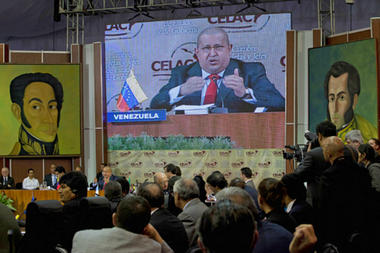
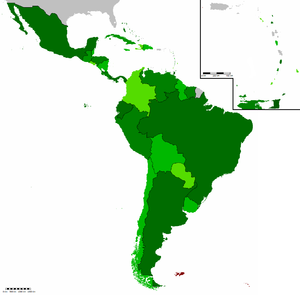
On December 2-3, 2011, the Community of Latin American and Caribbean States (CELAC) was born and the overwhelming force of a continent nearly 600 million strong, achieved a 200-year dream of unity. The 33 member nations of CELAC all agree on the unquestionable necessity to build a regional organization that represents their interests, and that excludes the overbearing presence of the US and Canada. While CELAC will take time to consolidate, the exceptional commitment evidenced by the 33 states present at its launching in Caracas, Venezuela, cannot be underestimated.
CELAC will have to overcome attempts to sabotage and neutralize its expansion and endurance, and the threats against it and intents to divide member nations will be numerous and frequent. But the resistance of the peoples of Latin America and the Caribbean who have resumed this path of unity and independence after nearly two hundred years of imperialist aggression, demonstrates the powerful force that has led this region to become an inspiration for those seeking social justice and true freedom around the world.
Phi Beta Iota: Emphasis added. This is largely a Cuban G-2 puff-piece, but it also represents real potential. A great deal will depend on whether Cuba and Venezuela get serious about creating the M4IS2 capabilities needed to harmonize internal spending while shutting out predatory external influences. We would not be surprised to find CIA Stations shut down across Central and South America in the next few years, as these governments stop tolerating incompetent but active spy units operating from official installations.
See Also:
CELAC Fulfills Dreams of Bolivar, Marti, Morazan
New non-U.S. Latin America group points to Washington's waning influence
CELAC: Speaking for Latin America and the Caribbean
Latin America’s Pacific bloc may actually work
Haiti – CELAC: U.S. and Canada, Personae non gratae
Did Hugo Chavez derail CELAC summit?
Cuba Strengthens Regional Ties
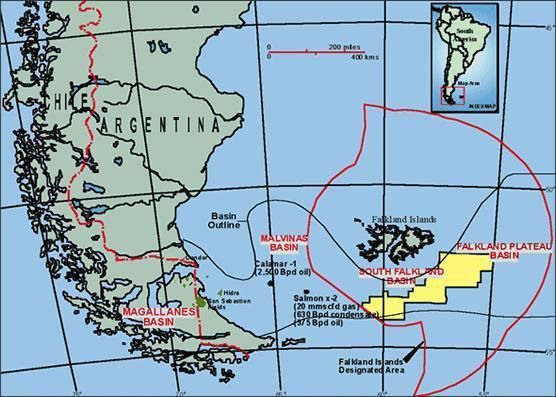
The 33-nation CELAC grants full support to Argentina in the Falklands’ dispute
2010 M4IS2 Briefing for South America — 2010 M4IS2 Presentacion por Sur America (ANEPE Chile)
An outstanding piece of bargaining power for Iran with both Russia and China….don't expect UN sanctions anytime soon…..
Updated 11 Dec 2011 to add more stories with photos and comment.
Iran won't return U.S. drone it claims to have
Iran Shows Video It Says Is of U.S. Drone
Zakaria and Baer: Downed U.S. drone an intel catastrophe
Phi Beta Iota: Variants of this stuff are for sale at Brookstone and Best Buy. The US has consistently refused to be serious about emission control, downlink security, and real-time processing. This is a “disaster” only to the degree that it reveals–once again–how immature the US “intelligence” archipelago of fiefdoms actually is.
Iran shows film of captured US drone
BBC, 8 December 2011
Iranian TV has shown the first video footage of an advanced US drone aircraft that Tehran says it downed near the Afghan border.
Images show Iranian military officials inspecting the RQ-170 Sentinel stealth aircraft which appears to be undamaged.
US officials have acknowledged the loss of the unmanned plane, saying it had malfunctioned.
However, Iranian officials say its forces electronically hijacked the drone and steered it to the ground.
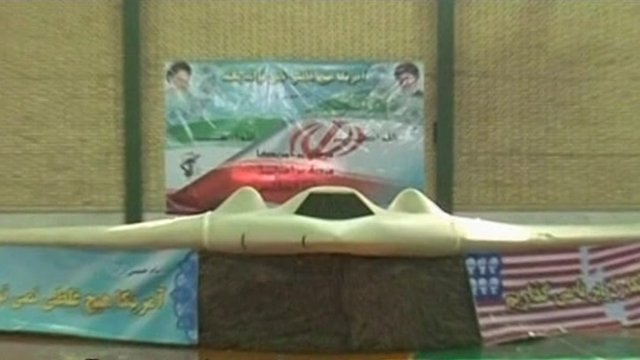
BBC security correspondent Frank Gardner says the intact condition of the Sentinel tends to support their claim.
Iran's Press TV said that the Iranian army's “electronic warfare unit” brought down the drone on 4 December as it was flying over the city of Kashmar, about 140 miles (225km) from the Afghan border.
Nato said at the weekend that an unarmed reconnaissance aircraft had been flying a mission over western Afghanistan late last week when its operators lost control of it.
Pentagon officials have said they are concerned about Iran possibly acquiring information about the technology.
Phi Beta Iota: Our first impression has been that Iran has downed the UAV with an Electromagnetic Pulse (EMP) beam. This is much cooler. As with the Taliban in Afghanistan able to hijack the downlinks, the Iranians simply hijacked the entire aircraft. From where we sit, the Chinese (who ride electric power circuits into “isolated” computers) and the Iranians [Persians, more PhDs per capita than most] are laughing at us, while the Russians simply ignore us. Newsflash for the Pentagon: our technology is not that great. Classifying the idiot vulnerabilities does not work–something we have been pointing out for twenty years.
Bob Seelert, Chairman of Saatchi & Saatchi Worldwide (New York): When things are not going well, until you get the truth out on the table, no matter how ugly, you are not in a position to deal with it.
See Also:
Dolphin: Their Drones, Our Drones, and EMP Rays
Journal: Insurgents Hack U.S. Drones
Journal: Gorgon Stare (All Eyes, No Brain)

Amplifying Somali Voices Using SMS and a Live Map: #SomaliaSpeaks
[Cross-posted from my post on the Ushahidi blog]
Somalia has been steadily slipping from global media attention over the past few months. The large scale crisis is no longer making headline news, which means that advocacy and lobbying groups are finding it increasingly difficult to place pressure on policymakers and humanitarian organizations to scale their intervention in the Horn of Africa. I recently discussed this issue with Al-jazeera’s Social Media Team whilst in Doha and pitched a project to them which has just gone live this hour.
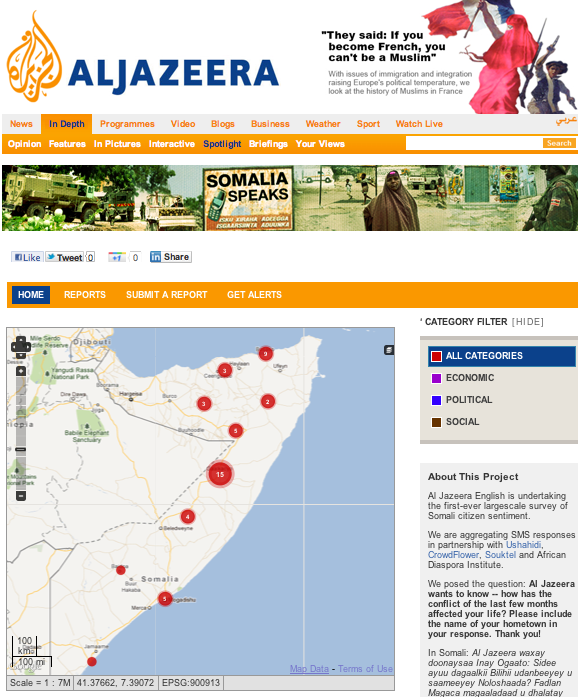

The joint project combines the efforts of multiple partners including Al-Jazeera, Ushahidi, Souktel, Crowdflower, the African Diaspora Institute and the wider Somali Diaspora. The basis of my pitch to Al-jazeera was to let ordinary Somalis speak for themselves by using SMS to crowdsource their opinions on the unfolding crisis.
. . . . . . .
I am often reminded of what my friend Anand Giridharadasof the New York Times wrote last year vis-a-vis Ushahidi. To paraphrase:
They used to say that history is written by the victors. But today, before the victors win, if they win, there is a chance to scream out with a text message, a text message that will not vanish, a text message that will remain immortalized on a map for the world to bear witness. What would we know about what passed between Turks and Armenians, Germans and Jews, Hutus and Tutsis, if every one of them had had the chance, before the darkness, to declare for all time:
“I was here, and this is what happened to me”?
The real history of today's excessive corporate power starts with a tobacco lawyer appointed to the Supreme Court.
The following is an excerpt of Jeffrey Clement's Corporations Are Not People: Why They Have More Rights Than You Do and What You Can Do About It.
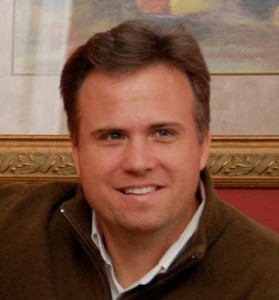
In 1971, Lewis Powell, a mild-mannered, courtly, and shrewd corporate lawyer in Richmond, Virginia, soon to be appointed to the United States Supreme Court, wrote a memorandum to his client, the United States Chamber of Commerce. He outlined a critique and a plan that changed America.
Complete excerpt below the line — real history killing real people.