Joseph Stiglitz (the Nobel prize winning economist) has a great new article: “The Book of Jobs“(behind Vanity Fair's paywall, sorry). In it, he makes a convincing case that the first global depression was caused by a process similar to what we are seeing today (I'm very happy somebody in the social sciences is actually attempting to show how technological change was a driver of the first depression, it's about time). Here it is in a nutshell:first depression, it's about time).
Technological change in the form of the internal combustion engine (cars, tractors, trucks) improved transportation and farm productivity. This led to an agricultural revolution that impacted a huge percentage of the US population.
Farm productivity soared and prices dropped. This forced many farmers into bankruptcy and led to a steady migration of people from rural to urban locations driving down incomes/demand.
The downward pressure on incomes this caused resulted in a protraced economic depression that only ended when the US and Europe mobilized/nationalized every segment of the economy during WW2 (put everyone to work, trained them, etc.).
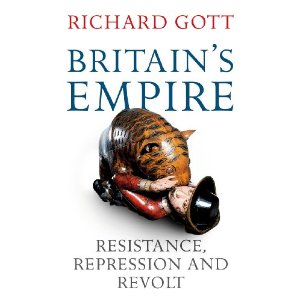
The violence at the heart of colonialism is exposed in Richard Gott's history
Richard Drayton
Guardian, 7 December 2011
Amazon Page for Reviewer's Book Nature's Government
“We insisted on reserving the right to bomb niggers.” So David Lloyd George explained the British government's demand at the 1932 World Disarmament Conference to keep the right to bomb for “police purposes in outlying places”. Airpower had shown its value in spreading what Winston Churchill, when defending in 1919 the use of poison gas against “uncivilised tribes”, had called “a lively terror”. Richard Gott shows how a hundred years earlier more hands-on means were used to similar ends: the heads of rebel slaves in Demerara in 1823 and Jamaica in 1831 were cut from their bodies and placed on poles beside the roads. The mutilation of the corpses of the defeated never quite goes out of fashion.
Amazon Page
Empires have always depended on violence. Killing, torture and the destruction of property are essential to those tasks of destroying resistance, extracting information and collaboration, and demonstrating dominance that underly all conquest. But it is the privilege of conquerors to tell stories that flatter their own past. It is, thus, rare to find the historians of any imperial power describing the ugly business of the frontier as more than unfortunate exceptions to an otherwise honourable enterprise. Britain is no exception: from the Victorians until the 1950s, its historians mainly saw in the British empire a great engine for diffusing liberty and civilisation to the world. If such Whig piety declined in the era after Suez, later scholars, studying particular places and times, never connected all the episodes of massacres, rebellions and atrocities. Popular historians continued profitably to sell happy stories of the empire to the British public – always marketed as daring revisionist accounts.
Gott's achievement is to show, as no historian has done before, that violence was a central, constant and ubiquitous part of the making and keeping of the British empire.
. . . . . . .
What Gott loses by this focus on resistance, however, is any subtlety in understanding the meanings of collaboration. He repeatedly imposes the lens of 20th-century nationalism, and even anti-fascism, so that those who did not rebel become traitors or “fifth columnists”. He does not examine with care or sympathy the varieties of loyalism, and the motives and experiences of those who chose, however mistakenly, to throw in their lot with the British. Neither does he explore how the economic and technological bases of British power changed between 1750 and 1850. For the revolution that science and industry brought to production, transport, communication and war made Britain able to attract and to extort indigenous collaboration more easily, and changed how the British understood themselves as a nation and their rights in the wider world. The empire was made by more than violence.
I was surprised to see this HRRR forecast model prediction of tonight's Northeast snow showing no snow for Harrisburg and York, PA, and showing the axis of heaviest snow (4-8″) over or west of State College, PA. This disagreed with overnight AccuWeather and NWS forecasts that showed it further east. This storm will be a good test of last minute “nowcasting” by the new higher-resolution models that we have access to this winter season. I thought I'd “crowdsource” this forecast on the WeatherMatrix Facebook page so my readers could weigh in.
. . . . . . .
This is an example of how Social Media is revolutionizing weather forecasting, something I'll be writing about in WeatherWise magazine‘s Jan-Feb. 2012 issue, and it's not at all unseen here at AccuWeather — when our company was started 50 years ago, our founder Joel Myers noted that the average consensus forecast of his entire meteorology class would always beat the best daily forecasters – which is why we have a twice-daily map discussion here at HQ to get all of the meteorologists on the same page – an internal crowdsourcing if you will.
Just the other day, a colleague asked me whether I could suggest some examples of organizations that have been successful with “innovation initiatives” in a commercial setting? He said that he had a CEO who wanted to launch an “innovation initiative” that would provide a laboratory for experiments in-house, so that his firm could become known as an idea factory in their sector.
I replied that I didn’t know of any “innovation initiative” that was ultimately successful on a sustained basis. That’s because if an organization is looking at innovation as “an initiative”, and it introduces that initiative into a culture that doesn’t support innovation, then the culture will sooner or later crush the initiative—usually sooner. So you can have temporary “successes” as “initiatives” with a lot of flag waving and hoopla ceremonies and celebrations of victories, but they don’t last.
If the firm wants innovation, which they should, since innovation is an essential ingredient for survival in today’s marketplace, then they need to ask themselves why are they thinking of an innovation as “initiative”. They need to look more deeply at how the organization is being run and think through what would be needed to make innovation a central part of the organization’s culture.
The three phases of the 20th Century organization
In the 20th Century, organizations tended to go through three phases, as sketched by f Robert X. Cringely’s Accidental Empires, by analogy with a military operation.
In the first phase, you had startups run by commandos. They were unpredictable and uncontrollable yet remarkably productive. They worked hard and fast. They succeeded with surprise and teamwork, establishing a beachhead before the enemy is even aware they exist. They pushed the state of the art, ideally providing creative solutions to customer needs and making existing products irrelevant. However most startups fail because they don’t meet customer needs. Sometimes the product was close to meeting customer needs but it wasn’t ideal and had bugs or even major failings that need more work. However commandos were useless of this type of work: they got bored.
In the second phase, the infantry moved in, i.e. the obedient workers who followed orders and methodically grew a company from its IPO to market dominance. They exploited the opportunity created by the commandos. They took the prototype, tested it, refined it, made it manufacturable, wrote the manuals, marketed it and ideally produced a profit. This work was governed by rules and procedures—all the stuff that commandos hated. While the commandos make success possible, the infantry makes success happen.
In the third phase, the firm was run by police: the bureaucrats and middle managers who defend the entrenched position of an established market leader. The third phase was an occupying force intent on holding territory. A middle manager’s job was to say no to ideas that don’t originate from on high, preferably near the CEO, or which don’t improve the bottom line for the quarter.
In the 20th Century, “management” was seen as the set of bureaucratic practices designed to run the second and third phases. Management comprised hierarchy, command-and-control, tightly planned work, competition through economies of scale and cost reduction, impersonal top-down communications, all focused on making money for the shareholders.
These management practices were seen as timeless truths of the universe, so obvious that there was scarcely any need to articulate them, let alone re-examine them. They are still pervasive in large organizations, business schools and management textbooks. John Sculley tried to run Apple [AAPL] as a third-wave organization. Most big old mastodons today like GE [GE] or Walmart [WMT] are still third-wave organizations.
This way of managing systematically kills innovative activities in organizations. The phenomenon can be observed in:
Generic is worthless–focus on real specific threats and opportunities. Do the collection rather than just speculating without data. Do not extrapolate from the past — instead intuit and shape the future.
Forgoing the plan to build independent floating cities away from chafing laws, some libertarians—led by Milton Friedman’s grandson, no less—have found something better: desperate countries willing to allow the founding of autonomous libertarian cities within their borders.
The seasteader-in-chief is headed ashore. Patri Friedman (that’s Milton Friedman‘s grandson to you), who stepped down as the chief executive of the Peter Thiel-backed Seasteading Institute in August, has resurfaced as the CEO of a new for-profit enterprise named Future Cities Development Inc., which aims to create new cities from scratch (on land this time) governed by “cutting-edge legal systems.” The startup may have found its first taker in Honduras, whose government amended its constitution in January to permit the creation of special autonomous zones exempt from local and federal laws. Future Cities has signed a non-binding memorandum of understanding to build a city in one such zone starting next year.
. . . . . . .
The brainchild of New York University economist Paul Romer (read his thoughts on FCI here), a charter city combines a host nation’s vacant land (in this case, Honduras) with the legal system and institutions of another (e.g. Canada) and residents drawn from anywhere. Romer’s central insight is that good governance is transplantable—rather than wait for a basket case nation to come around begging, a charter city could help show it the way, as Hong Kong did for Deng Xiaoping.
Phi Beta Iota: The focus on eradicating corruption from day one is most interesting. While the group does not appear to have fully thought through their role as a magnet for criminals, there are regions of Africa, Latin America, and even the now warming Arctic North that could permit this kind of innovation to test its premises.






 ..
..  ..
..  .. even