Should be Re-Issued, a Seminal Publication Relevant to Governance
October 3, 2006
Kirkpatrick Sale
I am finding that books written in the 1970's and 1980's a making a comeback and people realize that certain of those authors were a quarter century ahead of their times. Richard Falk is one, Kirkpatrick Sale is the other. This book could usefully be read with Leopold Kohr's “The Breakdown of Nations,” Joel Garreau's “Nine Nations of North America,” and Philip Alcott's “The Health of Nations,” on why sovereignty and the Treaty of Westphalia should be overturned in favor of more localized governance with more universal rights and protections.
The bottom line in this book is crytal clear half-way through the book: at a specific point of scale, variable depending on natural resources, technical and cultural sophistication, etc, an individual's share of earned income goes MORE toward “power” goods and services of common concrn than to their own benefit. It is at this point that “the state” has outgrown its utility and becomes a burden on the individual taxpayer.
It merits comment in this context that there are 27 seccessionist movements in the United States of America, and at least 3 in Canada. As we look at the idiocy of the elective war on Iraq, and the very real prospect that the German Pope has cut a neo-fascist deal with the Karl Roves and Otto Reichs of this world–all descendants of Nazi war criminals admitted to the US under espionage cover, we have to contemplate the possibility that our big states are *out of control* and need to be chopped back to more “human scale.” This is a Nobel Prize kind of book, quite extraordinary.
One Extra Star for Cool Idea That is Also Uplifting
October 3, 2006
Kevin O'Keefe
If you are an Amazon buyer you are probably not average, and Amazon reviewers even less so. I was compelled to buy this book simply on the premise that it would be interesting to learn what “average” was. I was NOT expecting an uplifting book that inspired reflection about what it means to be a good man, a good citizen, a good husband and father, and that is what this book is.
Yes, it would have benefitted from maps as well as a statistical table and a calendar of the search, and I would normally have given it four stars for lacking those “visualization & closure” elements, but I simply cannot get over the fact that this book made me feel good about America and good about the standard run of the mill American.
The idiocy and mendacity of our leaders aside, this is a great Nation, and I have tears in my eyes as I conclude the book, where the man chosen by the author as the average American, informed on the 4th of July, properly concludes that it is a great honor. Honor indeed. This is a superb book.
Edit of 11 Sep 08 to add links. the rest of the world (at least one quarter of the Germans, most Arabs, mixed ratios elsewhere) is quite certain that 9-11 was either made to happen by the US Government, or allowed to happen (my own view, with Silverstein adding controlled demolitions and Gulliani helping destroy the crime scene quickly).
This is an extraordinary, gifted piece of work that covers a broader swath of history, a deeper cultural well, and more detailed personal portraits of the key players, than any other book I have read in this area. It joins Louise Richardson's “What Terrorists Want,” Dick Clarke's “Against All Enemies,” and Professor Pape's “Dying to Win” as a core reference on the rise of suicidal terrorism.
I especially liked the historical survey from the 1940's through the 1960's (Six Day War), 1970's (Sadat and rise of Arab despots), 1980's (arming of the jihadists in Afghanistan) to the 1990's (Sudan as home base).
Towering sentence: 9-11 began in Egyptian prisons–“torture created an appetite for revenge.” It was the combination of Saudi government money and Egyptian prisoners and revolutionaries tortured by that government, and then inspired by jihad in Afghanistan, that created a global remobilization of terrorism.
Penetrating insight: Arab governments funded jihadists to get their rabble-rousers out of town, but no one gave any thought to how this was creating a permanent “stateless vagrant mob of mercenaries.”
The level of detail across the book is very good, and presented in an easy to read and compelling fashion. For all that I have read, here are a few gems from this particular book:
1) Despite Clinton's claims, US simply did not take Al Qaeda seriously until late 1990's, and then the lionized Bin Laden with the Tomahawk attack, in the process enriching Bin Laden by $10 million, the price he got from the Chinese for the unexploded Tomahawk missiles that failed.
2) FBI blew it in 1996 (the book does not mention the two walk-ins that the FBI brushed off in 2000 and 2001), CIA refused to share key information with FBI, NSA refused to share Bin Laden transcripts with CIA or the FBI, the grotesque incompetence and bureaucratic idiocy–even for someone like myself who has worked for the CIA, is simply unbelievable.
3) US support to Israel, US tolerance of Israeli genocide against Palestinians, is hands down more aggravating to the Arabs than US presence in Saudi Arabia, but it was the latter that began Bin Laden's radicalization. The US seriously misunderstood the negative impact of staying on in Saudi Arabia, and Dick Cheney's violation of his promise to pull out of Saudi Arabia when Iraq was displaced from Kuwait, can be said to be directly responsible for pushing Bin Laden over the edge.
4) Muslim Brothers of Egypt have mastered “civil affairs” and are able to sponsor hospitals, schools, factories, and welfare societies at the same time that they sponsor a violent secret side.
5) Both communism and capitalism are despised by the fundamentalists for their materialism; this slightly outranks the secular Arab dictators. Jews, England, and America are in for a rough time.
6) The author has done a really fine job of investigating and recounting details of Bin Laden's life including his illnesses, his genius, and his occasional possible loss of sanity.
7) The Saudi government is a hollow shell waiting to implode; Saudi Muslims are 1% of the global Muslim population, but Saudis fronted 90% of the money for mosques and maddresses all over the world, exporting radical Wahabbism over more balanced Islamic variants that tolerate Jews and Christians.
8) Al Qaeda playbook written by an Arab trained by US Special Forces.
9) Bin Laden was happily retired in Sudan, he was re-energized out of retirement by US forces staying in Saudi Arabia, and by the King stripping him of his citizenship.
10) US economic interests world-wide, not just cultural targets within the USA, are part of Bin Laden's total plan. He believes that the US will fragment over time, as the Soviet Union did (see my review of Joel Garreau's “Nine Nations of North America”_.
11) 1994 was the first time airplanes into the World Trade Center were discussed with Bin Laden. 2001, seven years later. My personal view, based on this book and others, is that we are about to be hit again, and I would not be surprised if it were a combination of a Taliban attack on Kabul, a nuclear or bio-chemical event in the US, and precision attacks on Saudi oil pumping stations.
12) Egypt recruits boy spies on their parents by drugging them and sodomizing them, taking photos, and threatening to publish the photos. Charming…..just the kind of stuff George Bush Junior wants to legalize.
The author concludes the book with a very good nine page description (one paragraph each) of the key characters in this saga. It's not over, by a long shot–as this and other books document, terrorism is a tactic, not an enemy, and we cannot beat Bin Laden by playing into his hands with heavy handed occupation in Iraq and lightweight easily over-run forces in Afghanistan. The next twelve months could see a great deal more damage done to the West by disparate allies from Iran to Hezbollah to Al Qaeda to white supremacists to a new break-out of terrorism in Asia.
Patrick Buchanan is much more serious, much more relevant, than either Newt Gingrich or the current illiterate President of the United States (illegally, through two stolen elections), George “Bring It On” Bush.
He opens the books with quotes from Teddy Roosevelt and from Wilson that set the context perfectly: you cannot have a Nation if there is, as Alexander Hamilton warned us, a tyranny of minorities that do not buy into the proposition of citizenship and loyalty to the flag.
The author is clearly very well read and historically grounded. He noted that Nations dye when they have dying populations, disintegrating cultures, and unresisted invasions.
His most important point, across the book, is that the Mexicans are invading deliberately and in massive force, and the federal government is failing to fulfill its constitutional responsibility for protecting states from invasion. He specifically suggests, and I agree, that Bush Junior is impeachable for failing to protect (and indeed inciting) illegal immigration.
According to the author:
1) We have gone from 5 to 57 million Asians and Hispanics;
2) There is moral rot in both parties;
3) 1 in 12 of the illegal aliens is a proven criminal
4) Aliens are 12% of the population and 30% of the incarcerated;
5) US allows foreign governments, e.g. China, to refuse returns;
6) Local police are hand-cuffed and not allowed to arrest and depot illegal aliens;
7) Illegal immigrants are a major vector for disease and potential pandemics.
8) Mexico, at 6 to 1, is the primary offender, and 58% of Mexicans believe that the US Southwest belongs to them and they are simply taking it back (to the Guadalupe-Hidalgo line);
9) CORPORATIONS are demanding the importation of poverty by supporting illegal immigration; CORPORATIONS are passing on to the individual taxpayer the social, cultural, and economic costs of accepting millions of poor, uneducated illegal aliens.
10) The churches and the film industry have become propagandists for illegal immigration.
11) America has lost its Christian characters, and is now a mélange of disloyal self-serving religions of all kinds, including Wahabbism which has since the 1990's had imams preaching the murder of Americans from pulpits on American soil, to individuals NOMINALLY U.S. citizens.
12) The emergence of the Minutemen (now spreading across America, not just at the border) is reflective of the fact that illegal immigration is the “crisis of the age.”
12) Babies born in America should NOT be automatically accorded American citizenship unless one of their parents is American; nor should dual citizenship be allowed. RIGHT ON!!!!
This is a tremendous book. I respect the author very much, and believe that he merits the full support and attention of every loyal American that believes that one should speak the language of America–English–and honor the flag of America. The illegal immigrants that displayed the Mexican flag during the recent demonstrations should all be deported.
America has lost its integrity. We need a new leadership team that can protect our borders, protect our middle class, protect our economy, and protect our culture. George Bush is a much greater threat to America than Bin Laden, because he is busy selling America out to the Saudis for oil, to the Mexicans for migrant labor, and to the Colombians for drug profits.
Pat Buchanan is a bright shining light, and this book is a very important contribution to the dialog needed to save the Republic.
This book is an excellent building block for those militaries that expect to be sent by their political masters into harms' way “in every clime and place.”
Blessed with a Foreword from General Peter Schoomaker, formerly Commander-in-Chief of the U.S. Special Operations Command and today the Chief of Staff of the severely beleaguered U.S. Army, this revised edition integrates the reality check that the author received under combat in Iraq, the book's first edition having been an academic reflection. The improvements are pointed out in an author's preface, and require that this edition be the one to be studied in war colleges.
The most important point in the book for me is that organizational culture–a willingness to learn and innovate or not–is an independent relevant variable for determining success under ambiguous conditions.
The author excels at documenting two facts for the future: 1) it is civil war inside of states, rather than inter-state conflict, that will be the primary military challenge; and 2) the U.S. military is not yet ready to learn and innovate, exceptions not-with-standing.
The comparison of British and US organizational cultures on page 51 is alone worth the price of the book, and can be summed up as the British excelling at long-term presence, regimental memory, bottom-up learning, emphasis on civil solutions and a minimalist use of force. The Americans are naturally the opposite, substituting technology for thinking, quantity for quality, and “shock and awe” force for reasoned instrumentalism. More tellingly, the British will go for the very long haul built on a century worth of localized presence and individualized relationships that built trust, settling for an independent country that gives England a 51% win, while the Americans demand dominance now, and 100%.
The author notes that a major contribution to British success in Malaya was the idea of a junior policeman, to offer channels for anonymous tips. The US has implemented this in Iraq, but typically relies on cell phones that most Iraqis do not possess.
The author credits Mao with having been the logical successor to Sun Tzu, Jomeni, and Clausewitz, and I would add Ho Chi Minh and today Bin Laden. Ho Chi Minh mastered tunnels; Bin Laden has leveraged suicide as a common means that changes everything about war and peace. Interestingly, the author of FIASCO was on television as I read this book, and pointed out that Paul Bremmer single-handedly gave the Iraqi insurgency the leadership (de-Bathification), the guns and volunteers (dismissing the Iraqi army), and the financing (opening the door for Iran) that would not have existed without his incredibly arrogant and ignorant decisions. It was Paul Bremmer who created the Iraqi insurgency and gave Bin Laden enormous international prestige and an increased following. See my reviews of “Blood Money” and “Squandered Victory.”
I was interested to learn from this author that the original view of the Viet-Nam war at the national level was as a replay of Korea, with the Chinese as the actual threat. Our ignorance of Viet-Nam's independence, and our deliberate refusal to allow elections, are as shocking are the ignorance of the White House regarding the Sunni-Shiite split, and its willingness to occupy Iraq rather than liberate it, to use torture and humiliation as a tactical measure without regard to its strategic cost.
The author does a good job of focusing on the importance of “the man.” History will show that Tony Zinni had it right, and Tommy Franks had it completely wrong.
I found the author's passing discussion of how the U.S. military is increasingly being charged with being an executive agent for non-military sources of national power to be especially interesting. The U.S. Central Command has 90 foreign military liaison teams co-located at its Headquarters, and a mere handful of people representing the varied agencies and departments of the U.S. Government. Inter-agency strategy and inter-agency campaign planning today are as non-existent as inter-agency tactical cooperation.
The author points out that an organizational learning model is virtually the opposition of the bureaucratic politics/budget share model that now prevails in the Department of Defense. In combination with the importance of inter-agency operations, I can anticipate the U.S. Army both replicating diplomatic, information, and economic capabilities to make up for the deficiencies of those departments, and simultaneously creating a new breed of military officer, one with the power to persuade, to be dedicated over the course of a career to herding cats–the autonomous and largely oblivious elements of the U.S. Government that are not pulling their weight in Iraq or anywhere else.
Since the early 1990's several of us have been independently proposing “four forces after next” that would cut the big war force in half, while redirecting the savings to taking small war/gendarme special forces up to $75B a year (a tripling), peace forces from zero to $100B a year, and homeland security from $15B (then) or $36B (now) to $75B a year. This author not only gets it, he helps make the case for doing precisely that. Goggling for “The Asymmetric Threat: Listening to the Debate,” no. 20 (Autumn/Winter 98-99), pp. 78-84, available online, is a good way to prepare to read this book.
I liked this book so much that I am creating a list of 13 books, none having to do with Iraq, that I recommend be read by anyone who wishes to learn not only how to eat soup with a knife at the tactical level, but how to avoid being part of someone else's soup in this new world disorder. Here is that list by title–I have reviewed all of them”
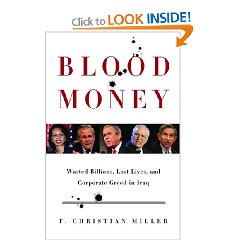
This is a definite five star piece of work that approaches our failures in Iraq from a different perspective, and hence should be read with, Squandered Victory: The American Occupation and the Bungled Effort to Bring Democracy to Iraq. It goes beyond Squandered Victory, which creates outrage over incompetence, and actually turns one's stomach with disgust toward the end.
The book starts with a very useful timeline of events, and the opening premise that Paul Wolfowitz was wrong on virtually every promise and claim made to Congress.
The author's strategic view, threaded throughout the book, is that the U.S. effort in Iraq never had coherent “supreme commander” type leadership, that virtually all elements (U.S. Army and U.S. Marines excepted) lacked both intelligence and integrity, and that this was one of the most incompetent, ignorant occupations in the history of mankind. He does seem to avoid pointing out that Rumsfeld demanded complete military control of the country, relegated the diplomats to the back room, and did not even tell Bremer for a year that there was a diplomatic plan for nation-building. This is on Rumsfeld and Bremer. History will judge them harshly.
The author documents that the US Government knew in advance that there was no plan for the peace (the State Department efforts not-withstanding) and no way of creating an effective plan.
The author is powerful in showing that “shock and awe” warfare made the transition to peace virtually impossible. 17 out of 21 Ministry headquarters buildings were completely destroyed (and then the occupying force allowed for the looting of all offices, all museums, all universities, and all stockpiles of ammunition and explosives needed for the Improvised Explosive Devices (IED) that have killed so many of our troops. The oil infrastructure was not protected, was completely looted, and this lost the chance for paying anything with oil in the early years.
Immortal quote on page 40: “…a circus, a Looney Tunes version of government, hatched on the fly, delivered at random, and operating without instruction.”
Reconstruction cost estimate: $2.4 billion. Actual cost: $30 billion and rising. Results after several years: less than 10% of the needed work. Money unaccounted for: $18 billion.
The author differs from those who supported sanctions in pointing out that the sanctions virtually destroyed Iraq's health system.
Psychologically, the author suggests that the months of lip service to freedom and reconstruction raised hopes that were then dashed. One is reminded of the Davies J-Curve from the 1970's–revolutions occur not among the oppressed, but among those who have been shown the prospect of freedom and prosperity, and then had it taken out of their grasp.
On contracting, one's stomach turns with every page. Cost plus, no incentive to save; U.S. companies doing for millions what Iraqi companies would do for tens of thousands; U.S. contractors earning $60K and more, foreign laborers imported for $3000 a year. The author specifically quotes contractors as saying they knew they could steal the process blind in the first year, which would be “open season.”
I consider this book to be the eventual final nail in the coffin of the Private Military Contractors. The author documents how the military's very unwise reliance on private contractors for combat zone logistics led to a need for private contractors to provide security, to the point that 22% of the reconstruction dollars are going toward Private Military Corporations (PMC).
My global reading program suggests that the Bush-Cheney Administration will go down in history as having pulled off the most blatant program of planned lies to the public, Congress, and the United Nations, and the most blatant slight of hand in switching the burden from a properly staffed military command to a war-profiteering mélange of PMCs. There is no question in my mind but that we need to eliminate PMCs along with Transnational Organized Crime (TOC) in the future, and we need to properly fund four forces after next: big war force, small war and gendarme force, peace force, and homeland security force. The US military today is a Cadillac built for the superhighway, when we need 10 jeeps, 100 motorcycles, and 1000 bicycles.
The author condemns both the U.S. Government in all its parts, and the PMCs in all their parts, for issuing frantic and confused orders and never really getting their act together. This book is the obituary for Donald Rumsfeld, Paul Wolfowitz, and Paul Bremmer, among others.


 Should be Re-Issued, a Seminal Publication Relevant to Governance

 One Extra Star for Cool Idea That is Also Uplifting