Hmm, does this defy the easy-big-data narrative? VentureBeat warns us, “The Data Is Not Enough: Creative Data Scientists Make the Difference.” Not only is there a shortage of data scientists in general, we are now told firms would do well to find data scientists graced with creativity. How pesky. Writer Jordan Novet refers to a recent panel given at VentureBeat’s 2013 DataBeat/Data Science Summit headed by LinkedIn‘s former lead data scientist, Peter Skomoroch. The article relates:
“Skomoroch envisions a world not too far in the future where balance sheets will track companies’ data assets. But he and other panelists don’t just want more data to analyze. They discussed the importance of creativity as a key trait to look for in people who work with the data. That means relying on proven algorithms might not always cut it.”
Novet shares with us the perspectives of a few panel members. For example, former Kaggle president Jeremy Howard, apparently the creative type himself, described his process:
“Howard likes to just dive into data and start getting hunches about it, without knowing about the industry the data comes from and other context that others would find valuable. ‘That way, there’s no blinkers,’ he said. It might come across as a contrarian view, but Howard thinks his approach is one reason he did well in Kaggle competitions.”
Other panelists quoted in the article include Jawbone‘s VP of data, Monica Rogati and Pete Warden, CEO of Jetpac. See the story for their thoughts.
The other day I said that I thought the markets were only understandable to insiders. I may have been too generous. Read this report and draw your own conclusions.
Canada has a Rightist government so no one should be surprised that they deny climate change and have energy interests that trump lesser agencies like fisheries. They don't like facts, so why not just get rid of them literally. This is the modern equivalent of book burning. This is a loss not just to Canada but to the whole world. These databases and reports they are describing constitute a significant part of humanity's understanding of Earth. It is straight out of the Dark Ages. An act of fanaticism as was its predecessor. Then it was Christianity. Today it is The Theology of Profit.
What this report describes should not be legal in a democracy, and would not be had the Supreme Court's conservative wing not opened the floodgates to gray and black money through Citizen's United, although the trend began earlier. No one should be allowed to dump $400 mi! llion dollars into the political process in an attempt to buy an outcome in an election.
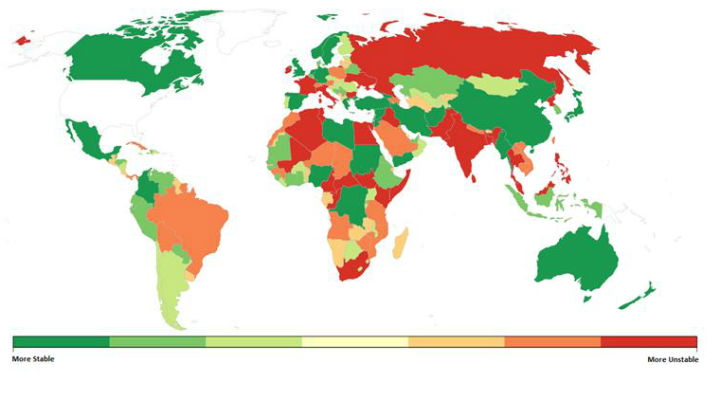
What big data tells us about next year’s crisis zones.
EXTRACTS:
….my 2011 “Culturomics 2.0” study demonstrated the unique insights gleaned from looking at how the media covers an event, rather than just what it covers.
Click on Image to Enlarge
The Global Database of Events, Language, and Tone (GDELT) project is the largest event database in the world, capturing over a quarter-billion events in every country, down to the city level — across 300 categories, from 1979 to the present, and with daily updates of 100,000 events a day.
. . . . . . .
Of course, the best part is being able to dive in yourself, so without further ado, download the complete 172-page report and take a look at the countries you are most interested in or check out how they compare in the master ranking table at the end of the report. Take a look through what a big data view of 675 million mentions of conflict tell us about how the world is changing. When you're done, sign up for the new GDELT Daily Trends Report email and get a miniature version of this delivered to your inbox each morning. Big data is giving us our first glimpse of a world in which we can map the Earth's riots as well as we can its earthquakes and hurricanes — and all from just reading the news a little more carefully.
Call me stupid, but I think journalism is an exciting way to change the world. But in order to do that these days, we need to favor change and promote disruptive innovation within the news and information ecosystem — and start thinking way outside the box.
This is something I’ve been working toward as hard as possible for several years: as a Knight Fellow at the International Center for Journalists; through Poderopedia.org, a website that reveals the links among Chilean business and political elites; and Hacks/Hackers Chile and Poderomedia Foundation, an organization that promotes the open web and the use of technologies to rethink journalism, teach new skills to journalists and foster cultural change in newsrooms in Latin America. So far this year, I’ve organized and taken part in 10 hackathons, two radiothons, two data journalism bootcamps, helped create a civic lab, participated in the birth of Chicas Poderosas (powerful women in newsroom tech) and collaborated on at least 30 workshops for journalists, students and newsrooms around South America.
5.0 out of 5 starsExplosive Opening, Less Satisfying Conclusion, January 5, 2014
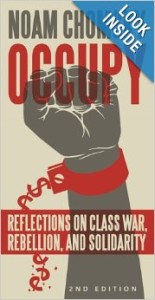
The book explodes on page one: no bankers arrested — none, zip, nada, rein — 7,762 Occupiers arrested from the first 80 in NYC on 24 September 2001 to the two arrested in SF on 15 June 2013. Talk about GRIFTOPIA — the police work for the thieves and arrest the owners!
There are a number of key insights within this book, and I strongly recommend it to anyone who wishes to pulse the state of the union — Chomsky, who eulogizes Howard Zinn throughout, brackets our current situation with two trenchant observations early on:
3.0 out of 5 starsRooted in State Paradigm, Ignores Non-State World, January 5, 2014
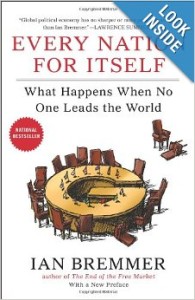
I made a mistake buying this book. I let the marketing hype get to me. As soon as I got the book in my hands and saw that it had jacket blubs from Fareed Zakaria and Larry Summers, the sinking feeling in my stomach was plapable.
I've gone through the book, which is double-spaced without a single chart or map or table. This is a long essay by someone who is out of touch with the latest thinking, still in the nation-state / banks rule the world mode.
For someone that reads very broadly, as I do, virtually every page in this book is irritating. The author's treatment of water, something I looked into for UNESCO (see my easily found review of fourteen books on water and water wars, < Water: Soul of the Earth, Mirror of Our Collective Souls >) the author considers the privatization of water and charging more for water to be a solution, never mind that fracking and Nestle-Coca Cola and all other predations on water by unregulated idiot practices (both individual and corporate) are wiping out hundreds of thousands of years worth of fresh water.
My sinking feeling grew stronger and stronger to the point of great dismay. This author clearly gets along with the powers that be, and he has a facile patter that suggests he has a very high elite social IQ, but from my point of view, that of an ethical 21st Century intelligence professional for whom transparency, truth, and trust are the bottom line, this book is lacking a holistic analytic model and not truly helpful to the public interest.
Most irritatingis the recognition that comes with the a reading of the author's conclusions. It just makes me sick to my stomach to read any endorsement of the Trans-Pacific Partership (Trade) Agreement. The author is a smart man, so I have to conclude that he has chosen to embrace evil. The Trans-Pacific (Trade) Partnership Agreement is the most secretive, most convoluted, most unethical, most anti-public trade agreement in the history of modern civilization. The 15 Asian nations meeting in November 2012 kicked Obama's ass out of town with good reason. The Regional Comprehensive Economic Partnership (the Association of Southeast Asian Nations, plus China, India, Japan, South Korea, Australia and New Zealand, will form a club and leave out the United States). The same thing is happening in South America (CELAC) and I expect it in Africa as well as South and Central Asia as well. Afghanistan has not signed the Bi-Lateral Security Agreement (BSA) in part because the US has blown the past twelve years, and in combination, a variety of non-ISAF nations are ready to step in with a focus on real trade instead of false terrorism (China, India, Iran, Pakistan, Qatar, Russia, Saudi Arabia, Turkey, UAE, among others).
This is a disappointing book that can be used as a measure of the elite hypocrisy, idiocy, and betrayal of the public trust as of today. In terms of substantive analytics and plausible sustainable solutions helpful to the 99% as opposed to the 1%, this book is not satisfactory.
Here are ten books whose summaries alone are worth more than this book (and free as well) — they are drawn from my broader collections of lists that are easily found at the Book page of Phi Beta Iota the Public Intelligence Blog (“the truth at any cost lowers all others costs”):