Steven Aftergood: Making Government Information Open and Machine Readable

Data
0Shares
Steven Aftergood
Steven Aftergood

Making Government Information Open and Machine Readable

An executive order issued by President Obama today directs that “the default state of new and modernized Government information resources shall be open and machine readable.”

“As one vital benefit of open government, making information resources easy to find, accessible, and usable can fuel entrepreneurship, innovation, and scientific discovery that improves Americans’ lives and contributes significantly to job creation,” states Executive Order 13642 on Making Open and Machine Readable the New Default for Government Information.

The new order was welcomed by the Sunlight Foundation, a proponent of open access to government data, particularly because it establishes a requirement to produce an inventory of “datasets that can be made publicly available but have not yet been released.” That will facilitate enforcement and advancement of the open data agenda, Sunlight said.

While one wants to believe in the efficacy of the order and to affirm the good faith intentions behind it, it is necessary to recognize how remote it is from current practice, particularly in the contentious realm of national security information.

The CIA, for example, has stubbornly refused to release the contents of its CREST database of declassified documents, even though the documents contained there are entirely declassified.  The CREST database is not open, it’s not machine-readable, and you can’t have a copy.

Meanwhile, the Obama White House itself has refused to publish even its unclassified Presidential Policy Directives (with a few exceptions), forcing requesters to litigate for access, or to surrender.


Berto Jongman: Russian Special Oprations Expansion

Military
0Shares
Berto Jongman
Berto Jongman

Russia's New Tip of the Spear

What's got the Kremlin so worried that it created a Special Operations Command?

Dmitri Trenin

Foreign Policy, 8 May 2013

Addressing the Russian National Security Council meeting on May 8, President Vladimir Putin said that the forthcoming departure of U.S. and coalition forces from Afghanistan confronts Russia with a more precarious situation on its southern borders. Valery Gerasimov, Russia's chief of the General Staff since November 2012, who was also present at the meeting, had announced last month the formation of a Special Operations Command — Russia's version of SOCOM. According to Gen. Gerasimov, the new command will include a special forces brigade, a training center, and helicopter and air transportation squadrons. These forces will be used exclusively outside Russian territory, including in U.N.-mandated operations. Creation of a separate SOCOM is not a new idea; it had been presented to Anatoly Serdyukov, who retired last fall as defense minister amid allegations of corruption in the Ministry of Defense (MOD), and who rejected it. The new minister, Sergei Shoigu, decided differently. What's behind this about face?

As Russia proceeds with its defense modernization, it's following the general trend toward specialization and enhanced mobility. Conflicts that have erupted since the end of the Cold War have put a premium on operations by relatively small and agile forces capable of engaging the enemy at a considerable distance, with no warning and deadly effectiveness. Such units existed in the days of the Cold War, too, but their role in World War III scenarios (that the Russian military is still largely built for) was essentially auxiliary to the tactical nuclear strikes and armored forces operations. With the dramatic change of the enemy and of the combat environment, special forces can play a more central role, critical to achieving success.

Read full article.

22-23 May 2013 University of Maryland Human-Computer Interaction Lab-Conference

Advanced Cyber/IO
0Shares

The University of Maryland's Human-Computer Interaction Lab's 30th Annual Symposium:
Wednesday, May 22, 2013
Thursday, May 23, 2013
www.cs.umd.edu/hcil/soh

HCIL's 30th Annual Symposium will consider the future of social media, networks, medical informatics, information visualization, interaction design, children, games, education, HCI design methods, tangible computing, accessibility, and MORE! Learn more about the HCIL's research at the UNIVERSITY OF MARYLAND through talks, tutorials, workshops, demos and posters.

Program:
Wednesday, May 22: Keynotes, talks in parallel with workshops and tutorials
Thursday, May 23: Demos, talks in parallel with workshops and tutorials

Attendees can focus on suggested tracks or sample talks from all topics. Sample tracks include:

* Education & Games
* HCI & Design
* Medical Informatics & Visualization
* Social Media & Networks

Please see below for suggested tracks:

Continue reading “22-23 May 2013 University of Maryland Human-Computer Interaction Lab-Conference”

Mini-Me: Air Force Nuclear Rotten; Nuclear Budget Waste to Point of Treason — Where, We Ask, Does the Buck Stop on This Nonsense?

08 Proliferation, Corruption, Idiocy, Ineptitude, Military
0Shares
Who?  Mini-Me?
Who? Mini-Me?

Huh?

AP Exclusive: Air Force sidelines 17 nuclear missile officers; commander cites ‘rot’ in system

WASHINGTON — Defense Secretary Chuck Hagel demanded more information Wednesday after the Air Force removed 17 launch officers from duty at a nuclear missile base in North Dakota over what a commander called “rot” in the force. The Air Force struggled to explain, acknowledging concern about an “attitude problem” but telling Congress the weapons were secure.

Huh, Huh?

Proponents of ‘First Strike’ Nuclear War against Iran ROB BILLIONS from Their Own Citizens: Multibillion War Budgets

While the Pentagon’s modernization budget for the pre-emptive nuclear option is a modest ten billion dollars (excluding the outlay by NATO countries). the budget for upgrading the US arsenal of “strategic nuclear offensive forces” is a staggering $352 billion over ten years. (See Russell Rumbaugh and Nathan Cohn,“Resolving Ambiguity: Costing Nuclear Weapons,” Stimson Center Report, June 2012).

These multi-billion military outlays allocated to develop“bigger and better nuclear bombs” are financed by the massive economic austerity measures currently applied in US and NATO countries.

Continue reading “Mini-Me: Air Force Nuclear Rotten; Nuclear Budget Waste to Point of Treason — Where, We Ask, Does the Buck Stop on This Nonsense?”

Stephen E. Arnold: A Fresh Look at Big Data & Big Data (-) Human Factor (+) Transformation (+) RECAP

Access, Advanced Cyber/IO, Architecture, Collective Intelligence, Communities of Practice, Cultural Intelligence, Design, Earth Intelligence, Ethics, Key Players, Peace Intelligence, Policies, Strategy, Threats
0Shares
Stephen E. Arnold
Stephen E. Arnold

A Fresh Look at Big Data

May 8, 2013

Next week I am doing an invited talk in London. My subject is search and Big Data. I will be digging into this notion in this month’s Honk newsletter and adding some business intelligence related comments at an Information Today conference in New York later this month. (I have chopped the number of talks I am giving this year because at my age air travel and the number of 20 somethings at certain programs makes me jumpy.)

I want to highlight one point in my upcoming London talk; namely, the financial challenge which companies face when they embrace Big Data and then want to search the information in the system and search the Big Data system’s outputs.

Click on Image to Enlarge

Notice that precision and recall has not improved significantly over the last 30 years. I anticipate that many search vendors will tell me that their systems deliver excellent precision and recall. I am not convinced. The data which I have reviewed show that over a period of 10 years most systems hit the 80 to 85 percent precision and recall level for content which is about a topic. Content collections composed of scientific, technical, and medical information where the terminology is reasonably constrained can do better. I have seen scores above 90 percent. However, for general collections, precision and recall has not been improving relative to the advances in other disciplines; for example, converting structured data outputs to fancy graphics.


I don’t want to squabble about precision and recall. The main point is that when an organization mashes Big Data with search, two curves must be considered. The first is the complexity curve. The idea is that search is a reasonably difficult system to implement in an effective manner. The addition of a Big Data system adds another complex task. When two complex tasks are undertaken at the same time, the costs go up.

Continue reading “Stephen E. Arnold: A Fresh Look at Big Data & Big Data (-) Human Factor (+) Transformation (+) RECAP”

Michael Kearns: Mapping the World with Tweets

Advanced Cyber/IO
0Shares
Michael S. Kearns
Michael S. Kearns

Mapping the world with Tweets

Posted By Joshua Keating Share

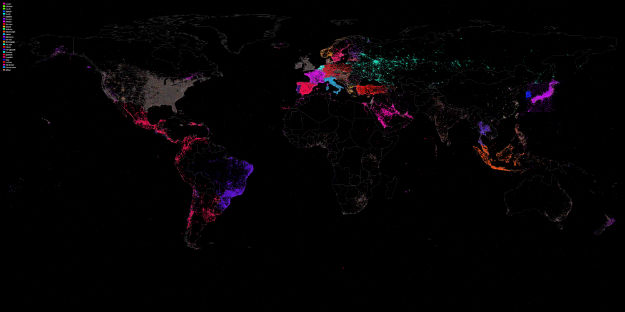
A new paper on the peer-reviewed online journal First Monday summarizes the results of a project to use geographic data gathered from Tweets to create a picture of the world according to Twitter.

Click on Image to Enlarge

The researches, led by GDELT co-creator Kalev Leetaru, used the Twitter decahose, a massive feed of 10 percent of all tweets, access to which is normally sold at high price to marketers. The project covers the period of the Oct. 23, 2102, to November 30, 2012. During this time, 1,535,929,521 tweets were streamed from 71,273,997 unique users — about 2.8 terabytes worth of data. But only about 3.04 percent of those contained geolocation data — either exact coordinates from mobile phones or user-selected locations. All the same, that's an awful lot of geographical information, and allowed the authors to create this map of a month in the life of Twitter (Bigger, high-resolution version here):

. . . . . . . . .

The plenty more in the paper itself, including list of the world's most retweeted cities. Not surprisingly, New York City is number one, but I was surprised to see that my current hometown, Washington D.C., didn't even crack the top 20, which includes some seemingly unlikely places as Riyadh, Porto Allegre, and San Antonio. Guess we're not the center of the world after all.

Read full article with additional graphics.