Here is why movements like the Tea Baggers, the modern version of the Know Nothings who plagued America in the 19th century, prosper. Willful Ignorance is like a dark cloud spreading across the nation. This essay is too polemic, but the points it makes are sound.
This report details the failure of Social Progressives to achieve traction in making change. I write regularly about the Willful Ignorance of conservatives, but it has its counterpart in the Willful Ignorance of Social Progressives. They don't like to hear bad news, or things that have “negative vibes.” Over the years a lo! ng list of progresives have told me that they started, but did not continue, to read SR because “I don't want to pollute my mind with the negativity you publish.” When I point out that they are facts one needs to be aware of if one is to make rational choices they smile and say, “Oh, I don't want to know about all that, it's too much of a downer.” As a result of this attitude social progressives, given their numbers, have made a disproportionately small impact on the major trends affecting our society.
Historically the only group of progressives that seems to understand how real social change is created are the Quakers, who look truth in the eye and, then, work to change it, however long it takes.
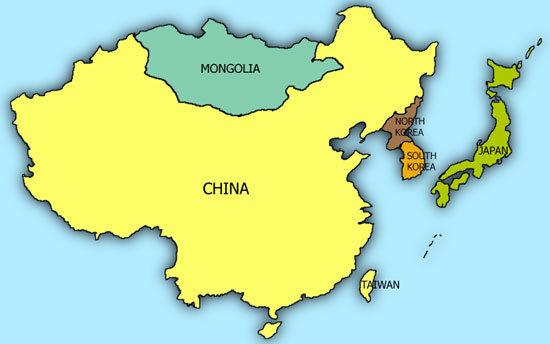
China-North Korea: China did not export any crude oil to North Korea in February, Reuters reported, citing customs data. It marks the first time since early 2007 that no deliveries were made.
Comment: China exports crude by means of a pipeline to North Korea's west coast refinery at Sinuiju. The pipeline has a throughput capacity of 1 million tons per year, but in the past few years it has carried about 500,000 tons, or just under 42,000 tons per month.
No other steady source of crude has been reported since before the end of the Warsaw Pact. Russian Far East companies send some crude to North Korea to have it refined at the east coast refinery and shipped back to the Far East, usually paying the North Koreans in kind.
The lack of Chinese crude supplies in February implies that North Korea has had to draw on fuel stocks to sustain the nationwide training. This is a chronic, strategic and systemic vulnerability of North Korea. China can make North Korea stop.
If China exports no crude in March, North Korean national readiness will have been degraded significantly because of the extra demands on supplies of food and fuel that are not being replaced. Whatever provocation North Korea plans must take place before the fuel runs low and the civilians begin to rebel or desert their mobilization stations. Contacts along the China border say the exercises will last until the US and South Korean exercises end.
China-North Korea: President Xi Jinping has sent a message to North Korean leader Kim Jong Un stressing that the two countries are “friendly neighbors,” according to the Korean Central News Agency on 21 March.
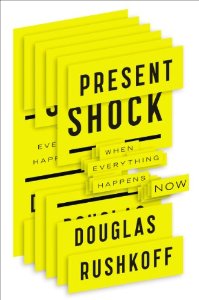
What Doug does that no one else has done, is a thoughtful dissection of our present circumstances, and a very able presentation of four deeply divisive and fatal social diseases that are directly related to how information technology “slices and dices” our present lives seemingly beyond our control:
01 Digiphenia [ADDICTION/SPLIT PERSONALITIES].
02 Overwinding [OVER-DOSED/BURNED OUT}.
03 Fractalnoia [SHATTERED MINDS/LOST SOULS].
04 Apocalypto [ASSIMILATED/CRAZY].
Bottom line up front: We are at risk of losing our humanity and being assimilated into a cyber-stein world in which we become automatons generating information that is sliced and diced totally divorced from ethics, community, Earth values, and so on. We must learn how to control this information technology we have unleashed.
Early insight: IT in its present design is moving individuals — including highly educated individuals, but most horrifyingly effective on the larger masses — DOWNWARDS toward reptilian instincts and irrational behavior, doing impulse things.
QUOTE (8): “When things begin accelerating wildly out of control, sometimes patience is the only answer. Press pause. We have time for this.”
Others have focused on “slow food” and other forms of simplicity living — e.g. Human Scale, Clock of the Long Now, and so on' What Doug has done is more of a form of laboratory dissection of the rat — the IT tiny brain, it's huge server butt, it's privacy invading and data non-protecting limbs, and worst of all, its stomach where data is destroyed rather than cooked.
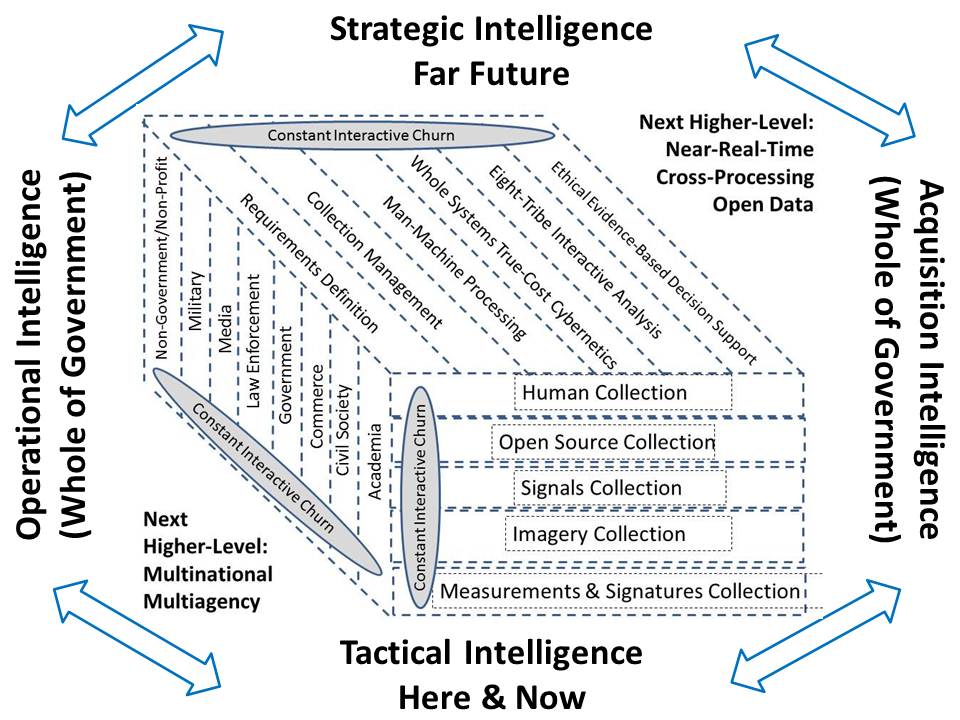
As an intelligence professional striving to define intelligence with integrity for the 21st Century, everything that this book talks about with respect to the pathologies of information technology and its cancerous effect on humanity, is totally consistent with what I know about the loss of the ability of think tanks and spy agencies to think.
The author focuses on the collapse of the narrative, the story being how civilization communicates aggregated validated wisdom to new generations. I am reminded of Will and Ariel Durant as well as Steve Denning's book The Springboard. CORE to the message is that there is now a chasm — a huge chasm — between the staple stories of the past that “made sense” and the chaos of today where advertising runs amok, governments and corporations and universities and non-profits all tell blatant lies, and there is no comfortable place where transparency, truth, and trust can be reliably found.
In passing futurists are properly slammed.
QUOTE (17): “Futurism became less about predicting the future than pandering to those who sought to maintain an expired past.”
I've spent a lot of time these past six years thinking about the future in structured term (see all the authors, books, centers, and forecasts at Earth Intelligence Network) and I can offer three opinions with certainty:
01) Most governments do not plan for the future, and most corporations disenfranchise both the past and the future — pleading bankruptcy to eliminate all pension fund obligations, refusing to invest in infrastructure needed to mature.
02) With the exception of Medard Gabel, co-creator with Buckminster Fuller of the analog World Game (I recommend all books by both of them), no one I know of is thinking in whole systems terms — no one I know of is is truly committed to cause and effect and cascading feedback loops seven generations or iterations down.
03) With the exception of Herman Daly and a tiny handful of those who follow him as I do, no one is at any level, and certainly no government or international organization (e.g. the UN) is embracing true cost economics as the foundation for sound decision-making about the future.,
The greatest fault that the author finds — as I do in a piece online, “Chapter: Paradigms of Failure” — is with the systemic lies that characterize virtually all that we receive from the traditional segments that comprise civilization: academia, civil society including labor and religion, commerce, government, law enforcement, media, military, and non-government/non-profit.
QUOTE (47): “The focus on immediate response engendered by the always on news becomes the new approach to governance….no one has time to think….what used to be called statecraft devolves into a constant struggle with crisis management.”
In the above the author is kinder to government than government deserves. What actually happens is that the political leadership micro-manages the narrative to leverage the Pavlovian themes that distract the public while micro-managing the Cabinet officers (especially State), all to the end of optimizing short-term financial gains for those that fund the political theater. In other words, *lies* are the root of non-strategy, non-policy, corrupt acquisition, and ineffective options — just look at Iraq, three trillion to destroy a once-working country and produce Fallujah mutant babies while destabilizing the entire region. And now, while some call for a Truth & Reconciliation Commission, others refuse to admit that the rush to an expensive war based on 935 now documented (truthout) lies should be “revisited.”
INSIGHT from the author: lacking goals over time to bring us all together toward future accomplishments, we end up fleeing what we perceive in the now. Alvin Toffler told me back in the late 1990's that when he was in Malaysia in the 1980's he was asked what his greatest fear was in the future and his one word answer was “fundamentalism.” Fundamentalism is dogma carried to its extreme. It *flourishes* in an environment where governments, corporations, and media all LIE.
OCCUPY is the first post narrative political movement. It has — the author tells us — dispenses with the left-right illusion (we are still teaching our children that there are only two parties in the USA instead of the eight accredited parties and 50 others), dispenses with sound-bite simplification, eschews end justifies the means; and for the “system,” is unweildy and unpredictable.
Sadly — my point of view having tried to get Occupy to focus on Electoral Reform — Occupy was quickly marginalized by the “system” mobilizing foundations and using tiny grants to pick Occupy apart one aspiring individual at a time.
There are rays of hope, including massive multiplayer games online. I personally do not like serious games in their current configuration for the simple reason that they are data free. As with Pentagon war games, the data base is rigged and not rooted in whole systems cause and effect or true cost economics. However, if the vision of Medard Gabel and others can be realized, there is every reason to believe that in the next ten years we will see an Open Source Agency (OSA) that funds the hub for the World Brain and the Global Game — in the latter, everyone plays themselves, has access to all relevant information, and has voice and vote on all issues they wish to weigh in on — all transparent, truthful, and therefore trusted.
This book merits slow reading and appreciative reflection. The author's discussion of time is particularly interesting to me. He makes how we relate to time central to his story, observing that time in the digital era is not lineal but rather disembodied and associative — However, while “our” time cycles are hosed, “Earth Time” is still on its natural cycle and we are out of step — this may be one of the key insights in the book: IT creates false time frames that disconnect us from reality and nature — I believe Bill McKibbin among others would find this important.
This entire section is alone worth the price of the book. He cites Clay Shirky on information overload and filter failure, and Stewart Brand on the long time cycles, to that I would add David Weinberger's books, especially Too Big to Know.
I was not expecting to find a discussion of money in this book but there is one, and it is important. Money is information. Here is one quote that is central to the matter, and completely supported by Matt Taibbi's GRIFTOPIA among others:
QUOTE (147): “The shift to central currency not only slowed down the ascent of the middle class, it also led to high rates of poverty. The inability to maintain local businesses, urban squalor, and even the plauge.”
In brief, centralized currency is optimized for storage (hoarding and compound interest) instead of transactions and physical investment.
I will not spoil the ending but will only say that it is a helpful “sauna” on the impact of IT to humanity that is timely, and it crushes the prevailing conventional wisdom represented by all of the major governments, corporations, and conventional wisdom mindsets that comprise the “norm.”
This book is educational, provocative, and righteous. Of course there are those that will find any criticism of IT and “the singularity” to be blaspheme, but on balance I find Doug Rushkoff and his writing to be part of what little sanity we have left.
The country received a D+ in the American Society of Civil Engineers’ (ASCE) report card for American infrastructure. That’s somewhere between “mediocre” and “poor,” according to their rating.
Optimists, take comfort: this is actually an improvement; last time the report was published, in 2009, the country received a D.
The ASCE reckons America would need $3.6 trillion worth of investment to bring infrastructure up to speed by 2020, significantly more than the $2 trillion currently dedicated.
Compared to measures spanning water and environment, transportation, public facilities, and energy, inland waterways and levees came in last, both with a D- grade. The backbone of the country’s freight network, these waterway systems have not been updated since the 1950s, and projected investment is stagnant. While levees were said to have prevented more than $141 billion in flood damages in 2011, many of the country’s levees are aging, unreliable, and would cost around $100 billion to repair.
On the brighter side, our railways and bridges earned a C+, the highest marks given out. While the overall number of structurally deficient bridges in the country continues to fall, the average age of the country’s 607,380 bridges is 42 years, and the Federal Highway Administration estimates $20.5 billion would need to be invested annually to eliminate the backlog by 2028 — compared to the $12.8 billion current annual spending.
As rail gains popularity as a viable – and energy-efficient – transport option for both freight and passengers, Amtrak has nearly doubled its ridership since 2000, with a ridership of 31.2 million passengers in 2012. Since 2009, capital investment in railroads has exceeded $75 billion – with investment actually increased during the recession.
Left untended, infrastructure lapses can significantly slow down the economy. Perhaps these grades will help spur investment in the areas that need it most.
A British Petroleum representative is being accused of rewriting almost half of the firm's environmental records on popular online encyclopaedia Wikipedia.
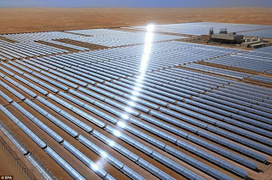
It took $ 600 million and 3 years to build this – not bad for a plant that doesn't need fuel, leaves no polluting exhaust and is extremely safe. Arabia could be exporting electricity instead of oil. Future business for desert countries?
You might think that as one of the world's top oil producing nations, the United Arab Emirates would have little use for solar energy. But that hasn't stopped the Middle East state from unveiling the largest concentrated solar power plant in operation anywhere in the world.
The 100-megawatt solar-thermal project in Abu Dhabi will power thousands of homes in the country and, it is hoped, displace approximately 175,000 tons of CO2 per year.

 This is the latest in the Homo Superiorus Trend. I predict this is going to become a major issue very quickly.