Don Beck: Three Book Rave and Spiral Dynamics in September

Cultural Intelligence, Earth Intelligence
0Shares
Don Beck

Dear Friends,

Here’s an old question I often put to my students in training: When you find yourself enveloped in twilight, can you be sure it’s just before the dark of night … or, instead, before a bright new day will dawn? Think about that for a while.

Indeed, no one can doubt that at this point the state of the world is of grave concern.
But have you noticed?  As our complex global challenges increase by the day, also more and more extraordinary human beings are pointing to a different direction for humankind. Unlike those succumbing to despondency and fear, they bear bright tidings – not of the imminent collapse of all we hold dear but of wise new ways to a whole other manner of doing and being. These intrepid ones are beacons of clarity and light for our world. They sound the clarion call for new systems of seeing, solving, and evolving.

Right now, the best-selling books by three such excellent humans compel our attention. We have written to you about them before, but the sheer importance of their recent publications bears repeating.

Foremost thought-leaders all, these authors are…

Continue reading “Don Beck: Three Book Rave and Spiral Dynamics in September”

Worth a Look: The People’s Congress (USA)

Advanced Cyber/IO, Civil Society, Ethics, Government, Worth A Look
0Shares

The People’s Congress

United to exercise the self-evident sovereignty of the American people over our government

Peoplescongress.org is calling for a week long event in which We the People pass specific amendments and legislation which, if enacted by Congress, would put an immediate end to the corporate take-over of our government, revitalize and re-democratize elections,  allow for a more responsible and open media, and end the secrecy in policy making. Until we reform these institutions and the laws governing them, our goals for a just and sustainable world will remain elusive at best. An earnest national dialog about our future cannot happen until we re-balance the wheels of democracy. It is the intention of the People’s Congress to secure that change directly in accordance with the will of the People and the principles established by our Constitution.

Continue reading “Worth a Look: The People's Congress (USA)”

DefDog: Senator Ron Wyden (D-OR) Shines on 4th Amendment

Ethics, Government, Law Enforcement, Military
0Shares
DefDog

Gov't surveillance ‘unreasonable' & violated the 4th amendment ‘at least once'

Ms. Smith

NetworkWorld, 23 July 2012

The Office of the Director of National Intelligence declassified three of Sen. Wyden's comments about FISA power. It also admitted the U.S. has violated the Fourth Amendment at least once when it comes to warrantless wiretaps done under Section 702 of the FISA Amendments Act.

It's official; the government's spying efforts exceeded the legal limits at least once, meaning it is also officially “unreasonable under the Fourth Amendment.” The Office of the Director of National Intelligence (DNI) sent a letter [PDF] to Sen. Ron Wyden giving permission to admit that much.

This started with Sen. Wyden requesting that the Office of the Director of National Intelligence (DNI) declassify some statements regarding the Foreign Intelligence Surveillance Act (FISA) enacted by the FISA Amendments Act of 2008 (FAA). Although this FISA power is supposed to sunset in December 2012, in May a new senate bill extended the warrantless wiretapping program for five more years. That vote was regarded as the first step “toward what the Obama administration hopes will be a speedy renewal of an expanded authority under the Foreign Intelligence Surveillance Act to monitor the U.S. e-mails and phone calls of overseas targets in an effort to prevent international terrorist attacks on the country.” Before Congress votes, Sen Wyden wants it know more about such surveillance powers.

Wyden believes the FAA of 2008 “has sometimes circumvented the spirit of the law,” reported Politico. Although the DNI does not go so far as to admit that, it does not dispute that the Foreign Intelligence Surveillance Court found such massive surveillance to be “unreasonable” on “at least one occasion.”

Continue reading “DefDog: Senator Ron Wyden (D-OR) Shines on 4th Amendment”

Smart Planet: Top Disease Spreading Airports in USA

SmartPlanet
0Shares
Home Page

Top disease-spreading airports in the U.S.

While the Honolulu airport gets only 30 percent as much air traffic as New York’s Kennedy International Airport, the new model predicts that it is nearly as influential in terms of contagion because of where it fits in the air transportation network: its location in the Pacific Ocean and its many connections to distant, large, well-connected hubs makes it third in terms of contagion-spreading influence.

Click on Image to Enlarge
  1. New York’s Kennedy Airport is ranked first by the model.
  2. Followed by airports in Los Angeles, Honolulu, San Francisco, Newark, Chicago (O’Hare), and Washington (Dulles).
  3. Atlanta’s Hartsfield-Jackson International Airport, which is first in number of flights, ranks 8th in contagion influence.
  4. Boston’s Logan International Airport ranks 15th.

Read full article.

Phi Beta Iota:  The day will come when organizations — and especially airports, bus terminals, and malls, will be held responsible for scrubbing their air and assuring a toxin and virus-free environment.  Environmental health is one quarter of the health solution.  That in turns requires intelligence and integrity and a sound understanding of true cost economics over the long term.

See Also:

Graphic: Health Quadrants & Open Source Information

Stephen E. Arnold: From Bad Search to Predictive Analytics Snake Oil

IO Impotency
0Shares
Stephen E. Arnold

From Search to Prediction 

The economic vise is closing on some search and content processing vendors. There are some significant repositioning’s underway. We are working on three at this time, and, believe me, the vendors are doing more than changing the color of the logo.

As we work on our projects, we have been aware of the emergence of a new buzzword closely allied to text mining, metatagging, and analytics. The word is “predictive” and we are seeing it in a number of different contexts.

Wikipedia marches through applications, statistical techniques, and tools. You can find that 5,000-word article at http://en.wikipedia.org/wiki/Predictive_analytics.

My problem with the application of “predictive” to everything from biosciences as in “predictive bioscience” to conferences as in “Predictive Analytics World” is that it sounds so darned good. Yet few know much about the numerical recipes upon which predictive operations rest. Do you recall “the axiom of choice”?  Even more disturbing is that most of the professionals with whom I work do not recognize that selecting a different mathematical procedure can generate quite different results. In effect, the “prediction” is more of an expression of what the algorithm generates than a manifestation of what the data may mean in the real world. A 70% “score” may mean wrong 30% in the output.

Continue reading “Stephen E. Arnold: From Bad Search to Predictive Analytics Snake Oil”

Patrick Meier: Enhanced Messaging for the Emergency Response Sector (EMERSE)

Advanced Cyber/IO, Collective Intelligence, Geospatial, Mobile, P2P / Panarchy
0Shares
Patrick Meier

Enhanced Messaging for the Emergency Response Sector (EMERSE)

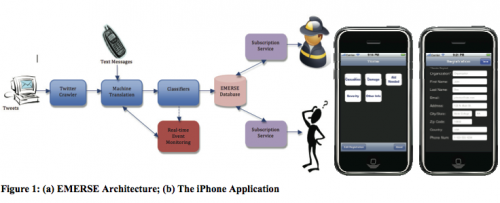
My colleague Andrea Tapia and her team at PennState University have developed an interesting iPhone application designed to support humanitarian response. This application is part of their EMERSE project: Enhanced Messaging for the Emergency Response Sector. The other components of EMERSE include a Twitter crawler, automatic classification and machine learning.

. . . . . . . .

The iPhone application developed by PennState is designed to help humanitarian professionals collect information during a crisis. “In case of no service or Internet access, the application rolls over to local storage until access is available. However, the GPS still works via satellite and is able to geo-locate data being recorded.” The Twitter crawler component captures tweets referring to specific keywords “within a seven-day period as well as tweets that have been posted by specific users. Each API call returns at most 1000 tweets and auxiliary metadata […].” The machine translation component uses Google Language API.

Click on Image to Enlarge

Read full post.

David Isenberg: NATO Connects with Open Source Everything Meme

#OSE Open Source Everything
0Shares
David Isenberg

James Stavridis: How NATO's Supreme Commander thinks about global security

Imagine a global security driven by collaboration — among agencies, government, the private sector and the public. That's not just the distant hope of open-source fans, it's the vision of James Stavridis, the Supreme Commander of NATO, who shares vivid moments from recent military history to explain why security of the future should be built with bridges rather than walls.

What will 21st-century security look like? NATO Supreme Commander James Stavridis suggests that dialogue and openness will be the game-changers.

In the world of security, says James Stavridis, “we are generally focused on risk. But I think we should spend a bit of our most precious resource — time — on thinking about and developing opportunities.” The first US Navy officer to hold the positions of Commander of the US European Command (USEUCOM) and of NATO's Supreme Allied Commander Europe (SACEUR), Stavridis has been advocating the opportunities perspective for a long time. He sees dialogue and collaboration — between nations, and between public and private sectors — as key to the future of security. As a Navy officer, he thinks deeply about protecting the value of our “global commons.” And he's a rare high-ranking military officer who tweets and blogs.

He has led the recent military effort in Lybia, among other NATO engagements. Previously Stavridis commanded US Southern Command in Miami, focused on Latin America and the Caribbean.

See TED Video (16:35)

Continue reading “David Isenberg: NATO Connects with Open Source Everything Meme”