Journal: New York Times Lies, Ha’aretz Does Not

07 Other Atrocities, 09 Justice, 10 Security, 11 Society, Collective Intelligence, Corruption, Counter-Oppression/Counter-Dictatorship Practices, Cultural Intelligence, Ethics, Government, Media, Misinformation & Propaganda
0Shares
Chuck Spinney Sounds Off

The below linked  article in the 2 October 2010 edition of the New York Times [Attachment 1] is a good example of the pro-Israeli bias in the US mainstream media when it comes to portraying Israel's relations with the Palestinians.

Note the paragraph I marked in bold which says unequivocally that “Israel halted most settlement construction for 10 months last November …”  This statement is clearly central to the reader's understanding of the questions of whether or not Israel has been negotiating with good will and who is responsible for the crisis in the peace talks.  It is also outrageously wrong, and that crucial fact was known at least five days before it was written.  That this is indisputably true can be seen in Attachment 2 beneath it, a 28 September 2010 report in Ha'aretz, perhaps Israel's most prestigious newpaper — ironically, Ha'aretz is often referred as the New York Times of Israel.  Ha'aretz tells the reader that the Israeli government's own official statistics show that the settlement freeze was barely a slowdown.

There is no way the author of the NYT report, Ethan Bonner, the senior New York Times reporter based in Israel, could have been unaware of the Ha'aretz report, and his (or his editor's) countenancing such an unequivocal statement, without at least a caveat, can only be construed to be a deliberate attempt to mislead the reader with respect to the nature of the settlement freeze, and by extension, the good will in Israel's negotiating stance vis a vis that of the Palestinians.  His biased outlook becomes transparently clear when one compares the tone and context to the two reports.

To those readers, who think I am nitpicking, I would urge them to think about the wisdom embodied in the following two quotes: The first is by James Madison, the father of the US Constitution, describing the importance of popular information to effective functioning of a representative democracy. The second is Edward Gibbon's assessment of how ignorance and fanaticism sapped the cognitive faculties of the Roman peoople:

“A popular government without popular information, or the means of acquiring it, is but a prologue to a farce or a tragedy, or perhaps both. Knowledge will forever govern ignorance, and a people who mean to be their own governors must arm themselves with the power which knowledge gives.” –  James Madison, from a letter to W.T. Barry, August 4, 1822

”Their credulity debased and vitiated the faculties of the mind: they corrupted the evidence of history; and superstition gradually extinguished the hostile light of philosophy and science.” – Edward Gibbon, Decline and Fall of the Roman Empire

Chuck Spinney

NEW YORK TIMES DECEPTION AND DECEIT

October 2, 2010

Palestinian Leaders Urge End to Talks With Israel

By ETHAN BRONNER, New York Times, 2 October 2010

RAMALLAH, West Bank — The Palestinian leadership said Saturday that four-week-old direct talks with Israel should be suspended if Jewish settlement construction resumed in the West Bank. It called on the international community to pressure Israel to stop the building but withheld a final decision on the talks until an Arab League meeting on Friday.

Read rest of this dramatically unprofessional and deceptive article…

HA'ARETZ CLARITY AND INTEGRITY

Settlement freeze? It was barely a slowdown

What took place in the past few months is, in the best case scenario, not more than a negligible decrease in the number of housing units that were built in settlements.

By Dror Etkes, Ha’aretz, 28 Sept 2010

The official statistics supplied by the Central Bureau of Statistics describe the story behind the 10-month construction moratorium in the West Bank. The story can be called many things but “freeze” is certainly not one of them. What took place in the past few months is, in the best case scenario, not more than a negligible decrease in the number of housing units that were built in settlements.

Read the rest of this honest factual article…

Phi Beta Iota: Apart from facts in isolation, context matters.  The Israeli settlements are unsustainabile in relation to available water and the continuing atrocities against the Palestinian people on their own land is an ongoing crime against humanity that is easily, in today's context, as terrible as the Holocaust was in Hitler's time.  None of this has entered the human consciousness of the US public because their leaders lack integrity, as do the corporate media led by the New York Times.

See Also:

Worth a Look: Book Reviews on Disinformation, Other Information Pathologies, & Repression

Three Audio/Video Segments on Intelligent Collaboration, Intelligence Of Crowds, and Collaborative Problem-Solving

Audio, Collective Intelligence, Collective Intelligence
0Shares

CISCO: Intelligent Collaboration: A Discussion with Professor Thomas Malone
Learn how new collaborative technologies help redefine teamwork, leadership, and the concept of collective intelligence. Start collaborating more intelligently. (30:16 min)

NPR: The Intelligence Of Crowds In ‘The Perfect Swarm' Talk of the Nation (Sept 10)
In his book The Perfect Swarm, Len Fisher talks about swarm intelligence — where the collective ideas of a group add up to better solutions than any individual could have dreamed up, including an example of how UPS reorganized its driving routes using the logic of an ant colony.

NPR: Collaboration Beats Smarts In Group Problem Solving by Joe Palca (Sept 30)
Everywhere you look, from business to science to government, teams of people are set to work solving problems. You might think the trick to getting the smartest team would be to get the smartest people together, but a new study says that might not always be right.

Thanks to those behind the inSTEDD Twitter feed

#1 Amazon Reviewer for Non-Fiction Says Hello

About the Idea, Blog Wisdom
0Shares

Robert David SteeleRobert David Steele

Recovering spy, serial pioneer for open and public intelligence

Posted: October 2, 2010 09:54 AM

#1 Amazon Reviewer for Non-Fiction Says Hello

Click on Title to Read at Huffington Post and/or Comment.

I am going to be a most faithful contributor to the new vertical in Education. I agree with the propositions of Thomas Jefferson and James Madison, respectively:

A Nation's best defense is an educated citizenry.

Knowledge will forever govern ignorance; and a people who mean to be their own governors must arm themselves with the power which knowledge gives.

Unfortunately, we have become a nation of cheats and liars, with our two-party tyranny leading the way. Thankfully, “Open Everything” is here to stay, and Howard Zinn (RIP) had it right when he called the public a power no government can repress.

By way of introduction to my many reviews that provide the context for my deliberative focus on education, below are two booklists created in support of my most recent book proposing the creation, immediately, of a World Brain and Global Game. The first is a negative list, all the books that document all the negatives that we have allowed to proliferate over the past fifty years. The second is a positive list, and I must salute Tom Atlee, Barbara Marx Hubbard, and many others who have educated me this past decade on wisdom among us all.

Worth a Look: Book Review Lists (Positive)

Worth a Look: Book Review Lists (Negative)

Now with that as an introduction, here are my two “opening shots” in what is sure to be one of the most influential and useful educational sites on the Internet.

Child-Driven Education (Sugata Mitra at TED)

The World Is Open-How Web Technology Is Revolutionizing Education (Review)

If you want to see all of my reviews to date of education books, below are the two links.

Education (General)

Education (Universities)

All reviews lead back to the Amazon Page, and at the bottom, to my often-buried review should you wish to vote or comment — I respond to all comments at Amazon on a daily basis, and of course here at The Huffington Post as well.

Journal: US Strategy in Afghanistan Out of Balance

09 Terrorism, 10 Security, Military, Strategy
0Shares
Dr. Steve Metz
America's Flawed Afghanistan Strategy
  • Added August 09, 2010  Op-Ed 2 Pages

The concluding paragraph:

Ultimately, then, the basic rationale of American strategy in Afghanistan is questionable. Certainly America cannot ignore that country as it did before September 11, 2001, and should continue supporting the national government and other Afghans opposed to the Taliban. But in strategy, balance is the key—the expected security benefits of any action must justify the costs and risks. Today, America's Afghanistan strategy, with its flawed assumptions, is badly out of balance.

Tip of the Hat to Dale Mark Benedict at Facebook.

Journal: True Cost of US Government Ineptitude

03 Economy, Commercial Intelligence, Corruption
0Shares
John R. Talbott

John R. Talbott

Bestselling author whose books predicted the economic crisis

Posted: October 1, 2010 12:28 PM

TARP Uncovered — the Real Cost of the Government Bailout

The New York Times reports this morning (“TARP Bailout to Cost Less Than Once Anticipated“) that the true cost of TARP will be less than $50 billion. I find this type of reporting to be incredibly misleading and deceitful. Focusing solely on TARP and ignoring the other more costly portions of the government bailout of our biggest banks and corporations ignores the true cost of the government's (both the Bush and Obama administrations, the Fed and Congress) inept response to this crisis. One of the reasons that TARP did not cost more was because of the government's other more costly bailout policies, and to ignore them is to dramatically understate the true cost of the bailout.

By claiming a narrow TARP success, the Times attempts to invalidate citizen anger at the bailout by making it appear that the electorate is somehow misinformed about its costs or is just plain stupid. Nothing could be further from the truth. Claiming that TARP was successful, but ignoring the much larger and more relevant costs of other areas of the government bailout is like claiming the voyage of the Titanic was successful because many of the lifeboats were recovered. It is important to remember that the ship sunk.

Read his entire article with detail list that adds up to:

  • Total estimated cost of government bailout = $14.85 trillion.

John R. Talbott is the bestselling author of eight books on economics and politics that have accurately detailed and predicted the causes and devastating effects of this entire financial crisis including, in 2003, “The Coming Crash in the Housing Market”, in January 2006, “Sell Now! The End of the Housing Bubble” and in 2008, “Contagion: The Financial Epidemic that is Sweeping the Global Economy”.

Phi Beta Iota: This author impresses us.  This is precisely the kind of public intelligence in the public interest that must be structured so as to be available to all citizens in time to keep government honest as well as effective.

Search: buckminster fuller map

Advanced Cyber/IO, Earth Intelligence, Geospatial, Geospatial, info-graphics/data-visualization, IO Mapping, Policies-Harmonization, Strategy-Holistic Coherence
0Shares

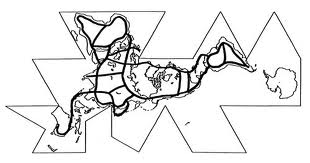
Phi Beta Iota: Although the search produces Graphics Directory A-Z as of 28 September 2010 and within that one can find Graphic: Robert Steele Adopts Buckminster Fuller that is too far from our preferred outcome.  Here is the human in the loop answer: it's called the Dymaxion map.

Here are a whole bunch of images.

Within those, the two below are the most interesting.  The second was used in a discussion between Buckminster Fuller and the Russian leadership, to show how a global electrical grid could be achieved that would eradicate the current 50% loss from source to end-user.