InfoWar Editor’s note: Birgitta Jónsdóttir is the leader of The Movement, a group within the Icelandic Parliament which has emerged from the mass struggle of Icelanders against the financial blackmail brought to bear against their country by the governments in London and The Hague, with the backing of the IMF, in the wake of the insolvency of three large Icelandic banks in the midst of the Lehman Brothers-AIG world financial panic of September-October2008. Birgitta Jonsdottir is a courageous leader in the fight for national sovereignty, independence, dignity, and the economic well-being and future of her country.
Phi Beta Iota:This story is being ignored in the mainstream media, which is a mistake. This is an early signal of the populism that will come like a tsunami over the next few yeras. People of good will and common sense are beginning to recognize that governments are no longer working in their interests, and are making decisions that may be legally binding under the old paradigm, but are questionable in terms of sustainability of the commonwealths the governments are supposed to be protecting and nurturing. In the end, as both Minister Mentor Lee Kuan Yew and Howard Zinn and Joanathan Schell all agree, demography rules.
Phi Beta Iota: Insane is continuing to do what is not working. Stupid is continuing to do what is not working combined with throwing more money at it. The US Intelligence Community and the Department of Defense may finally be closing in on a paradigm shift that restores OUTPUTS (decision-support for the first, peace for the second) as the reason for existence, rather than INPUTS (budget share). As with Viet-Nam, it would be a lot cheaper, faster, and better to simply give the money we are spending to the individual Afghanis. The IC desperately needs a Multinational Engagement lifeboat built predominantly on open sources and methods, focused on needs assessment and satisfaction at the household level. Time for a paradigm shift. Click on the book cover to see what one man armed with pennies accomplished.
1. “Reforms” were never really implemented–this is business as usual
2. No one will be held accountable–President has no one who knows HOW to do reforms
3. This article is as close as we will get to soul searching.
1. poor mix of folks in the field, most new to the business, untrained and not using tradecraft
2. opposition has figured out that suicide bombers neutralize precision munitions, and are cheaper. this is not a war we can win, which we pointed out after 9/11 (they can spend $1 to equal every $500,000 we sepdn).
Intel Swap Is Key Vs. Afghan IEDs (But Refusing to Share)
Former commander urges better sharing
Key points:
1. Shades of Viet-Nam not sharing images of targets with pilots
2. What part of IEDs will outlast drones do we not get?
3. Legitimacy comes from meeting needs, not finding IEDs all day
EDIT of 7 Jan 09. I got halfway through another book last night and now understand the Princeton-based idea that the US has enough power to demand changes and that earlier “balance of power” constraints might not apply. On the one hand, this is an idea worth pursuing, but if you know nothing of strategy, intelligence (decision-support) and how to integrate Whole of Government and Multinational Engagement campaigns against the ten threats by harmonizing the twelve policies and engaging the eight demographic leaders, then this is just academic blabber. On the other hand, this is 100% on the money–if the USA were a Smart Nation with an honest government, now is the time to lead–but it's not going to come out of the ivory tower or politicals in waiting for their next job, it will come from the bottom (Epoch B), the poor, and the eight demographic powers (Brazil, China, India, Indonesia, Iran, Russia, Venezuela, and Wild Cards such as South Africa, Thailan, and Turkey, with the Nordics and BENELUX always lurking positively on the fringes.
Original review:
I tried hard to find enough in this book to warrant five stars, but between the pedestrian threats, buying in blindly to the climate change fraud, assertions such as “There is no prospect for international stability and prosperity in the next twenty years that does not rest on U.S. power and leadership,” and the general obliviousness of the authors to multiple literatures highly relevant to their ostensible objective of answering the question “how do we organize our globalized world,” this has to stay a four. It has some worthwhile bits that I itemize below, but on balance this is an annoying book, part cursory overview, part grand-standing proposals for new organizations, and part job application–at least one of these authors wants to be the first High Commissioner for Counter-Terrorism.
Had the author's actually sought to tailor their suggestions to the above elegant threat architecture, this could have been a much more rewarding book. As it is, it strikes me as a book written around a few ideas:
International Intelligence Ethics Association (IIEA) and Georgetown University School of Continuing Studies present the 5th International Conference on the Ethics of National Security Intelligence
In the coming months, we are going to be inundated by the rhetoric surrounding an economic policy debate over the question of whether or not the Federal Government ought to begin to reduce the fiscal imbalances in its budget. The ideology of Joseph Schumpeter's Creative Destruction will be pitted against ideology of John Maynard Keynes, and the dominant issue will be the question of retrenchment: Should the Federal Government retrench? … or .. Will consumers and businesses continue to retrench?
The chart, which I have used before. It portrays the buildup of debt as a percentage of GDP for the different categories indebtedness that are at the center of the retrenchment question. All of the data from 1946 forward was compiled by the Federal Reserve. Earlier data is from a mixture of sources including the Census, Fed, GAO, and Morgan Stanley. I believe , it shows why some kind of retrenchment is now inevitable.
Although most economists and policy makers like to think of an economic system in mechanistic terms, the economy is in fact an unpredictable living thing made up of millions of players who move forward on a one-way trip through time along a pathway shaped by an interplay between chance and necessity. In this sense, you can think of the figure above is an outward manifestation of the historical behaviour of a complex living organism. When we hear pundits speak of the interplay of fear and greed, Greenspan's “irrational exuberance, or Keynes' “animal spirits” they are talking about the living aspects of this system (to which they immediately slip backward in to applying mechanistic diagnostics). When they do so, they forget that all living systems are complex open systems that use an ever-changing homeostatic mix of positive and negative feedback loops to maintain stability, while they maintain their structure by feeding on and expelling waste into their environment. When these internal control loops get out of balance, the homeostatic regulating system breaks down, and the entire organism goes out of control in a form of runaway behavior, like cancer cells in living tissue.
Phi Beta Iota: See also the many superb references in the US Agency for International Development (AID) Development Experience Library. In our own experience encountering AID across Asia and Latin America, their capacity for ground truth and grass roots effectiveness is phenomenal, held back only by Congressional mandates that are politically motivated and operationally insane–such as the requirement to spend 75% of every development dollar via a US beltway bandit.




 Bubba Book
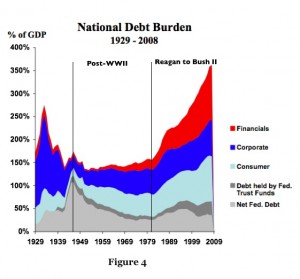 The chart, which I have used before. It portrays the buildup of debt as a percentage of GDP for the different categories indebtedness that are at the center of the retrenchment question. All of the data from 1946 forward was compiled by the Federal Reserve. Earlier data is from a mixture of sources including the Census, Fed, GAO, and Morgan Stanley. I believe , it shows why some kind of retrenchment is now inevitable.